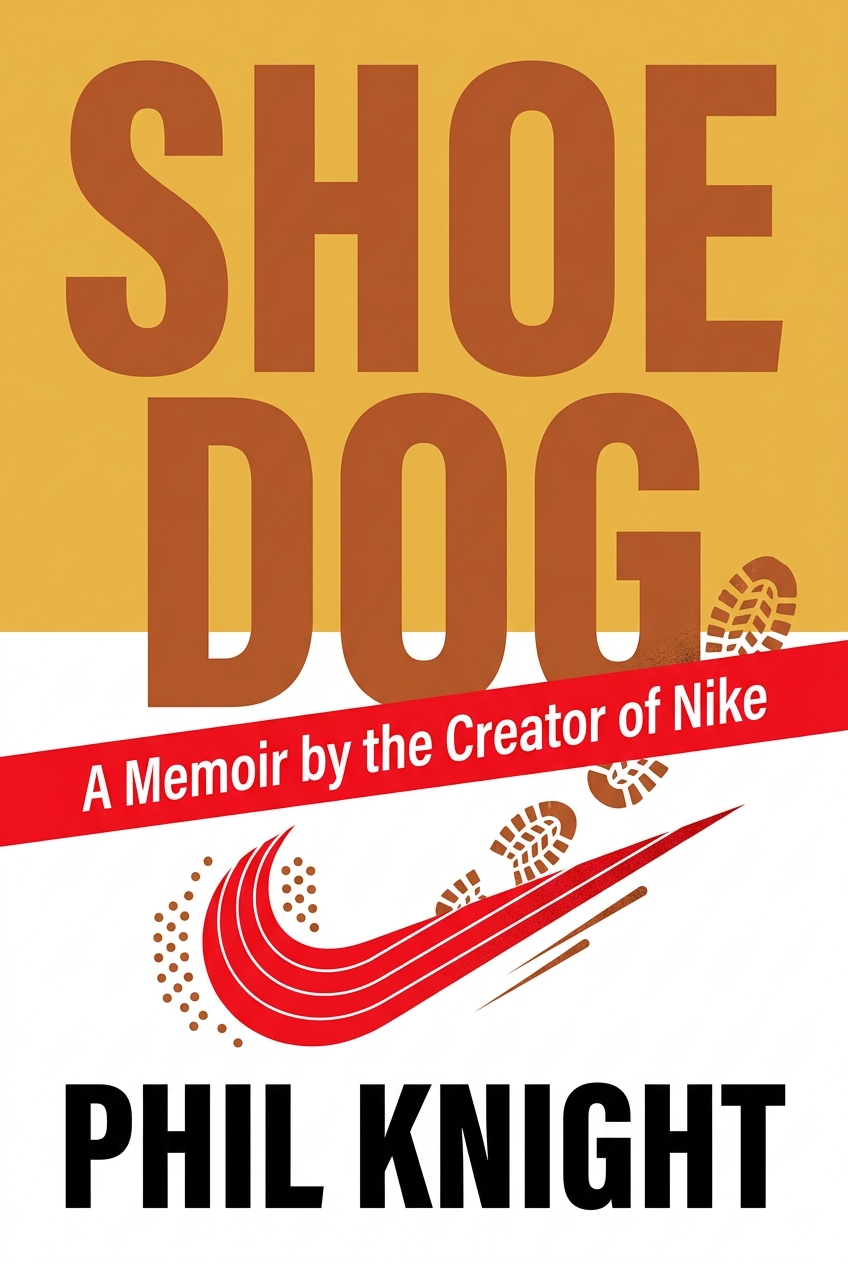
Shoe Dog
A Memoir by the Creator of Nike
What's it about
Ever wonder what it really takes to turn a crazy idea into a global empire? Before the iconic swoosh, Nike was a chaotic startup run from a car trunk, fueled by a borrowed fifty dollars and constantly teetering on the brink of failure. Step inside Phil Knight’s raw, unfiltered story to learn his unconventional rules for business and life. You'll uncover the power of assembling a team of misfits, embracing uncertainty as your ally, and why believing in your mission is the only currency that truly matters when cash runs out.
Meet the author
Phil Knight is the visionary co-founder of Nike, Inc., the man who built one of the world's most iconic brands from a fifty-dollar loan and a crazy idea. Previously a famously private leader, Knight shares his story for the first time in this candid memoir. He reveals the chaotic early days, the immense risks, and the relentless determination required to turn a scrappy startup into a global phenomenon, offering a masterclass in grit, innovation, and entrepreneurship.
Opens the App Store to download Voxbrief

The Script
Think of a garage band, years before their first hit. The air is thick with the smell of dust and damp concrete. An old amplifier hums with a persistent buzz, the drummer is rushing the tempo again, and the singer’s voice cracks on a high note. There are no record deals, no screaming fans, no polished sound. There is only a raw, chaotic energy fueled by a shared, slightly unhinged belief that the noise they’re making matters. For every moment of harmony, there are ten minutes of frustrating dissonance. They argue over a single chord, tape down a frayed cable, and finish a song feeling both exhausted and electrified. This is the messy, uncertain, and deeply human process of creating something from nothing—a story that rarely makes it onto the album's liner notes.
That same raw, improvisational energy—the kind that powers a three-chord anthem in a dusty garage—is the very heartbeat of one of the world's most iconic companies. For decades, the public only saw the finished product: the ubiquitous swoosh, the legendary athletes, and the global brand that defined an era. But the real story, the one filled with near-failures and desperate gambles, was locked away. Phil Knight, the quiet, introverted co-founder of Nike, was the keeper of that story. After fifty years of near-total silence, he decided to finally open the door to that garage. This book, "Shoe Dog," is the personal, unfiltered diary of a young man with a 'Crazy Idea,' a borrowed fifty dollars from his father, and a trunk full of Japanese running shoes. Knight wrote it to reveal the truth he knew intimately: that the path forward is never a straight line, but a chaotic, stumbling, and often terrifying journey paved with constant improvisation.
Module 1: The "Crazy Idea" and the Leap of Faith
We begin with a young Phil Knight. He has a Stanford MBA. He has a stable career path. But he feels a deep sense of dissatisfaction. He craves a life that feels like "play," like the focused intensity of an athlete. This is where his "Crazy Idea" is born. His "Crazy Idea" was a simple thought that emerged from his own life.
This leads to the first major insight. A compelling vision must solve a personal problem. Knight was a runner. He saw that German shoes dominated the market, but he believed high-quality, low-cost Japanese shoes could compete. The idea came from a research paper he wrote at Stanford. It came from his own passion. He wasn't chasing a trend. He was solving a problem he understood intimately. This personal connection gave the idea a power that no spreadsheet could. It transformed work from a chore into a mission.
So, he decides to act. He books a trip around the world, with a stop in Japan to pitch his idea to a shoe manufacturer called Onitsuka. This is a huge leap into the unknown. He faces skepticism from his family. He has no company, no funding, and no experience in imports. And here is where we find a foundational principle of his journey. Persistence is the only strategy that matters in the beginning. Knight tells himself one thing: "Don't stop." He believed the greatest risk was stopping. This mindset becomes his driving force. He just keeps moving forward, even when the path is completely unclear.
Now, let's turn to how he gets started. He needs his father's approval and a small loan. He doesn't win him over with a flawless business plan. Instead, he appeals to his father's own sense of regret for not traveling when he was young. This reveals a critical lesson for any founder. Secure early support by appealing to shared values. Knight understood his father valued conventional success. But he also understood the human desire for adventure. By framing his trip as a once-in-a-lifetime journey, he connected on an emotional level. This secured the initial blessing he needed to even begin.
Building on that idea, Knight's first meeting with the Onitsuka executives is a masterclass in improvisation. He has no company. When they ask who he represents, he blurts out the first name that comes to mind: "Blue Ribbon Sports." He pulls the name from the track ribbons hanging on his bedroom wall. He projects confidence he doesn't feel. The takeaway here is powerful. Embrace uncertainty and act on instinct, even without a clear plan. Knight didn't wait for perfect conditions. He didn't wait until he had a registered business or a polished pitch deck. He acted on instinct and created the reality he wanted as he went along. That single, improvised moment was the birth of the company.
Module 2: Building the Foundation on Grit and Unconventional People
We've covered the initial leap. Next up: the messy reality of starting a business from nothing. The first shipment of Tiger shoes arrives. Where is the worldwide headquarters? His parents' basement. Where is the primary sales channel? The trunk of his Plymouth Valiant. This wasn't glamorous. It was pure, unadulterated hustle. This brings us to a core truth of the early days. Embrace utterly pragmatic and improvisational hustle to survive. Knight sold shoes at track meets. He talked to runners, coaches, and fans. He was sharing a belief with his own community. He saved money by wearing his Army Reserve uniform to get free flights on military transport planes. Every dollar was sacred. Every action was geared toward one thing: survival.
But he couldn't do it alone. His first key partners were people who shared his obsession. First, there was his old track coach, Bill Bowerman. Bowerman was obsessed with shoe technology. He was constantly tinkering, trying to create lighter, better shoes for his runners. Knight sent him the first samples, and Bowerman immediately saw the potential. Their partnership was sealed over a hamburger. It was built on mutual respect and a shared passion for running.
Then came Jeff Johnson, the company's first full-time employee. Johnson was relentless. He sent Knight a constant stream of letters filled with ideas, sales reports, and customer feedback. He was needy and overwhelming. But he was completely devoted. This leads to a crucial insight about team building. Your first team should be a tribe of believers. Knight didn't hire for résumés. He hired for passion. Bowerman, Johnson, and other early employees were runners. They were "shoe dogs," people obsessed with the craft and culture of footwear. They were often eccentric and difficult, but they believed in the mission with an almost religious fervor.
And here's the thing about Johnson's approach. It wasn't just about moving product. He was building a community. He created a detailed database of his customers on index cards. He sent them birthday cards, training tips, and personal notes. This practice reveals a timeless principle. Build brand loyalty through authentic community. Johnson designed his first retail store to be a "mecca" for runners. It had books, photos, and a welcoming atmosphere. He turned customers into evangelists. They weren't just buying shoes; they were joining a movement. This deep engagement created a foundation of loyalty that advertising could never buy.
So what happens next? Knight recognized the power of Johnson's obsessive drive. He did something that many founders struggle with. He let him run. Knight rarely answered Johnson's letters. He didn't micromanage. He gave him a direction and trusted him to execute. The lesson is simple but profound. Grant autonomy to passionate people and get out of their way. This hands-off style unleashed Johnson's creativity. He invented a new cushioning system with a local cobbler. He designed his own marketing materials. He expanded his territory far beyond what was assigned. Autonomy fueled his fire and drove the company's early growth.
Module 3: The Relentless Grind of Growth and Near-Death Experiences
So far, we've seen the spark and the early hustle. But the defining feature of Nike's story is the constant, near-fatal struggle. The company was growing explosively. Sales were doubling year after year. From the outside, it looked like a runaway success. But internally, it was a different story. They were perpetually on the verge of collapse. This brings us to the most brutal lesson of the book. Growth without cash flow is a death sentence. Knight's banker constantly warned him to slow down. The bank saw rapid growth purely as a liability. Every dollar they made was immediately reinvested into more inventory. They were "living on the float," writing checks and praying the money would arrive before they bounced. This constant financial pressure was the central conflict of the company's first decade.
This precarious situation was made infinitely worse by their supplier. Blue Ribbon was completely dependent on Onitsuka. And Onitsuka started to see their success as a threat. Shipments were late. Orders were wrong. Then, Knight discovered the ultimate betrayal. Onitsuka was secretly meeting with other U.S. distributors. They were planning to cut Blue Ribbon out and take over the market they had built. For most founders, this would be the end. For Knight, it was a turning point. Partner betrayal is a catalyst for reinvention. The betrayal forced him to do what he should have done years earlier. It forced him to create his own brand.
This is the moment Nike is born. The name comes to Jeff Johnson in a dream. The logo, the iconic Swoosh, is designed by a local graphic design student for just $35. The team is skeptical of both. Knight himself preferred the name "Dimension Six." But they were out of time. They had to make a decision. This moment underscores a vital truth. Your brand identity is forged in moments of crisis. Nike was born out of desperation and necessity. The name and logo were chosen under extreme pressure, and they went on to become two of the most recognizable brand assets in history.
But flip the coin. While Onitsuka was betraying him, another Japanese partner became his savior. To escape his bank's tight grip, Knight began working with Nissho Iwai, a massive Japanese trading company. They provided the financing that allowed Blue Ribbon to survive. At one point, when the bank finally cut them off, a Nissho executive named Ito personally paid the bank's debt to keep Nike alive. It was an act of incredible trust. This highlights a powerful lesson. Maintain personal relationships with financial partners; they can be your last line of defense. Ito and another Nissho manager, Tom Sumeragi, looked beyond the numbers and believed in Knight and his team. That human connection, built over years of honest dealings, proved to be more valuable than any formal contract.