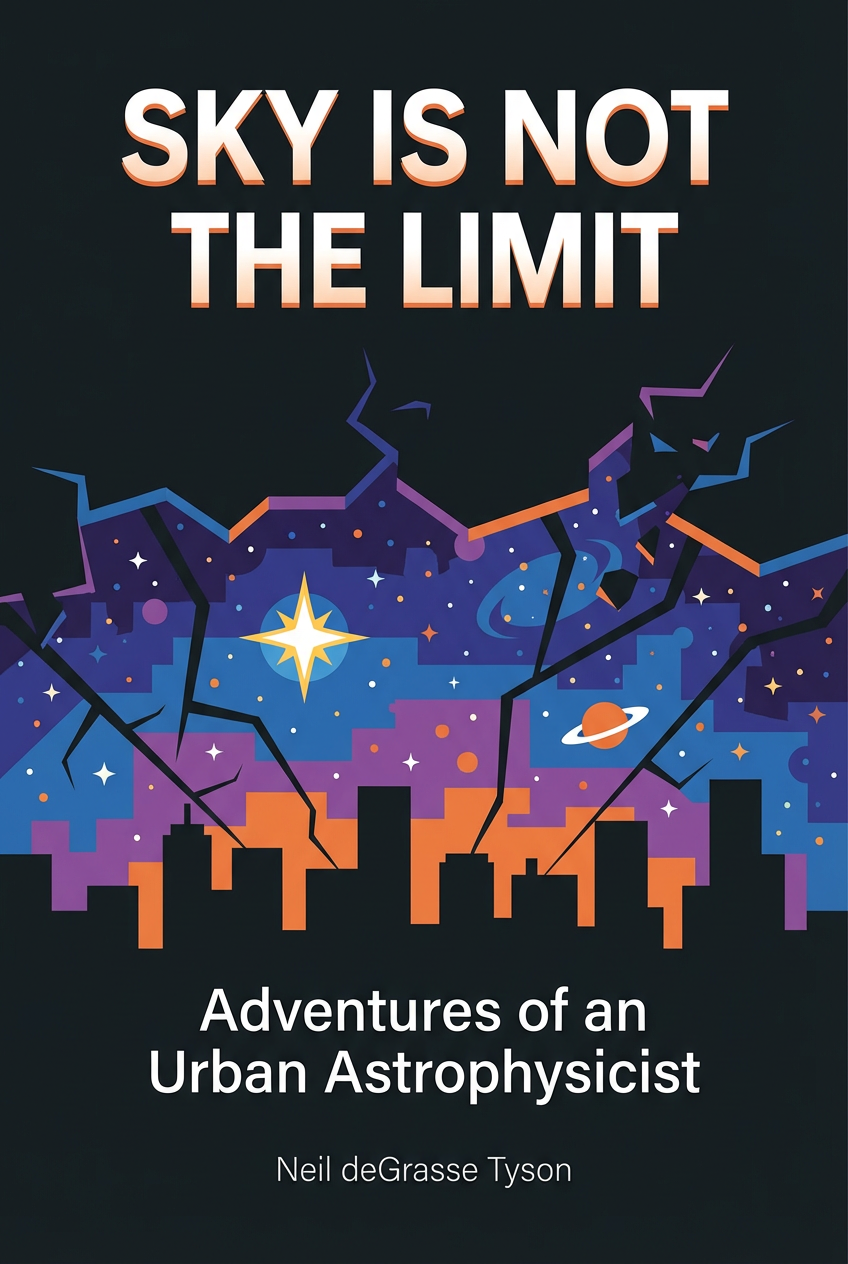
Sky Is Not the Limit
Adventures of an Urban Astrophysicist
What's it about
Have you ever felt like your dreams are too big for your reality? Neil deGrasse Tyson proves that with enough curiosity and drive, even the universe is within your reach. This summary reveals how a kid from the Bronx became one of the world's most famous astrophysicists. You'll discover the key moments and mindset shifts that propelled him past social and academic barriers. Learn how to harness your own passion, overcome doubt, and turn seemingly impossible goals into your life's work, one stellar step at a time.
Meet the author
Neil deGrasse Tyson is the Frederick P. Rose Director of the Hayden Planetarium, a world-renowned astrophysicist, and the most recognizable science communicator of our time. His journey from a curious kid in the Bronx to a leading voice in cosmology fueled his passion for making the universe accessible to everyone. In this memoir, Tyson recounts the personal and professional challenges he overcame, revealing how his urban upbringing shaped his unique and inspiring perspective on science and life.
Opens the App Store to download Voxbrief

The Script
In 1996, the world’s most famous astronomer, Carl Sagan, died. His passing left a void not just in science, but in culture. Sagan had a rare gift for making the cosmos feel personal, for connecting the dots between a distant nebula and the atoms in our own bodies. He was the public face of wonder, a trusted guide who could stand on the brightly lit stage of 'The Tonight Show' and, in a few minutes, transport millions of people to the edge of a black hole. When he was gone, a question lingered: Who would pick up the fallen torch? Who could bridge the gap between the ivory tower of astrophysics and the public's imagination, not just by explaining science, but by making us feel it?
That torch wasn’t so much picked up as it was reignited, and from an unexpected source. Neil deGrasse Tyson, then a young, largely unknown astrophysicist and the new director of the Hayden Planetarium—the very institution where a teenage Sagan had inspired him—found himself at the center of this cultural vacuum. He wasn't trying to be the next Sagan; he was trying to answer the flood of letters and questions that poured in from a public hungry for cosmic perspective. This book, 'Sky Is Not the Limit', is a collection of his early essays from this period. It is something more intimate: the origin story of a public scientist, capturing the moments he first stepped onto the cultural stage and began translating the universe for the rest of us.
Module 1: Cultivating an Unshakeable Intellectual Core
The foundation of a meaningful career is built through passion, curiosity, and a relentless drive to learn outside the lines. Tyson’s early life shows that the most formative experiences often happen far from the classroom. At age nine, a visit to the Hayden Planetarium created an indelible impression. It sparked a lifelong ambition to become an astrophysicist. This single moment of wonder was more powerful than any school lesson. It proves that early exposure to the cosmos can ignite a lifelong passion for science.
This passion wasn't a "gift." Tyson pushes back hard against the idea of being "gifted and talented." He argues it dismisses the real engine of achievement: hard work. He funded his first serious telescope by walking dogs. His parents supported him only after he proved his dedication. So what’s the real lesson here? Passionate, self-directed learning, supported by family, is crucial for intellectual development. It’s about initiative and grit.
Interestingly, this intense focus on self-directed learning reveals a surprising truth about formal education. Tyson notes that while many research scientists were straight-A students, most of society’s innovators were not. His own report cards criticized his social energy. Teachers saw it as a lack of seriousness. They would never have predicted his future success. The key insight is that traditional academic metrics are an incomplete measure of potential. Grades don't capture curiosity, resilience, or the ability to make unconventional connections.
Building on that idea, the most profound learning often comes from unexpected sources. Tyson's critical astronomy education came from courses at the Hayden Planetarium, not his high school. A chance encounter with a mentor from the Explorer's Club led to a scholarship for a solar eclipse expedition. This reinforces a vital principle: Significant learning and mentorship often occur outside formal educational structures. You have to seek out knowledge in extracurriculars, personal hobbies, and informal networks. This is where true growth happens.
Module 2: The Laws of Physics as a Toolkit for Life
How can the abstract laws of the universe apply to your daily life? Tyson demonstrates that a deep understanding of physics is a practical framework for navigating the world, solving problems, and cutting through noise. He shows how to build a powerful "common sense" grounded in reality. This starts early. He observed his young daughter dropping peas and spilling juice. These were experiments in gravitational potential energy and fluid dynamics. This illustrates that early, hands-on exposure to the laws of physics builds real-world common sense.
But flip the coin. What happens when this reality-based sense is undermined? Tyson points to popular films like Mary Poppins. These stories present impossible physical events as normal. For a developing mind, this can create a confusing disconnect. The takeaway is that media that blatantly violates the laws of physics can undermine a child's developing, reality-based logic. It’s a subtle but important point about the media we consume.
This principle extends far beyond childhood. A failure to value critical thinking leaves adults vulnerable to deception. People justify not wearing seatbelts without understanding inertia. A woman was defrauded by a fortune-teller diagnosing "negativity in her aura." Tyson argues that widespread scientific illiteracy enables fraud and poor decision-making. Without a framework for evaluating claims, we are susceptible to scams, cults, and bad ideas.
And here's the thing. This lack of rational thought even permeates our most formal institutions. Tyson was once dismissed from jury duty simply for being an astrophysicist. He concluded the legal system often prioritizes emotional narratives over objective evidence. Eyewitness testimony can be deeply unreliable, yet it can send someone to their death. This leads to a sobering conclusion: The legal system often fails to adequately value rational, scientific evidence.
In contrast, physics provides an objective standard for truth. It’s a court where evidence doesn't lie. Tyson once helped convict a hit-and-run suspect by analyzing shadows in an alibi photo. He used astronomy software to prove the photo was taken hours later than claimed. This demonstrates that scientific evidence, particularly physics, provides an objective and reliable standard for establishing truth. It’s a powerful tool for cutting through bias and emotion to find what is real.