Solaris
What's it about
Have you ever felt completely unable to understand someone, no matter how hard you tried? Imagine that person wasn't a person at all, but an entire planet. This is the challenge facing a psychologist sent to a remote space station orbiting the mysterious, sentient ocean-world of Solaris. You'll discover why human logic and emotion fail when confronted with a truly alien intelligence. As the planet begins to manifest haunting, physical replicas of the crew's most painful memories, you'll explore the profound limits of communication and question whether we can ever truly know a mind that is not our own.
Meet the author
Stanisław Lem is celebrated as a giant of science fiction, a visionary philosopher whose works, including the iconic novel Solaris, have been translated into over 50 languages. A trained physician who lived through the traumas of the 20th century, Lem used the canvas of space to explore profound questions about humanity, technology, and the unknowable nature of the universe. His unique blend of scientific rigor and philosophical depth continues to challenge and inspire readers worldwide, cementing his legacy as a master of speculative thought.
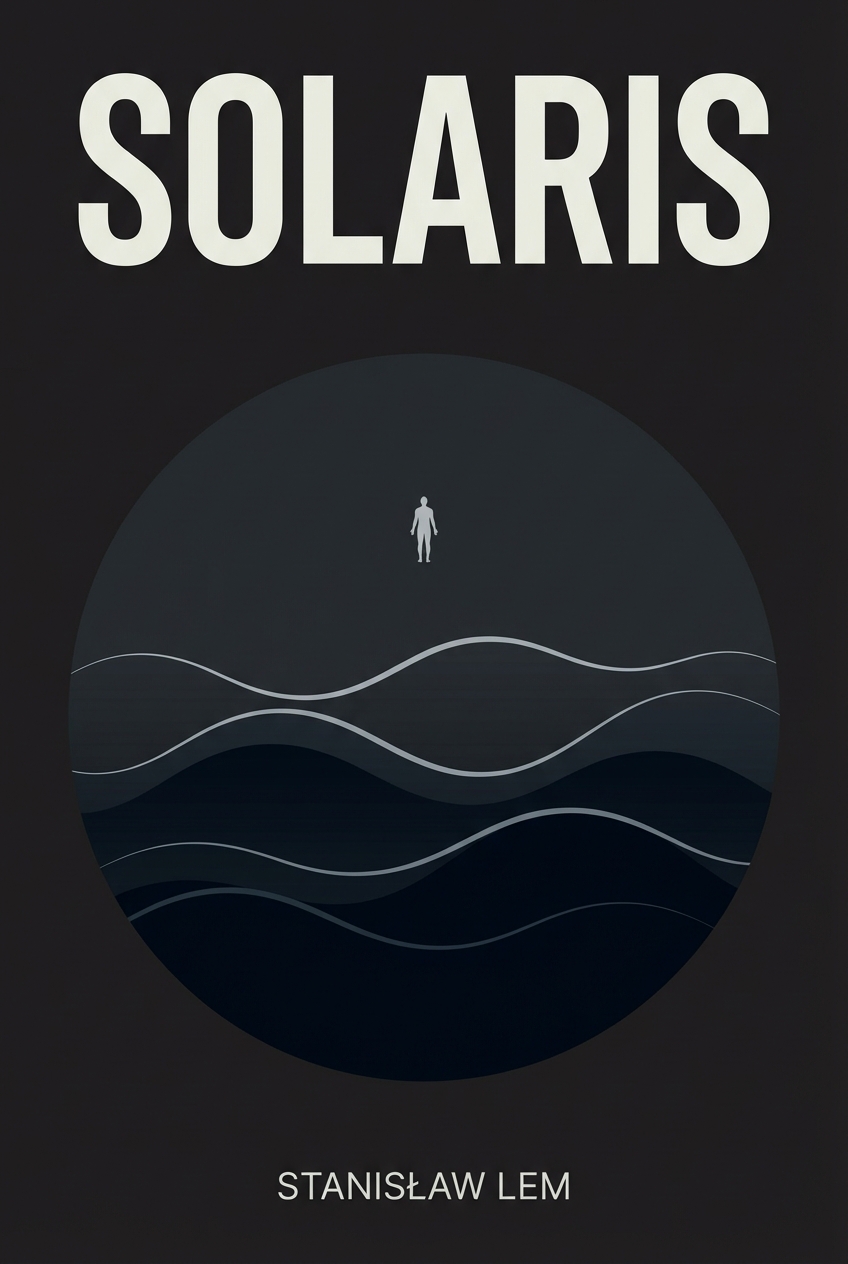
The Script
We believe our greatest strength is our capacity for reason, our ability to analyze, categorize, and ultimately understand the universe. It’s the engine of science, the foundation of philosophy, and the very tool we use to define ourselves as human. But what if this celebrated tool has a critical blind spot? What if, when faced with something truly, fundamentally alien, our obsession with finding a rational explanation becomes a cage? The impulse to dissect and label a phenomenon might be the very thing that prevents us from truly perceiving it. We might be so busy trying to fit an ocean into a test tube that we fail to notice we are drowning.
The human mind, in this view, isn't a passive observer but an active projector, constantly casting its own shadow onto the world and mistaking it for reality. When we encounter something that refuses to conform to our logical frameworks—something that doesn't just defy our expectations but seems to reflect our own hidden psychologies back at us—our most sophisticated intellectual tools don't just fail; they short-circuit. The result is a kind of madness, a spiral of confusion where the observer and the observed become hopelessly entangled. This suggests a terrifying possibility: that the ultimate barrier to understanding the cosmos is our own complexity.
This profound skepticism about the limits of human reason was the lifelong project of Stanisław Lem. As a Polish writer and philosopher who lived through the ideological chaos of the 20th century, Lem was deeply familiar with systems of thought that promised total explanation but delivered catastrophic failure. He channeled this experience into science fiction that questioned the very foundations of scientific inquiry itself. Writing from behind the Iron Curtain, he used the canvas of outer space to explore the inner space of the human mind, culminating in his 1961 masterpiece, Solaris. It was a thought experiment designed to push the human intellect to its breaking point and see what, if anything, remained.
Module 1: The Alien Mirror
The core premise of Solaris is a confrontation with an intelligence so vast and different it defies all human understanding. The setting is a remote research station orbiting the planet Solaris. This planet is covered by a single, living, plasmatic ocean. For decades, a field of study called Solaristics has tried to understand this ocean. They've cataloged its bizarre creations. They've mapped its strange behaviors. But they've made no real progress. The ocean remains a complete enigma.
This brings us to the first crucial insight. The universe does not exist to be understood by humans. Lem introduces us to a scientific discipline in crisis. Solaristics is a graveyard of failed theories. Scientists have tried to label the ocean's phenomena with clumsy terms like "symmetriads" and "mimoids." Some saw it as a primitive pre-biological soup. Others imagined it as a cosmic yogi in deep meditation. The result is a fractured field where experts can't even communicate with each other. This is a critique of human epistemology. We arrive with our frameworks and our taxonomies. We expect the universe to fit neatly into our boxes. Solaris simply doesn't.
So what happens next? The scientists, frustrated by decades of failure, take a drastic step. They bombard the ocean with high-intensity X-rays modulated with human brain patterns. This desperate act of communication triggers a response, but it’s not the one they wanted. This leads to the central, terrifying mechanic of the novel: True contact with the alien may force a confrontation with your deepest self. The ocean begins to probe the minds of the station's crew. It reaches into their subconscious. It finds their most durable, repressed memories. It pulls out their deepest guilt, shame, and loss. And then, it gives those memories physical form.
This is where the psychological horror begins. The crew members find themselves haunted by "visitors." These are tangible, physical beings, seemingly constructed from a sub-atomic material stabilized by unknown forces. The protagonist, psychologist Kris Kelvin, arrives at the station to find the crew in a state of paranoid breakdown. One scientist, Gibarian, has already died by suicide. The other two, Snow and Sartorius, are barricaded in their rooms, hiding from their own personal demons made real. And here's the thing. These visitors are indestructible. They regenerate from any injury. They cannot be reasoned with. They are simply there, a living embodiment of the crew's most painful inner secrets. Kelvin is a rationalist. He tries to find a logical explanation. But soon enough, he wakes up to find his own visitor: Rheya, his wife who died by suicide years ago, a death for which he feels immense guilt.