All Books
Self-Growth
Business & Career
Health & Wellness
Society & Culture
Money & Finance
Relationships
Science & Tech
Fiction
Topics
Blog
Download on the App Store

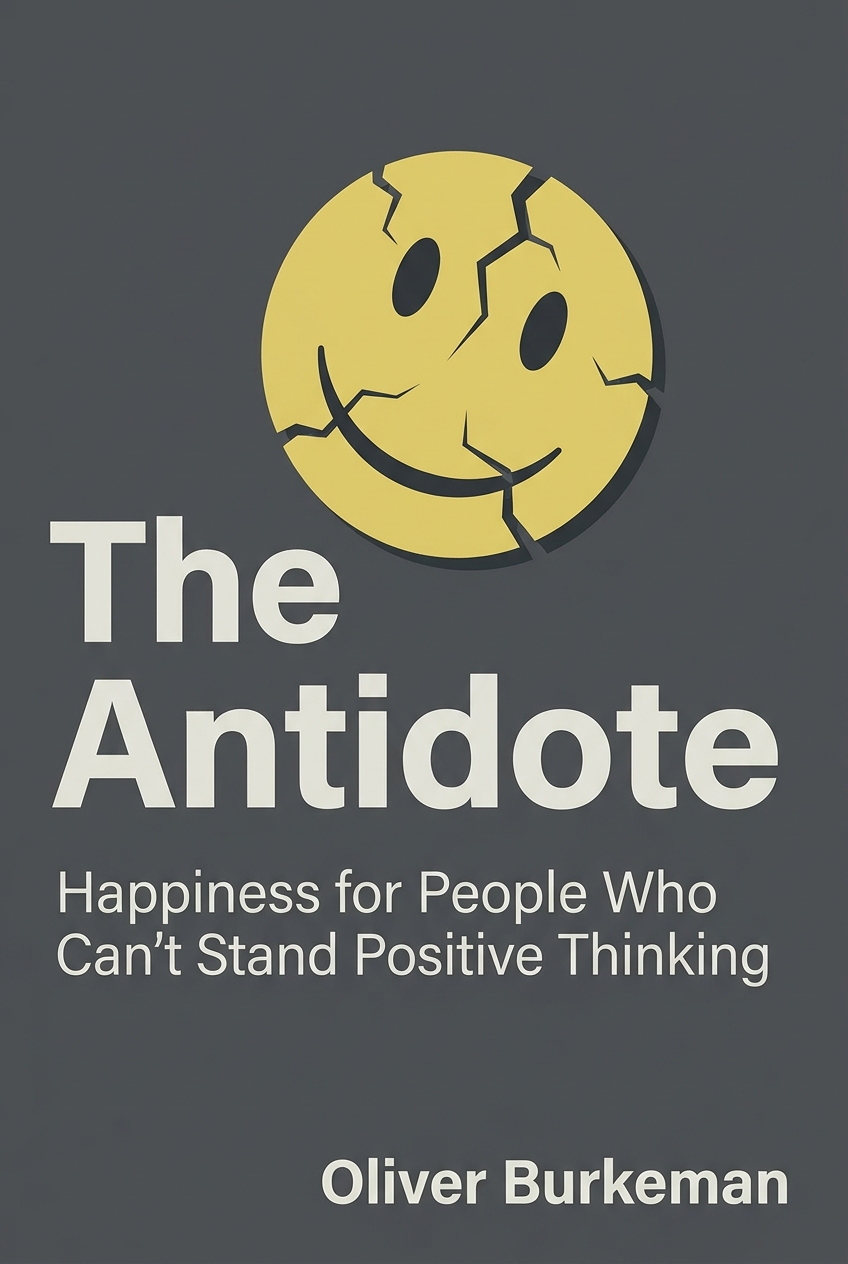
The Antidote

Happiness for People Who Can?t Stand Positive Thinking

12 minOliver Burkeman

What's it about

Tired of being told to "just think positive"? What if the relentless pursuit of happiness is actually making you miserable? This summary offers a radical alternative, showing you how embracing what you usually avoid—uncertainty, failure, and even death—can lead to a more authentic and fulfilling life. Discover the surprising power of the "negative path" to happiness. You'll learn ancient Stoic techniques for managing anxiety, understand why setting goals can backfire, and see how accepting imperfection can bring you more joy than striving for an impossible ideal ever could.

Meet the author

Oliver Burkeman is the award-winning former Guardian columnist whose long-running weekly feature, "This Column Will Change Your Life," explored psychology, productivity, and the science of happiness. For years, he investigated the relentless cult of optimism, discovering that our constant efforts to be happy are precisely what make us miserable. This counterintuitive journey led him to embrace a more realistic and surprisingly effective path to a good life, which he shares in The Antidote.
Listen Now
The Antidote book cover

The Script

We are taught to wage a relentless, internal war against anything that feels negative. Anxiety is a dragon to be slain. Insecurity is a fortress to be besieged. Sadness is a poison to be purged. We are handed an arsenal of affirmations, goal-setting journals, and visualization techniques, all designed to enforce a state of unyielding positivity. But what if this entire strategy is based on a catastrophic misunderstanding? What if our constant struggle against the tide of negative feelings is precisely what keeps us stuck, exhausted, and feeling like failures? This approach treats human emotion like a misbehaving pet that can be disciplined into perfect, happy obedience. It promises control, but it delivers a quiet, exhausting battle that can never truly be won, because the enemy is part of us.

This is the very paradox that drove journalist Oliver Burkeman to investigate the world’s most counter-cultural philosophies. For years, as a writer for The Guardian, he explored the endless buffet of self-help strategies, from the power of positive thinking to the secrets of hyper-productivity. Yet, he noticed a strange pattern: the more ferociously he and others applied these optimistic techniques, the more anxious and dissatisfied they seemed to become. This realization sent him on a journey away from the gurus of positivity and toward the ancient Stoics, modern-day psychologists studying failure, and spiritual teachers who find peace by ceasing to run from discomfort. This book is the chronicle of that journey, an exploration of the 'negative path' to a surprisingly more contented life.

Module 1: The Backwards Law of Happiness

The central idea of the book is a concept called the "backwards law." It's the law of reversed effort. The harder you try to achieve something, the less likely you are to get it. Think about trying to fall asleep. The more you stress about it, the more awake you become. Happiness works the same way.

The problem starts with our obsession with positive thinking. We're told to eliminate negative thoughts and visualize success. But this strategy often backfires spectacularly. Trying to suppress negative thoughts only makes them stronger. This is based on a psychological principle called ironic process theory. Psychologist Daniel Wegner famously demonstrated this with a simple instruction: "Don't think of a white bear." Of course, everyone immediately thought of a white bear. The effort to suppress the thought made it more powerful. When you tell yourself, "Don't be anxious," your mind scans for anxiety, making you more anxious. It’s a feedback loop from hell.

This brings us to the next point. For many people, positive affirmations can actually decrease self-esteem. Research by Joanne Wood found that when people with low self-esteem repeat phrases like "I am a lovable person," they often feel worse. Why? The affirmation is so contrary to their deep-seated belief that their mind actively rejects it. This rejection reinforces their original negative self-image. The positive mantra becomes proof of their own inadequacy.

So what's the alternative? Instead of fighting negativity, the book suggests we should stop struggling. This is where the wisdom of ancient philosophy comes in. The Stoics, for example, didn't try to banish negative thoughts. Instead, Stoicism offers a practical toolkit for building resilience by confronting the worst-case scenario. This practice, called premeditatio malorum or the premeditation of evils, involves vividly imagining what would happen if your fears came true.

What if you lost your job? What if that big presentation failed? By mentally walking through the worst-case outcome, you accomplish two things. First, you realize that even the worst case is often survivable. It might be "very bad," as psychologist Albert Ellis would say, but it's not "100% terrible." This transforms an infinite, terrifying fear into a finite, manageable problem. Second, it prepares you. It strips away the shock and panic, allowing you to respond with calm and reason if adversity does strike. It's the opposite of positive thinking, and it leads to a much more durable form of tranquility.

Read More