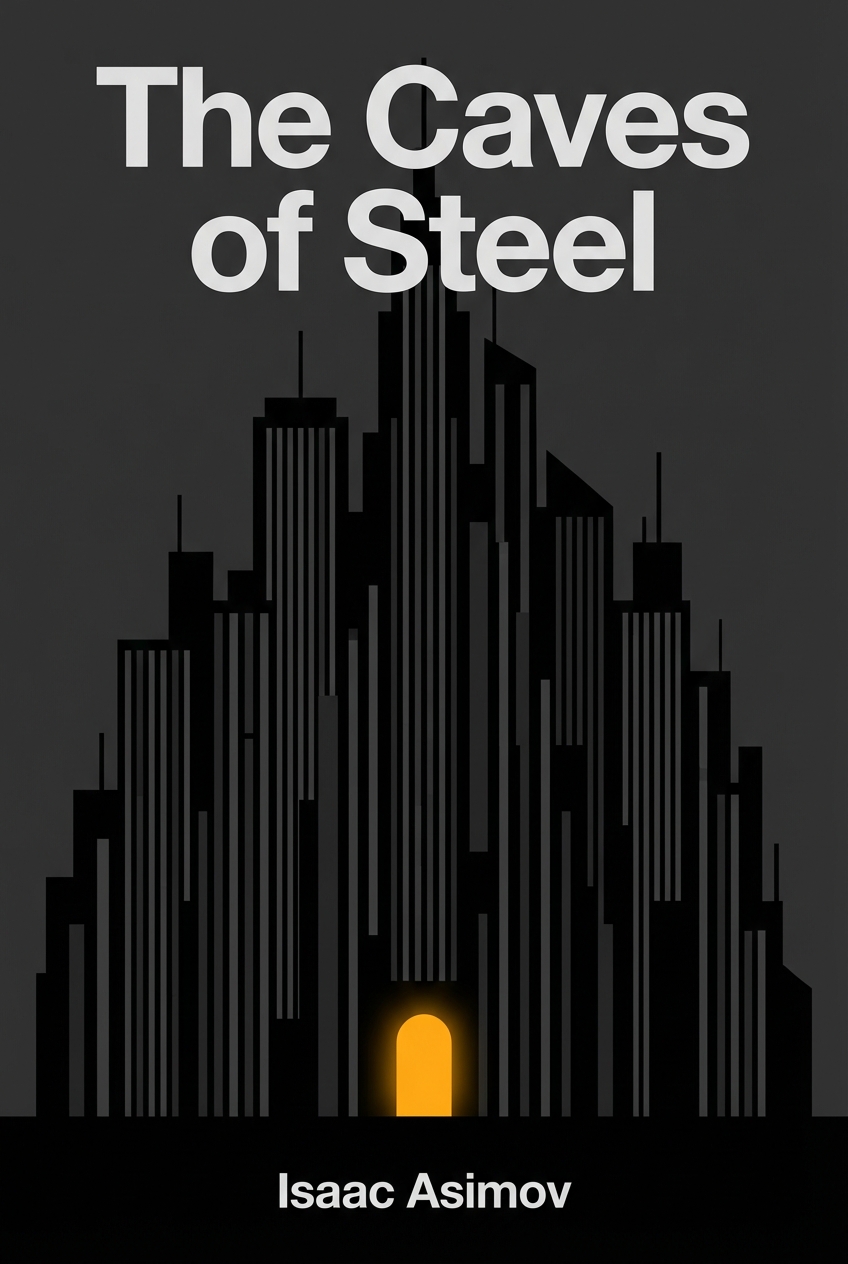
The Caves of Steel
What's it about
Could you trust a robot partner to solve a murder, especially if you hate robots? Dive into a future where humanity lives in massive underground cities, fearing the open sky and the very androids they created to serve them. This is the world of detective Lije Baley. You'll join Baley as he's forced to team up with the eerily human-like robot, R. Daneel Olivaw, to investigate a shocking crime that threatens to shatter the fragile peace between humans and robots. Discover how their clashing perspectives uncover a conspiracy that could change civilization forever.
Meet the author
Isaac Asimov was one of the 20th century's most prolific and influential writers, a Grand Master of Science Fiction celebrated for his groundbreaking Foundation and Robot series. A professor of biochemistry at Boston University, his scientific background gave his futuristic visions an unparalleled sense of realism and logic. This unique blend of scientific rigor and creative imagination allowed him to explore complex themes of humanity, technology, and society, which are masterfully woven into the detective story of The Caves of Steel.
The Script
The greatest danger to a civilization isn't invasion from without, but decay from within. We often assume this decay looks like chaos and disorder—rioting in the streets, a collapse of authority. But what if the most insidious form of societal collapse looks like perfect, sterile order? What if it feels like safety, like every need being met, every risk eliminated? This is the paradox of managed existence: the more we outsource risk and discomfort to flawless systems, the more we atrophy the very human qualities required to face the unknown. Courage becomes a forgotten language. Resilience becomes a theoretical concept. The human spirit, evolved over millennia of strife and uncertainty, finds itself unemployed in a world of absolute, soul-crushing security. When the walls we build to protect us become our cages, the real threat is the comfortable apathy growing inside.
This chilling question of security versus stagnation was a central preoccupation for Isaac Asimov in the early 1950s. As a biochemist and a prolific writer, Asimov was fascinated by the logical extremes of human progress. He noticed a trend in science fiction to portray robots either as benevolent servants or as rebellious monsters. He saw a third, more unsettling possibility. His editor, John W. Campbell, challenged him to write a story that fused the seemingly incompatible genres of science fiction and the classic detective novel. Asimov used this challenge to explore his deeper anxieties about humanity's future, creating a world where the ultimate 'perfect' system—an enclosed, automated city—was producing a species that had forgotten how to live. "The Caves of Steel" was his answer, a thought experiment on whether humanity could solve the mystery of its own self-imposed prison.
Module 1: The Pressure Cooker of the City
The story unfolds in a future New York City. The city is a massive, enclosed, underground metropolis—a steel cave housing tens of millions of people. Life here is efficient and also psychologically crushing. Asimov builds a world where the environment itself shapes human behavior, creating a society that is both highly advanced and deeply fragile.
One of the first things you notice is the social structure. A rigid class system dictates every aspect of life. The system is built on a citizen rating, a grade like C-5 or C-7, that determines your privileges. It decides if you get a better seat on the public transit strips. It dictates the quality of your food. It even controls your access to basic amenities like a private washbasin. Losing your job means "declassification." This is a terrifying prospect. It means being cast down into the lower-status barracks, eating bland yeast mush, and losing all inherited status for your children. The fear of this fall keeps everyone in line.
And here's the thing. This system is under immense strain. The City is an engineered ecosystem. It depends on a constant, uninterrupted flow of resources. Yeast farms produce the food. Atomic plants provide the power. Any disruption, even for an hour, could cause a catastrophic collapse. This hyper-efficiency creates extreme fragility. Dr. Fastolfe, a key Spacer character, points out that New York's survival depends on a precarious balance. This fragility makes the population deeply conservative and resistant to change. They are trapped in a system that works, but just barely.
So what happens when people live like this for generations? They develop a collective agoraphobia. A fear of open spaces. The outside world is a terrifying, alien concept. The physical environment forges a psychological prison. Detective Elijah Baley, our protagonist, finds the idea of leaving the City utterly unthinkable. When he's forced to step into the open air of Spacetown, he feels physically ill. The unconditioned air feels dirty. The direct sunlight is blinding. This fear is a critical plot point. It creates a massive blind spot in the City's security, as no one imagines a criminal would ever dare to escape "cross country."
This enclosed existence also breeds a strange nostalgia. Many Earthmen become "Medievalists." They romanticize a pre-City past they've never known. This is a coping mechanism—a psychological escape from the pressures of their crowded, impersonal lives. This movement becomes a hotbed of resentment, particularly against the two forces disrupting their fragile world: Spacers and robots.