All Books
Self-Growth
Business & Career
Health & Wellness
Society & Culture
Money & Finance
Relationships
Science & Tech
Fiction
Topics
Blog
Download on the App Store

The Color of Law

A Forgotten History of How Our Government Segregated America

14 minRichard Rothstein

What's it about

Ever wonder why American cities are still so segregated, long after segregation was outlawed? You might think it was just private prejudice or economic differences, but the truth is far more deliberate and shocking. This book summary uncovers the forgotten story of how the government itself was the architect of modern segregation. You'll discover the specific laws, policies, and court decisions that systematically separated communities by race. Learn how federal housing programs, zoning ordinances, and even law enforcement created the racial divides we still see today. This isn't just history; it’s the key to understanding the roots of inequality in America.

Meet the author

Richard Rothstein is a Distinguished Fellow of the Economic Policy Institute and a Senior Fellow at the Thurgood Marshall Institute of the NAACP Legal Defense Fund. His decades of research into education and housing policy culminated in this groundbreaking work, revealing the unconstitutional, racially explicit government policies that created residential segregation. Rothstein meticulously uncovered a history hidden in plain sight, challenging the myth of de facto segregation and reshaping our understanding of American inequality.
Listen Now
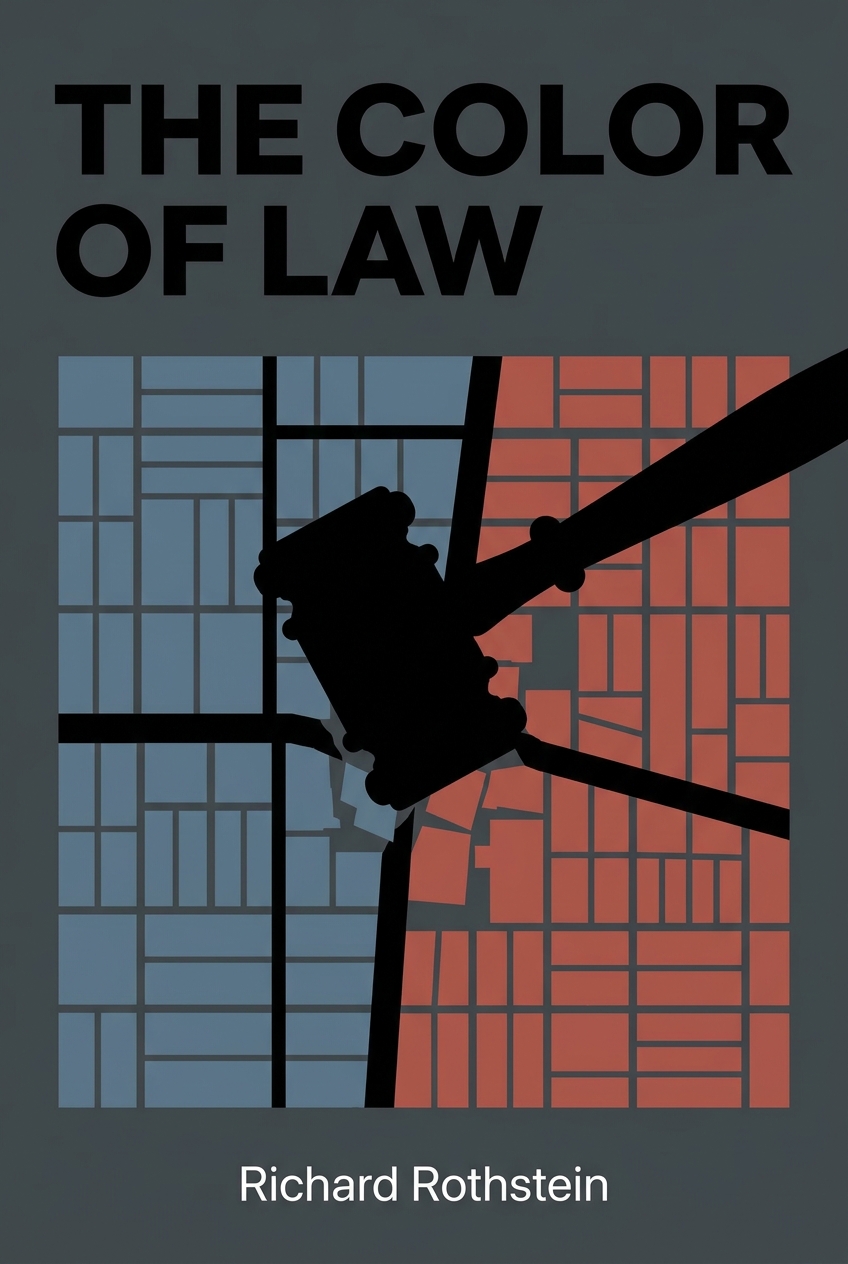
The Color of Law book cover

The Script

In 1948, the Supreme Court case Shelley v. Kraemer made it illegal for courts to enforce racially restrictive covenants—private agreements that barred non-whites from owning or occupying property. In theory, this decision should have dismantled a key pillar of housing segregation. Yet, in the decade that followed, the Federal Housing Administration financed over 35 million new homes, with less than 2 percent of that financing going to non-white families. Even more pointedly, FHA underwriting manuals from the era explicitly recommended the use of racial covenants and zoning to maintain 'neighborhood stability,' effectively circumventing the court's ruling. These weren't isolated incidents; they were documented policies.

This stark contradiction between legal principle and federal practice is the central pattern. The belief that residential segregation arose organically from private prejudice is one of America's most persistent myths. Economist and historian Richard Rothstein was teaching a course on social and educational policy when he casually repeated this conventional wisdom. A student challenged him, prompting an investigation that would consume the next decade of his life. Sifting through thousands of pages of forgotten public records, from city ordinances and zoning maps to federal housing guidelines, Rothstein uncovered a vast and undeniable record of official, state-sponsored segregation. The Color of Law is the result of that investigation, a meticulous assembly of evidence revealing a history that was intentional.

Module 1: The Blueprint for a Divided Nation

The common story is that segregation arose from private prejudice. But Rothstein's core argument is that the U.S. government was the primary architect of residential segregation. It was an active designer of the system.

This began with a seemingly positive goal: promoting homeownership. But these programs had a hidden, racialized agenda. The government’s "Own-Your-Own-Home" campaign in the early 20th century, for instance, used posters that exclusively depicted white families. Herbert Hoover, as Secretary of Commerce, promoted homeownership while openly advising communities to use restrictive districts to avoid racial conflict. He even called single-family homes an "expression of racial longing."

This thinking became official policy during the New Deal. The federal government created a system of redlining that choked off investment in African American neighborhoods. The Home Owners' Loan Corporation, or HOLC, created color-coded maps of American cities. Green-lined areas were deemed "best" for investment. Red-lined areas were labeled "hazardous." The primary factor for a red designation was the presence of African American residents, regardless of their income or the quality of the housing. This made it nearly impossible for Black families to get mortgages.

Next, the government took this a step further. The Federal Housing Administration, or FHA, explicitly required racial segregation as a condition for insuring mortgages. The FHA’s official underwriting manual, used by appraisers nationwide, stated that "incompatible racial groups should not be permitted to live in the same communities." It warned against the "infiltration of inharmonious racial groups." To get an FHA-insured loan, developers had to agree that homes would not be sold to African Americans. This was written policy. This meant that the construction of entire suburbs—places like Levittown, New York, or Lakewood, California—was directly subsidized by the federal government on the condition that they remain whites-only.

Finally, the government used public housing to physically separate the races. You might think public housing was always for the poor. It started as a program for working and middle-class families displaced by the Great Depression. And it was explicitly segregated. The Public Works Administration, or PWA, implemented a "neighborhood composition rule." This rule was used to justify building separate projects for whites and Blacks, often creating segregation where none existed before. In Cleveland, a historically mixed neighborhood was demolished to build two separate projects: one for whites, one for African Americans. This was a national phenomenon, happening in San Francisco, Detroit, and across the North.

Read More