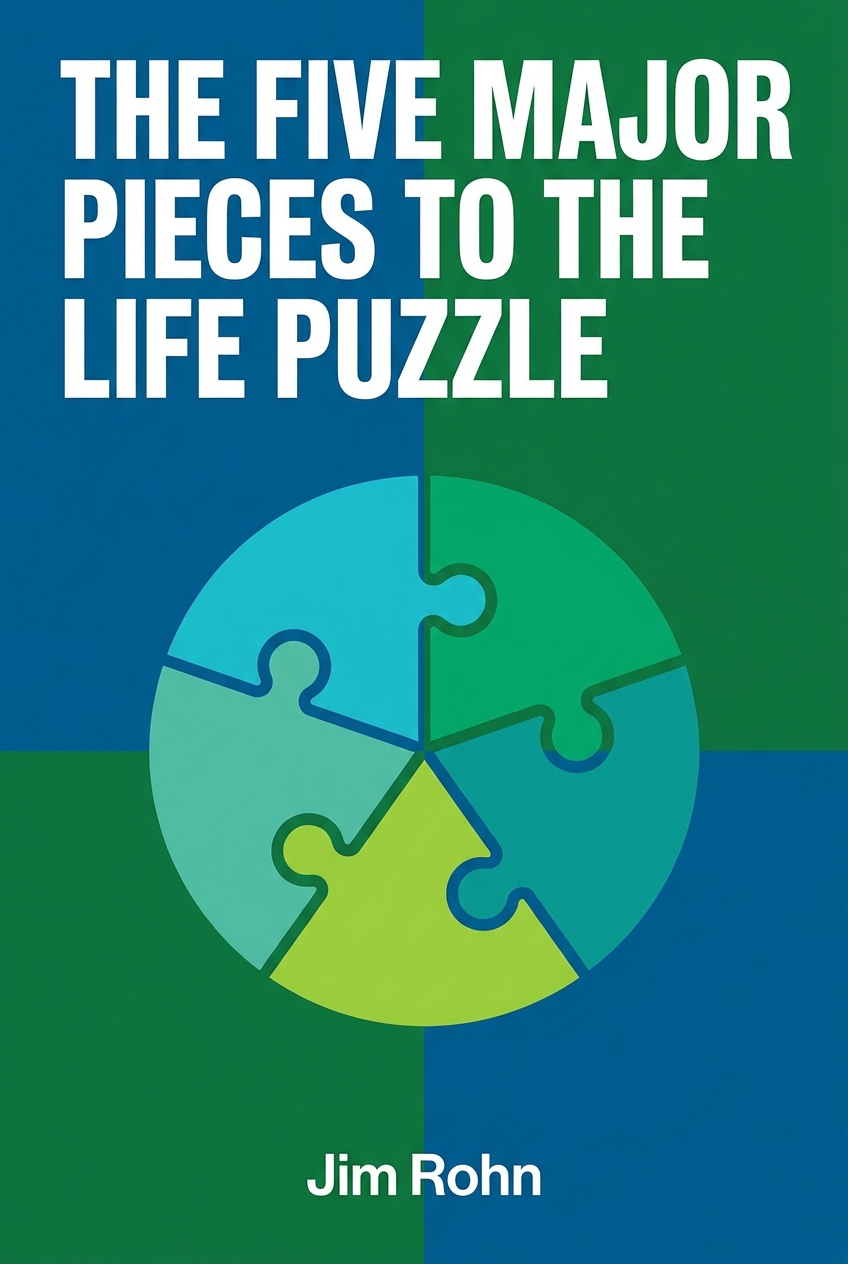
The Five Major Pieces to the Life Puzzle
What's it about
Ever feel like you're just drifting through life without a clear direction? What if you could assemble the five key pieces needed to build a life of success, happiness, and meaning? This summary reveals Jim Rohn's timeless framework for taking control of your destiny. You'll discover how to develop an empowering philosophy, cultivate a winning attitude, and take massive, disciplined action. Learn to connect with the right people and design a lifestyle that truly fulfills you. Stop guessing and start building a life by design, not by default.
Meet the author
Widely regarded as America's foremost business philosopher, Jim Rohn mentored a generation of personal development icons, including Tony Robbins, and addressed over 6,000 audiences worldwide. His own journey from a broke farm boy to a millionaire by age 31 became the foundation for his powerful, common-sense principles on success and happiness. Rohn's life experience and decades of teaching distill complex ideas into the simple, actionable steps found within his work, inspiring millions to achieve a more meaningful life.
Opens the App Store to download Voxbrief

The Script
When Barbra Streisand decided to direct the film 'Yentl,' she was attempting to orchestrate a universe. For nearly fifteen years, she wrestled with the project, fighting for financing, clashing with studio heads, and meticulously overseeing every detail from the script to the score. She was the producer, the co-writer, and the director. Critics at the time questioned her relentless, all-consuming drive. Why pour so much of herself into one project? Why not just stick to singing and acting, the domains she had already mastered? The answer lies in a desire for a coherent, unified vision. Streisand was trying to solve a complex puzzle where every piece—the story, the music, the performance, the message—had to fit together perfectly to create a single, meaningful whole. This drive to assemble a life, or a project, that makes sense is a deeply human one, yet few of us have a clear idea of what the major pieces even are.
That very challenge—the struggle to see the distinct but interconnected parts of a well-lived life—is what drove a man named Jim Rohn. He experienced his own dramatic turning point. At age 25, Rohn found himself broke, in debt, and baffled by his own lack of progress. His life felt like a collection of random, ill-fitting parts. His transformation began when he met a mentor, Earl Shoaff, who offered a simple, profound framework for viewing his life. Over the next three decades, Rohn refined this framework through his own experience and by speaking to millions. He discovered that success and fulfillment were the deliberate assembly of five key areas. He wrote 'The Five Major Pieces to the Life Puzzle' to share that fundamental clarity he had so desperately needed, providing a way to see the essential components and how they fit together.
Module 1: Philosophy—The Set of Your Sail
The first and most important piece of the puzzle is your personal philosophy. This is about the way you choose to think. It's the collection of information, ideas, and values you've gathered over your lifetime. This philosophy acts as a filter. It determines which ideas you accept and which you reject. Ultimately, it drives every decision you make.
Rohn argues that your personal philosophy is the primary cause of your life's outcomes. Many people make a critical error. They curse the effect but continue to nourish the cause. They're unhappy with their income, but they don't change the thinking that produces it. For example, an employee feels underpaid. His philosophy leads him to reduce his effort to match his paycheck. This feels logical. But it guarantees he will never be promoted or earn more. The problem is the flawed information that shaped his philosophy.
This leads to a powerful metaphor. The same winds of circumstance blow on everyone. Disappointment, challenge, and opportunity visit both the rich and the poor. The difference in where they end up is the set of the sail. Your philosophy is how you set your sail. When the wind changes, you can't change the wind. But you can reset your sail. This ability to adjust your thinking in response to adversity is what determines your destination. How quickly and responsibly you react matters more than the adversity itself.
So what's the next step? You need to actively revise your philosophy. Most of our beliefs are formed passively. We absorb them from school, friends, and the media. Many of these inputs lead to faulty conclusions that hold us back. Rohn insists that you must become a deliberate student of life to build a powerful philosophy. This is about actively seeking new, high-quality information.
Here’s how to do it:
- Learn from your experiences. Seriously review your past. What worked? What didn't? Make your past your servant, not your master.
- Learn from others. Study the failures of others to learn what to avoid. More importantly, study success. Read the books and biographies of people you admire. Their wisdom is condensed and waiting for you.
- Become a good observer and listener. Get from the day. Pay attention. Listen selectively. Tune out the noise and focus on valuable signals.
- Keep a journal. This is a game-changer. Writing slows down your thinking. It allows you to capture ideas, analyze your actions, and refine your philosophy with clarity.
Ultimately, this leads to a simple but profound choice. Rohn presents two formulas. The formula for failure is "a few errors in judgment, repeated every day." The formula for success is "a few simple disciplines, practiced every day." The choice is yours. Neglect is easy. It's easy not to read the book. It's easy not to keep a journal. But these small acts of neglect accumulate. They create a negative spiral of guilt and low confidence. By consciously choosing new disciplines, you strengthen the voice of success and build a philosophy that attracts the results you want.
Module 2: Attitude—The Colors of Your World
Now we move to the second piece of the puzzle: Attitude. If philosophy is what you know, attitude is how you feel about what you know. It's the emotional lens through which you see the world. It colors your perception of your past, your future, your work, and other people. Rohn is clear: a powerful attitude can move mountains. A poor one can make you stumble over a grain of sand.
A common mistake is to let the past define our present attitude. We carry regrets and failures like a weapon we use against ourselves. But Rohn offers a healthier perspective. You must learn to use the past as a school. The past is for learning. You can't change it. But you can change how you feel about it. Gather the lessons from your mistakes, forgive yourself, and invest that wisdom into your future. This single shift can repair a broken attitude.
From that foundation, we can focus on the future. And here's the key insight: your future must be designed in advance. Everything ever created was finished in the mind of its creator before it was started. A house, a car, a company—they all began as a clear vision. The same is true for your life. You must become the architect of your own future. Create clear, written goals. Let the pull of that exciting future inspire your discipline today. A goal casually pursued is just a wish. A wish is self-delusion. But a future vividly imagined creates an emotional pull that makes the price of discipline easier to pay.
But what about other people? It's easy to think we can succeed alone, especially in a competitive environment. Rohn argues this is a fatal error. Interdependence is a fact of life. We all need each other. Your attitude toward others—your team, your family, your community—has a massive impact on your own success. As John Donne wrote, "No man is an island." Appreciating the value of each person is a strategic necessity for collective progress.
This brings us to a crucial point about influence. The people you associate with will profoundly shape your attitude. Take a hard look at your inner circle. Are they lifting you up or pulling you down? Rohn suggests a simple audit. Who are you around? What effect are they having on you? What have they got you reading, listening to, and thinking? Negative influences are often subtle. They are small nudges that slowly steer you off course. To protect your attitude, you must be ruthless. Limit your association with negative people. And deliberately expand your association with those who inspire and educate you. Spend your time with the productive, the optimistic, and the ambitious.
Finally, remember this. Your attitude is one of the few things in life over which you have total control. No one can make you angry. You choose to become angry when you surrender control of your attitude. It's your most valuable personal asset. Protect it fiercely. Cultivate it daily. It determines the size of your dreams and the intensity of your efforts.
Module 3: Activity—The Work That Converts Potential to Reality
We've covered philosophy and attitude. But ideas and feelings alone produce nothing. The third piece of the puzzle is Activity. This is where potential meets reality. It's the disciplined work required to turn your vision into achievement.
Rohn makes a stark point. Life rewards activity. The universe responds to what you deserve based on your actions. He uses the Parable of the Talents to illustrate this. The servants who put their talents to work were rewarded. The one who buried his talent out of fear lost everything. The lesson is clear: your knowledge, your skills, and your opportunities are worthless until you act on them. Without action, a great philosophy and a positive attitude just lead to sophisticated excuses.
This is where many well-intentioned people fail. They have good ideas and a great heart, but they get stuck in "quiet desperation." They choose ease over enterprise. Rohn argues that disciplined labor is superior to rest. Every time you choose action over ease, you build self-worth. The reward for activity is what you become. Rest is necessary, but it should be a pause to recover, not a destination. The punishment for excessive rest is mediocrity.
But it’s not just about being busy. Motion is not the same as progress. Your activity must be intelligent, planned, and disciplined. You need a game plan. This means setting clear, written goals—both short-term and long-range. It means planning your day before it begins. A "magnificent obsession," a major life purpose, can provide the gravitational pull to keep you focused and disciplined. Discipline is what keeps you on track when doubt, fear, or complexity try to derail you.
So, how do you start? You start small. Mastering small, daily disciplines is the foundation for all major achievements. The mental and emotional muscles you build by doing simple things—like paying a bill on time, writing a thank-you letter, or cleaning your workspace—are the same muscles required to run a company or build a fortune. Neglecting the small things erodes your capacity to handle the big things. Progress begins with a single, disciplined choice. You can choose today to open a book, start a new activity, or make a call you've been avoiding. Change doesn't require a lightning bolt of inspiration. It requires a conscious decision to act.