All Books
Self-Growth
Business & Career
Health & Wellness
Society & Culture
Money & Finance
Relationships
Science & Tech
Fiction
Topics
Blog
Download on the App Store

The Good Place and Philosophy

Everything is Forking Fine! (The Blackwell Philosophy and Pop Culture Series)

13 minWilliam Irwin

What's it about

Ever wondered if you're truly a good person, or just trying to score points for some cosmic afterlife? This book summary dives into the hilarious, mind-bending ethical dilemmas of The Good Place, using the show's best moments to make complex philosophy surprisingly simple and fun. You'll explore what Aristotle, Kant, and Sartre would say about Chidi's constant stomachaches and Eleanor's journey from "arizona dirtbag" to ethical student. Learn to navigate your own moral quandaries, understand virtue ethics without the boring lectures, and finally figure out what it really means to be good.

Meet the author

William Irwin is a Professor of Philosophy and the originator of the philosophy and pop culture book genre, which includes the bestselling The Matrix and Philosophy. This unique background allows him to expertly unpack complex ethical dilemmas, like those in The Good Place, making profound philosophical concepts accessible and engaging for everyone. His work reveals how our favorite stories can help us understand life's biggest questions, proving that philosophy is, indeed, forking everywhere.
Listen Now

Opens the App Store to download Voxbrief

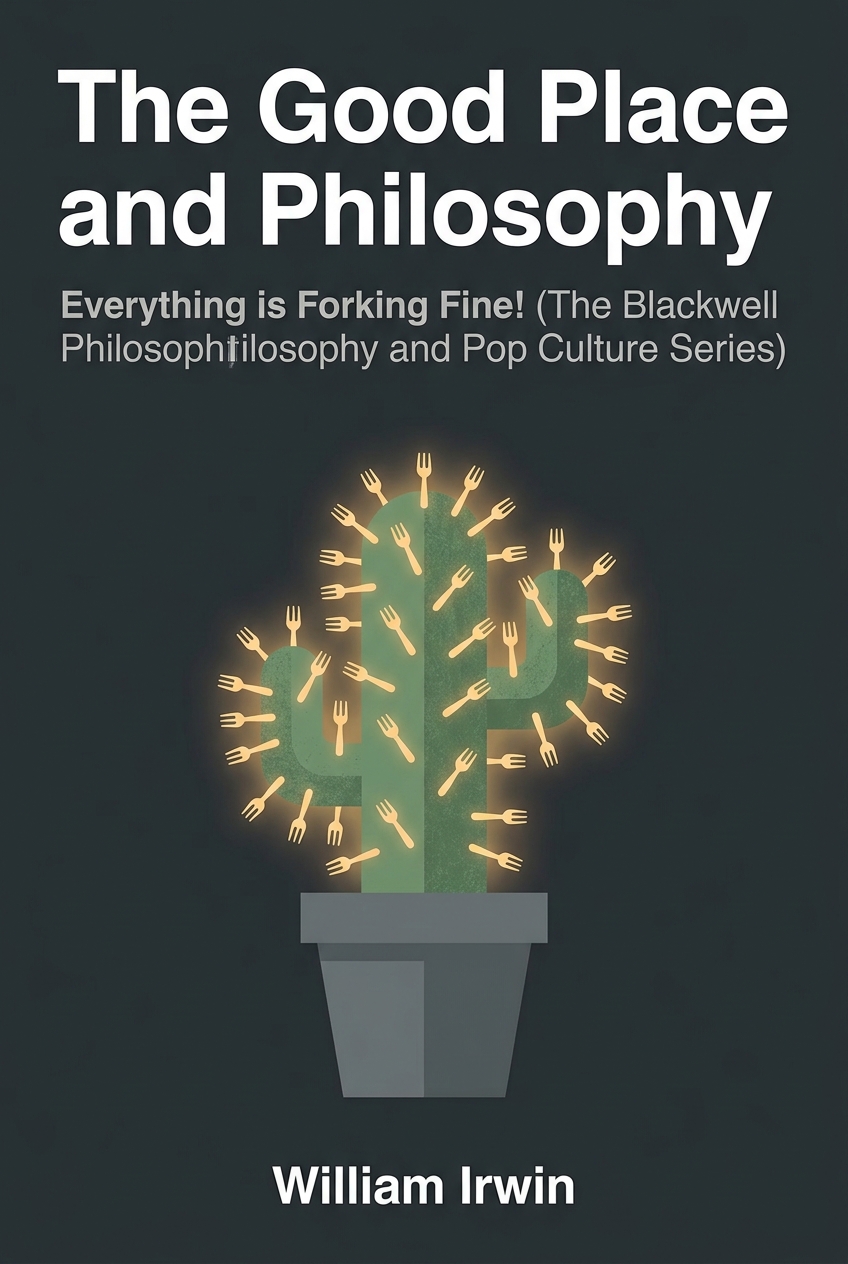
The Good Place and Philosophy book cover

The Script

Most ethical systems are built on a flawed foundation: the assumption that becoming a better person is a matter of solitary study and private struggle. We treat morality like a final exam, cramming philosophical theories and memorizing rules in the hope of acing the test when it arrives. But what if this entire model is wrong? What if genuine goodness is forged in the messy, unpredictable, and often hilarious interactions with other people? The real ethical work, it turns out, is the clumsy, frustrating, and deeply human project of trying not to be a jerk to the people stuck with you in an elevator—or, perhaps, in the afterlife.

The very structure of this collaborative, relational ethics is what captivated William Irwin and the team of philosophers he assembled. As a long-time editor of the popular 'Philosophy and Pop Culture' series, Irwin recognized that the hit TV show The Good Place was conducting a vibrant, four-season-long thought experiment. The show's characters didn't improve by reading Kant; they improved by annoying, supporting, and ultimately relying on each other. This book was born from that observation—a collective effort by professional thinkers to unpack the surprisingly profound lessons embedded in a sitcom about what it truly means to be good, together.

Module 1: The Moral Accounting System is Rigged

Imagine your life is a video game. Every action you take adds or subtracts points from a cosmic score. Buying flowers for your grandma? Plus 15 points. Telling a white lie? Minus 5. At the end, your final score determines whether you get into "The Good Place." This is the system the show introduces. And this book's first major insight is that such a system is fundamentally broken.

The book argues that a simple, point-based moral system is inherently unfair. It fails to account for the messy reality of human life. The show's creator, Michael Schur, even came up with the idea while stuck in traffic. He wondered if a driver who illegally used the breakdown lane would lose points. But how many? And would all philosophers agree? The question itself reveals the problem. There is no universal consensus on a moral calculus.

This leads to a critical observation about our modern world. In the show, it's revealed that no one has entered The Good Place in over 500 years. Why? Because life has become too complicated. Buying a tomato might seem like a simple act. But that purchase could inadvertently support toxic pesticides, exploitative labor practices, and carbon emissions. Your good intention to make a salad ends up generating negative points. The system punishes people for unforeseeable consequences in a deeply interconnected world. This is a powerful critique of pure consequentialism, the ethical theory that judges actions solely by their outcomes.

So what's the real-world parallel? Think about judging a colleague's performance based on a few rigid KPIs without considering their circumstances. Or evaluating a startup based only on its quarterly revenue, ignoring the market conditions or the team's long-term vision. These are small-scale versions of the show's flawed point system.

From this foundation, the book introduces the concept of Moral Luck. This is the idea that factors entirely outside our control significantly shape our moral lives. Moral luck makes a simple tally of good and bad deeds unjust. The book breaks this down into different types. There's constitutive luck, which is the kind of person you are, including your innate temperament. Chidi, the ethics professor, is plagued by indecisiveness, a trait he's had since childhood. It causes real harm to others. But how much is he to blame for a core part of his personality? Then there's circumstantial luck, which is the environment you're born into. Tahani's lifelong insecurity and name-dropping are a direct result of being pitted against her sister by their parents. Eleanor’s selfishness is rooted in her upbringing with neglectful, unreliable parents. A fair judgment must consider this context.

And here's the thing. The book suggests that true moral assessment requires a compassionate understanding of human complexity. People are not just "good" or "bad." The show constantly reveals hidden depths in its characters. Eleanor discovers a conscience she long ignored. Tahani learns her sister was also suffering. The lesson is to move beyond snap judgments. It advocates for nuance and grace, both for others and for ourselves. We are all products of circumstances we didn't choose. Acknowledging this doesn't erase responsibility. But it does call for a more empathetic and less rigid approach to evaluation.

We've explored the problem with moral accounting. Next, let's look at what the book suggests is a better way forward.

Module 2: Becoming Good is a Team Sport

If a point system doesn't work, then how do we become better people? The book’s answer is surprisingly simple, yet profound. It argues that ethics is a communal endeavor. You don't become a good person by locking yourself in a room and studying philosophy books.

The central thesis of the book is this: Moral growth is a relational and communal process. We become better through and with other people. This idea is woven throughout the entire series. The four main human characters—Eleanor, Chidi, Tahani, and Jason—are all deeply flawed. On their own, they were doomed. But by being forced together, they start to change. Their bonds, forged in a literal hell designed to torture them, become the very engine of their redemption.

The book draws heavily on Aristotle's virtue ethics. For Aristotle, being good is about practice. You become brave by doing brave things. You become generous by acting generously. It’s like learning an instrument. You need practice, and you need a teacher. In the show, Chidi becomes Eleanor’s teacher. But she, in turn, teaches him. Her pragmatism and willingness to act force him out of his crippling indecision. They improve because they help each other. As Chidi himself concludes, "We choose to be good because of our bonds with other people and our innate desire to treat them with dignity."

This brings us to a really actionable insight. Friendships built on shared values are essential for a good life. Aristotle distinguished between different kinds of friendships. Some are based on utility, what you can do for each other. Others are based on pleasure, how much fun you have together. But the highest form is a friendship of virtue, where you admire and encourage the good in each other. You help each other become the best versions of yourselves. This is what the "Soul Squad" eventually achieves. Their relationships evolve from pure utility—Eleanor using Chidi to stay out of The Bad Place—to genuine care. They become a community dedicated to mutual improvement.

But flip the coin. What happens when you try to go it alone? The book presents a fascinating case study in the character of Doug Forcett. He’s the man who, on a mushroom trip in the 1970s, figured out 92% of how the afterlife works. He dedicates his entire life to maximizing his point score. He lives off-grid, eats only lentils, and lets people walk all over him, all to earn points. The book labels him a "happiness pump," a person so obsessed with maximizing the overall good that he makes himself miserable. Extreme self-sacrifice can become a moral flaw if it negates your own well-being. Doug's life is a cautionary tale. It shows the absurdity of a purely transactional approach to morality. He isn’t living a good life; he’s just grinding for points. The ethical life requires balance and connection. It’s about being a decent person in a community.

Now that we understand morality is a social project, let's turn to the philosophical toolkit the show provides.

Read More