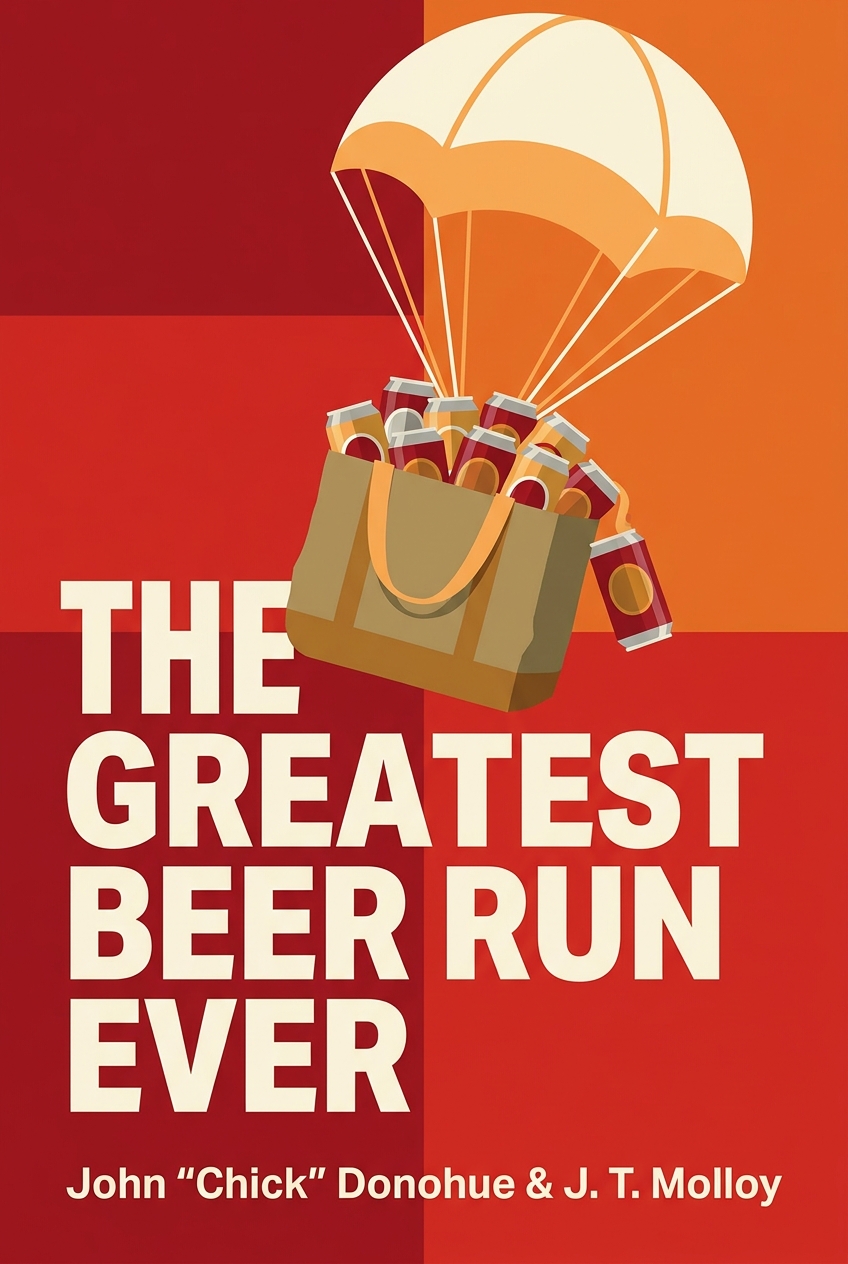
The Greatest Beer Run Ever
A Wild Story of Friendship, War, and One Man’s Unbelievable Mission to Vietnam
What's it about
What if the most outrageous act of friendship could also be the most inspiring? Discover the true story of John "Chick" Donohue, a man who, fueled by bar-room patriotism, embarked on an impossible mission to bring his friends a beer—in the middle of the Vietnam War. You'll learn how this one civilian navigated a war zone, hitching rides on military planes and supply ships, all for his buddies. This unbelievable journey reveals powerful lessons about loyalty, the absurdity of war, and how a simple, heartfelt gesture can become a legendary tale of hope.
Meet the author
John "Chick" Donohue is a U.S. Marine Corps veteran whose real-life, impossibly daring mission to bring beer to his friends during the Vietnam War became a global phenomenon. A former union sandhog and lifelong New Yorker, Donohue's story of loyalty and friendship in the face of unimaginable danger was first a local legend before becoming an Oscar-winning film. He collaborated with Pulitzer Prize-winning journalist J.T. Molloy to share his incredible journey, offering a unique, ground-level perspective on hope amidst conflict.
Opens the App Store to download Voxbrief

The Script
In a New York City bar, a conversation can take on a life of its own. It starts as a murmur, a half-serious suggestion tossed over the rim of a glass. But in the right atmosphere, fueled by camaraderie and a potent mix of grief and patriotism, that suggestion can grow. It can twist from a foolish joke into a solemn promise. One person says something impossible, another agrees, and suddenly a pact is formed—a pact that feels more real and binding than any written contract. It’s the kind of bar-stool vow that should evaporate by morning, a story to be laughed off with the first light of day. But what happens when someone refuses to let it die? What happens when one man decides that a wildly impractical, borderline insane promise made to his friends is the most important thing in the world?
That’s exactly what happened to John “Chick” Donohue in 1967. Sitting in his neighborhood bar in Inwood, Manhattan, he listened as the bartender railed against anti-war protestors, wishing someone would go over to Vietnam and bring the neighborhood boys a beer to show them they were appreciated. While others nodded and went back to their drinks, the idea took root in Chick’s mind. A former Marine and merchant mariner, he saw it as a sacred mission. This was about keeping a promise and showing up for his friends who were caught in the middle of a conflict the country was starting to turn against. Donohue, with the help of journalist J.T. Molloy, decided to tell the story of how this absurd, heartfelt idea led him on an incredible journey into a war zone, armed with little more than a duffel bag of Pabst Blue Ribbon and an unshakeable sense of loyalty.
Module 1: A Promise Forged in a Neighborhood Bar
The entire beer run begins not on a battlefield, but in a local pub. It's an idea born from a specific time and place. Inwood, Manhattan, during the Vietnam War, was a world of fierce patriotism and community solidarity. The local bartender, a man known as "The Colonel," organized parades and treated returning soldiers like heroes. This was a neighborhood where "The Star-Spangled Banner" was sung after Sunday Mass. So when news reports showed protesters calling soldiers "murderers," the community felt it as a personal attack. The idea of the beer run was a direct, almost defiant response. It was a way to send a message of support that was more tangible than a letter.
This leads to the first crucial insight: A symbolic gesture can become a powerful mission when fueled by community spirit. What started as a half-serious dare from The Colonel quickly became a neighborhood project. People in the bar started scribbling down the names and units of their sons, brothers, and friends serving in Vietnam. The mission belonged to everyone. Even a mother who never set foot in a bar sought him out, pressing money into his hand to find her son. The weight of this collective hope transformed a wild idea into a deeply personal obligation.
But here's the thing. That sense of duty comes with a heavy price. Personal commitment to a dangerous mission creates immense psychological pressure, even amid public encouragement. While the bar patrons cheered him on, Chick was riddled with doubt. He even refused the mother’s money, terrified that accepting it would seal his fate. He knew how risky this was. The night before he shipped out, he called his own mother, but couldn't bring himself to tell her his true destination. He was scared he wouldn't come back. This internal conflict between his public bravado and private fear is a constant thread throughout his journey.
So how do you even begin such a mission? You get practical. Turning a bold idea into reality requires improvisation and leveraging the systems you know. Chick was a merchant mariner, not a soldier or a spy. He used his union card to get a job as an oiler on the SS Drake Victory, an ammunition ship headed for Vietnam. His planning was minimal. He grabbed a razor, some socks, and a case of Pabst Blue Ribbon. He relied on scraps of paper with names and locations, many of which were already outdated. There was no grand plan. It was just a series of small, pragmatic steps, driven by the sheer will to keep a promise.
Module 2: Navigating the Fog of War
We've covered how the mission began. Next up: the reality of executing it. Landing in Vietnam, Chick Donohue was a man without a plan. He wore civilian clothes—white jeans and a madras shirt—in a war zone. He was an anomaly. And this is where his journey takes a strange turn. In a rigid, hierarchical system, ambiguity can be a superpower. Because no one could figure out who he was or why he was there, they often made their own assumptions. Military officers saw his civilian attire and his confident, unbothered demeanor, and concluded he must be with the CIA. This "CIA Effect" became his unofficial passport. It got him past checkpoints, onto helicopters, and even earned him a meal with a major. He never claimed to be a spy. He just didn't correct anyone's assumptions.
This informal access was critical, because finding his friends was like searching for needles in a sprawling, chaotic haystack. His first success came through sheer, dumb luck. While asking a group of Military Police for directions, he mentioned he was looking for a soldier named Tommy Collins. One of the MPs replied, "You’re looking for Collins? We're on our way to relieve him right now." Just like that, the first beer was delivered. This sets the tone for the entire journey. It's a mix of unbelievable chance and Chick's own stubborn persistence.
And it doesn't stop there. He needed to get to the Central Highlands to find another friend. So, what does he do? He walks into a bar, strikes up a conversation with an Air Cavalry sergeant, and asks for a ride. The sergeant, disregarding the need for official orders, simply agrees to take him on a mail plane. This reveals another key aspect of the war. Formal military rules are often bypassed by informal networks built on camaraderie. Soldiers recognized in Chick a shared spirit. He was there for one of them, and that was enough. They helped him because his mission, however absurd, resonated with their own values of loyalty and looking out for your buddies.
But flip the coin. While Chick was navigating the system, he was also witnessing the brutal realities of the conflict. He saw the ancient temples of Vietnam, a reminder of the country's long history of foreign occupation. He saw young soldiers, barely out of their teens, who were old enough to die for their country but not old enough to drink in most states. He saw the surreal "Saigon tea" girls in bars and the civilian truck drivers risking their lives to run ammo to the front lines. The absurdities of war are starkly visible when viewed through a civilian lens. Chick's journey became an unfiltered tour of the logistics, the dangers, and the profound human ironies of the Vietnam War.