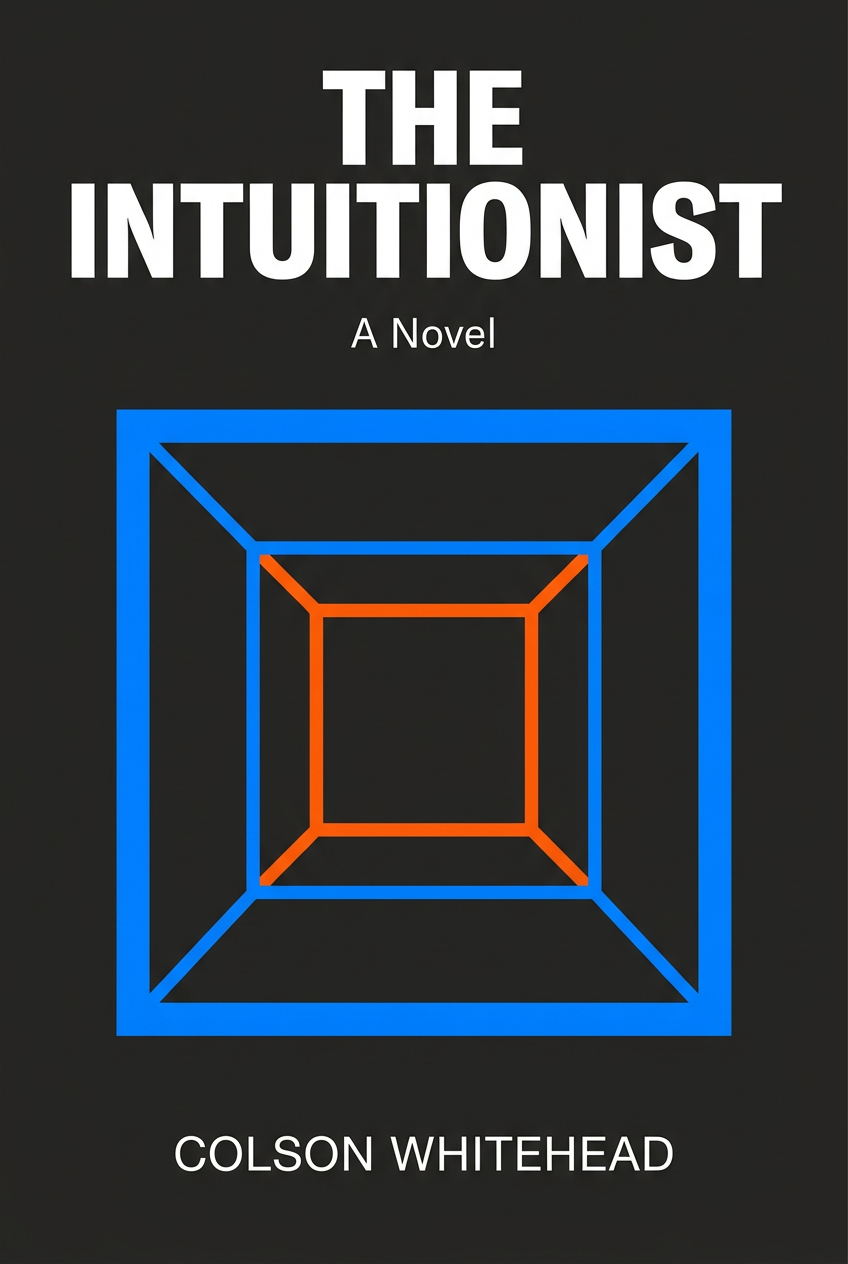
The Intuitionist
A Novel
What's it about
Ever wondered if your gut feelings are more reliable than cold, hard facts? Imagine a world where your intuition isn't just a hunch—it's a proven science. This is the reality for Lila Mae Watson, one of the city's few Black female elevator inspectors. You'll follow Lila Mae as she's thrust into a dangerous mystery after a catastrophic elevator failure threatens her career and reputation. To clear her name, she must navigate a shadowy world of corporate espionage and racial politics, relying solely on her intuitive connection to machines to uncover a conspiracy that could change her city forever.
Meet the author
Colson Whitehead is a two-time Pulitzer Prize winner and a MacArthur Fellow, recognized as one of the most acclaimed American novelists of his generation. A Harvard graduate and a lifelong New Yorker, Whitehead's work masterfully blends genre fiction with social commentary. His unique background and keen eye for the allegorical possibilities within everyday life gave rise to the inventive world of The Intuitionist, his celebrated debut novel that launched a remarkable literary career.
Opens the App Store to download Voxbrief

The Script
Two elevator inspectors are assigned to the same brand-new, top-of-the-line building. One arrives with a heavy satchel of tools: gauges, levels, calipers, and sound detectors. He spends his day meticulously checking tolerances, measuring cable stress, and listening for the telltale hum of perfect mechanical alignment. He trusts his instruments, the numbers, the verifiable data. His report is a testament to objective science. The other inspector arrives with nothing but a small notebook. She rides the elevator up and down, eyes closed, feeling for the slightest shudder, the subtlest dip, the almost imperceptible sway that signals a deeper, hidden flaw. She trusts her body, the lived sensation, the intuitive sense of rightness or wrongness in the machine's soul. When a catastrophic failure occurs, which inspector’s method will be blamed, and which will hold the key to the truth?
The world of these two inspectors, with its rival schools of thought—one grounded in empirical data, the other in felt experience—is the backdrop for Colson Whitehead’s debut novel, The Intuitionist. Whitehead, who would later become a two-time Pulitzer Prize winner, began his career by building this richly imagined, allegorical world. He was fascinated by the idea of creating a secret history, a complete, self-contained universe with its own jargon, politics, and philosophical divides, all hidden within the mundane reality of elevator maintenance. He used this uncanny setting to explore profound questions about progress, tradition, and different ways of knowing, crafting a detective story where the central mystery is which version of reality we choose to trust.
Module 1: Two Competing Realities
The world of The Intuitionist is split by a deep philosophical divide. This conflict is a battle for the soul of the industry and a metaphor for how we decide what is true.
On one side, you have the Empiricists. They are the old guard, the establishment. They believe truth is found in what you can see, measure, and touch. The Empiricist worldview demands that truth be grounded in verifiable, physical evidence. To an Empiricist inspector, a safe elevator is one with no visible stress fractures, perfectly lubricated gears, and meticulously documented maintenance logs. They trust their tools, their eyes, and the rulebook. Anything outside of that is considered nonsense. This is the "data-driven" approach we know so well. It’s logical, systematic, and trusted by the establishment.
But then there's the other side. A newer, more radical school of thought. They are the Intuitionists.
Intuitionists believe that a machine, like an elevator, has an essence, a kind of consciousness. They don’t rely on physical inspection alone. Instead, they feel the elevator's vibrations. They listen to its hum. The Intuitionist method seeks a deeper truth by connecting with the non-physical essence of a system. The protagonist, Lila Mae Watson, is an Intuitionist. When she inspects an elevator, she doesn't just look at the cables. She stands inside, closes her eyes, and waits for an impression. She might visualize a color or a shape—an "aqua-blue cone"—that tells her a specific part is failing. To the Empiricists, this is "voodoo." It’s unscientific and dangerous.
And here's the thing. This conflict isn't just theoretical. It has real-world consequences. The Guild of Elevator Inspectors is a political body, and these two factions are locked in a power struggle. The upcoming election for Guild Chair pits the Empiricist incumbent, Frank Chancre, against an Intuitionist challenger. Every elevator accident becomes a political weapon. Every inspection report is a potential point of attack. This professional rivalry shows how ideological differences are exploited for political and institutional power. When a catastrophic elevator crash happens at the Fanny Briggs Memorial Building—a building Lila Mae recently inspected—Chancre immediately blames Intuitionism. He uses the tragedy to discredit his rivals and consolidate his own power, demonstrating how easily "facts" can be manipulated to serve a narrative. The conflict between Empiricism and Intuitionism, therefore, is a proxy war for control.
Module 2: The Architecture of Corruption
Beneath the surface of this philosophical debate, the novel reveals a system saturated with corruption. The institutions meant to ensure public safety are deeply compromised. Power is about controlling the flow of money and influence, often through criminal means.
The first layer of this is simple, everyday graft. When Lila Mae inspects an elevator, the superintendent tries to bribe her with sixty dollars to ignore a violation. He assumes this is standard practice. He’s shocked when she refuses. This small moment reveals a culture where cutting corners and paying off inspectors is the norm, not the exception. The expectation of corruption is so ingrained that Lila Mae's integrity makes her an anomaly.
Moving up the ladder, we see how this corruption is institutionalized. Political power is maintained through a toxic alliance between industry, government, and organized crime. The Empiricist Guild Chair, Frank Chancre, doesn't just run the Department of Elevator Inspectors. He plays golf with a mobster named Johnny Shush, whose organization controls the city's lucrative elevator maintenance contracts. When Lila Mae starts digging into the Fanny Briggs crash, it’s not Internal Affairs who come after her. It's Shush's thugs. They ransack her apartment as a warning. This reveals that the Guild is a front, intertwined with a criminal enterprise that uses violence to protect its interests.
And it doesn't stop there. Even seemingly progressive actions are revealed to be cynical political maneuvers. Lila Mae, the first colored woman inspector, was assigned the high-profile Fanny Briggs building inspection by Chancre himself. Why? It was a calculated political move. He wanted to appear progressive to court votes from a changing demographic. A note from his assistant confirms it: "Your good service won't be forgotten after the election." This cynical use of tokenism demonstrates how marginalized individuals can be used as pawns in larger power games. Lila Mae's identity was exploited to create a political narrative. When the crash happened, that same identity made her the perfect scapegoat. Chancre could blame both a radical philosophy—Intuitionism—and a marginalized inspector in one fell swoop. The system is designed to protect the powerful at the expense of everyone else.