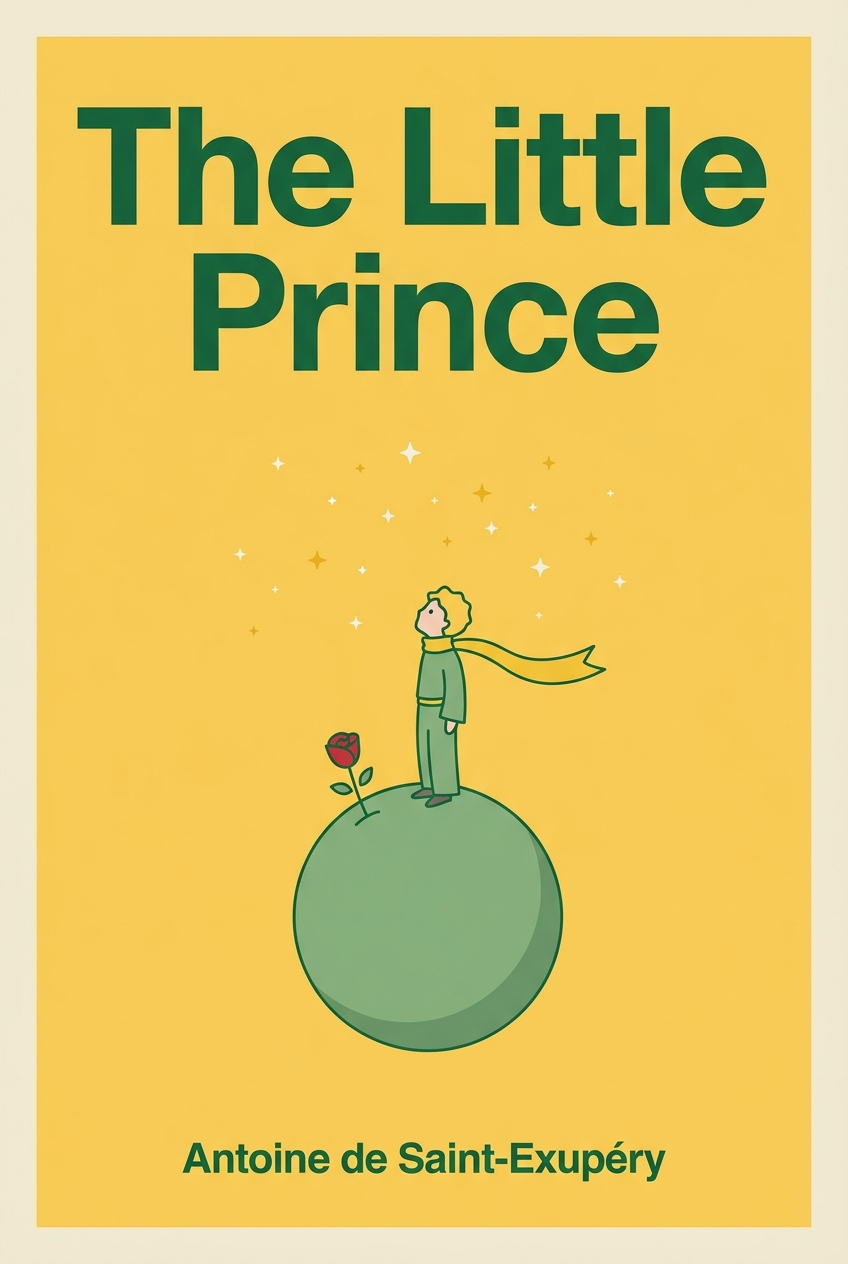
The Little Prince
What's it about
Have you ever felt like you've lost your sense of wonder and imagination in the seriousness of adult life? Rediscover the magic in the everyday and learn why the most important things in life are invisible to the eye. This summary will help you reconnect with your inner child. You'll explore profound lessons on love, loss, and friendship through the allegorical journey of a young prince and a stranded pilot. Uncover the secrets to seeing with your heart, taming what is important to you, and understanding the simple, powerful truths that grown-ups so often forget.
Meet the author
Antoine de Saint-Exupéry was a pioneering French aviator, decorated military pilot, and celebrated author whose experiences flying solo across deserts directly inspired his literary masterpieces. His life as a professional airmail pilot, filled with adventure, isolation, and near-death encounters, gave him a unique perspective on humanity, loneliness, and connection. This profound understanding of the human condition, viewed from the vastness of the sky, is beautifully woven into the timeless philosophical journey of The Little Prince.
Opens the App Store to download Voxbrief

The Script
Two people are given identical, near-perfect telescopes. The first, a professional astronomer, sets it up with practiced efficiency. She calibrates the lenses, aligns the finder scope, and connects it to her laptop, ready to capture data on distant nebulae. The second, a young child, ignores the tripod entirely. He carries the heavy tube out into the backyard, points it clumsily toward the moon, and presses his eye directly against the cold glass. The astronomer sees celestial mechanics, redshift, and the predictable dance of gravity. The child sees a face, a lonely man living on a silver rock, and wonders if he ever gets visitors. One sees the universe as a set of rules to be understood; the other sees it as a story to be entered.
The adult world often feels like that first telescope—a sophisticated instrument for measuring, categorizing, and explaining away the wonder of things. We learn that a drawing of a boa constrictor digesting an elephant is just a hat, that a sunset is merely atmospheric scattering, and that the important matters are things like stock prices and property lines. We forget how to see with the second telescope, the one that finds meaning. This profound sense of loss, of a world made small by grown-up seriousness, haunted a man who spent his life between the clouds and the sand.
Antoine de Saint-Exupéry was a pioneering aviator, a man who navigated by the stars and knew the unforgiving reality of a sputtering engine over the vast emptiness of the Sahara. In 1935, his plane crashed in the desert, leaving him and his co-pilot with only a few days of water and the looming certainty of death. Surrounded by a landscape that was both beautiful and hostile, facing his own mortality, he didn't just survive; he found a story. Years later, drawing on this experience and his feeling of alienation from the pragmatic adult world, he wrote and illustrated a strange and beautiful tale for the child every grown-up has left behind.
Module 1: The Tyranny of "Matters of Consequence"
We begin with a fundamental conflict. It's the clash between two worlds. The world of adults, and the world of children. The author argues that as we grow up, we trade imagination for a narrow definition of practicality.
The narrator, a pilot, shows us this gap early on. As a child, he drew a picture. It showed a boa constrictor digesting an elephant. But every adult saw the same thing. They saw a hat. Their minds were closed to the story inside. They advised him to focus on "serious" subjects. Things like geography, history, and arithmetic. So, he gave up his artistic dreams. He became a pilot. But he never forgot. He carried that drawing with him, a secret test for every adult he met. Their answer was always the same. "That is a hat."
This leads to a powerful insight. Adults mistake quantifiable facts for genuine understanding. When the narrator introduces the little prince, he notes that adults would want to know his age, his weight, his family's income. They believe figures provide knowledge. They would demand a price tag to appreciate a beautiful house. They would not ask about the sound of his voice or the games he loves. This focus on numbers blinds them to the essence of a person or a thing. The Turkish astronomer who discovered the little prince's home, Asteroid B-612, was ignored when he presented his findings in traditional attire. Years later, he gave the same presentation in a European suit. Only then was he taken seriously. Adults, the author suggests, value appearances over substance.
And here's the thing. This obsession with the "serious" creates a deep sense of alienation. The narrator feels he must "bring himself down" to the level of adults. He talks about bridge, golf, and politics. He conforms. He feels disconnected. He lives a lonely life among people who cannot see the elephant inside the snake.
This brings us to the core of the problem. We must distinguish between urgent tasks and what is truly important. The little prince finds the narrator frantically trying to fix his crashed plane in the desert. The narrator is focused on survival. He sees his work as a "matter of consequence." But the prince asks a seemingly trivial question. "Why do flowers have thorns?" The narrator, annoyed, dismisses it. He is busy. The prince becomes furious. He compares the narrator to a "red-faced gentleman" who does nothing but add up figures, a man who has never loved anyone, never looked at a star, and never truly lived. The prince argues that understanding why a unique flower bothers to grow thorns—understanding the battle between the sheep and the flowers—is far more important than a stuck bolt in an engine.
So what happens next? The story reveals the danger of this mindset through the people the prince meets on his journey. There's the businessman, obsessively counting the stars he claims to own. He believes he is a serious man engaged in matters of consequence. His ownership is meaningless. It provides no value to the stars. It brings him no real joy. He is just busy. There's the king, who rules over nothing but issues "reasonable" commands to maintain the illusion of authority. And the conceited man, who only desires applause from an admirer who isn't there. Each character is trapped in a lonely, absurd loop. They are consumed by their own "matters of consequence," blind to the world and to themselves. These self-absorbed pursuits lead to isolation and absurdity. They are rich, powerful, or admired in their own minds. But they are profoundly alone.