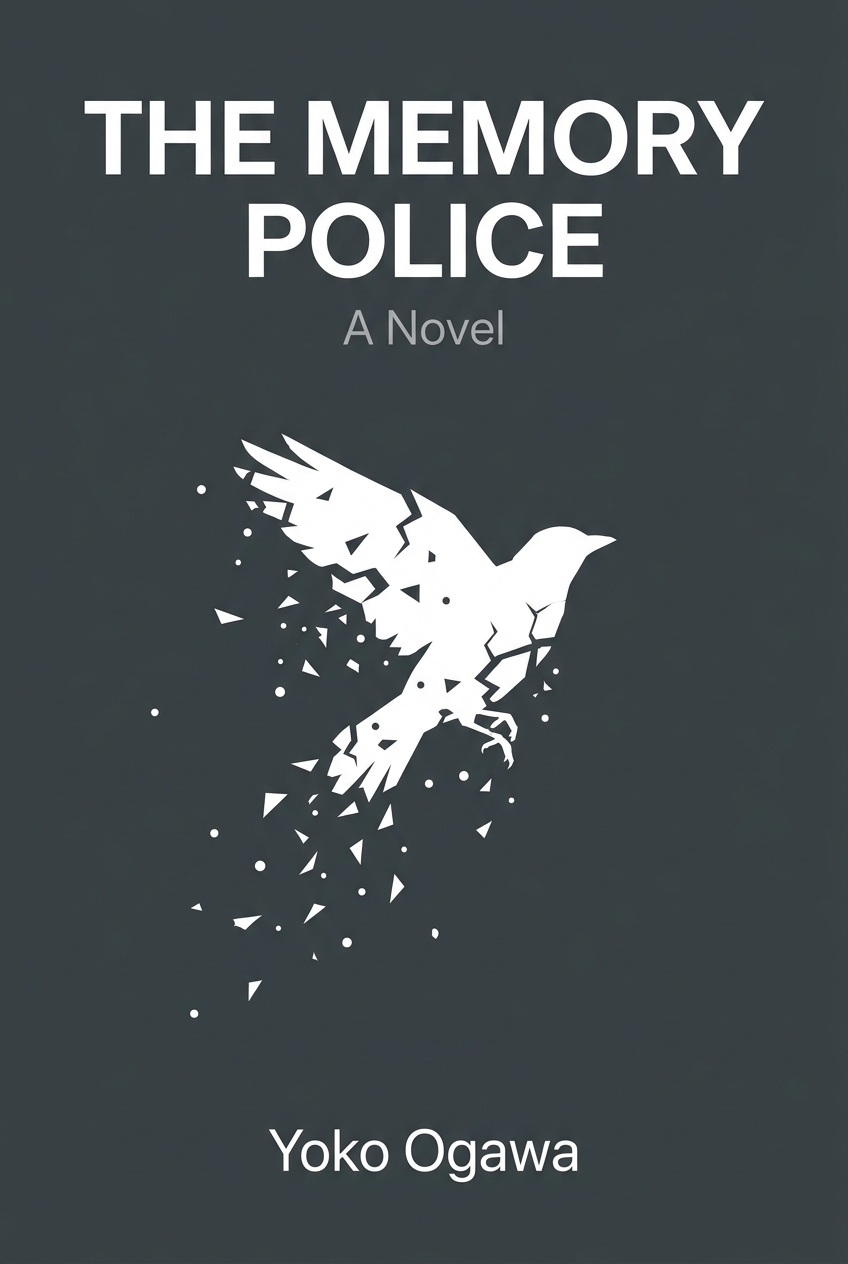
The Memory Police
A Novel
What's it about
What if the things you hold dear—cherished objects, precious memories, even parts of yourself—could simply vanish from the world? On a strange, isolated island, this is reality. Discover how a young novelist fights to preserve what matters when a sinister force erases things one by one. You'll explore the profound power of memory and the quiet terror of forgetting. Learn how the island's inhabitants cope with their disappearing world and see how the novelist risks everything to hide her editor, a man who, unlike others, can't forget. This story challenges you to consider what defines your identity when your past is taken from you.
Meet the author
Yoko Ogawa is one of Japan's most acclaimed contemporary writers, having won every major Japanese literary award, including the prestigious Akutagawa Prize and the Yomiuri Prize. For over thirty years, she has captivated readers by exploring the fragility of memory, the nature of existence, and the quiet horrors lurking within everyday life. Her profound and often surreal storytelling, evident in The Memory Police, delves into the essential human need to preserve what matters most in a world where things mysteriously disappear.
Opens the App Store to download Voxbrief

The Script
Two people are given identical, unorned wooden boxes. One person, a carpenter, immediately begins to analyze the object. She feels the grain, notes the joinery, taps the surface to gauge its resonance, and estimates its weight. The box exists as a collection of physical properties—wood type, dimensions, construction technique. To her, it is a thing to be understood. The other person, a poet, simply holds the box. She doesn't inspect it. Instead, she closes her eyes and feels the subtle shift in the room's gravity now that the box is present. She imagines what it might hold, not in a literal sense, but what stories it could contain, what secrets it might protect. The box is a vessel for meaning, a catalyst for the unseen world of memory and emotion. For the carpenter, the box is defined by what it is. For the poet, it is defined by what it evokes.
Now, what happens when the carpenter's world begins to crumble? What if, one by one, the concepts she uses to define the box—the names of the wood, the techniques of the joinery, the very idea of a hinge—begin to vanish from her mind, and from everyone else's? The box remains, but its physical identity dissolves into a meaningless shape. Only the poet's world, the world of feeling and association, remains. This is the quiet, terrifying space explored by Yoko Ogawa. An acclaimed Japanese author known for her explorations of memory, mathematics, and the fragility of the human heart, Ogawa crafts intimate, unsettling fables that get under the skin of existence itself. With The Memory Police, she wanted to capture the experience of a loss that is both collective and deeply personal—the slow, creeping dread of watching the world and its meaning fade away, one small, forgotten thing at a time.
Module 1: The Quiet Erasure of Reality
The core premise of the novel is a phenomenon known as "disappearances." On the unnamed island where the story is set, objects and concepts periodically vanish from existence. This process is passive and strangely peaceful. One day, people simply wake up with a feeling that something is gone. The physical remnants are gathered and disposed of, often through communal rituals like burning or burying. Then, the collective memory fades until no one can recall what was lost.
This creates a world where the fabric of reality is constantly thinning. The most insidious form of control is the normalization of loss. The islanders don't rebel. They adapt. When hats disappear, the town's milliner calmly becomes an umbrella maker. When ferries are disappeared, the proud ferry mechanic becomes a warehouse guard. The narrator observes that people accept these changes with a quiet, dazed resignation. Complaining is dangerous. It might attract the attention of the Memory Police, the silent enforcers of this new reality. This illustrates a chilling truth about human nature. We can adapt to almost anything, even the gradual dismantling of our world. The disappearances become a part of life's rhythm, an accepted, inevitable subtraction.
This brings us to the Memory Police. They are not depicted as cartoonish villains. They are efficient, bureaucratic, and impersonal. They raid homes in silence, wearing uniforms with simple shapes as badges. Their job is to ensure that the disappearances are complete. They confiscate and destroy any remaining physical evidence of a vanished object, like the narrator's father's research on birds. Systematic erasure requires both collective forgetting and the physical destruction of historical records. The police ransack her father’s office, removing every photograph, note, and document. This act ensures that the memory cannot be reconstructed. It leaves behind what the narrator calls "an emptiness that would not be filled."
And here's the thing. The loss isn't just factual. It’s emotional and sensory. When perfume disappears, the narrator’s mother tries to explain its significance. She holds a bottle to her daughter's nose, but the narrator feels nothing. She can’t comprehend the romantic memories her mother associates with the scent. To her, it's just a smell, no different from chlorine or toast. For those who forget, the entire emotional context of an object is gone. Losing a memory means losing the part of yourself that was shaped by it. This creates a profound chasm between those who remember and those who don't. The emerald becomes just a stone. The stamp, just a piece of paper. The objects are stripped of their cultural and personal meaning, becoming inert artifacts in a world that no longer has a place for them.