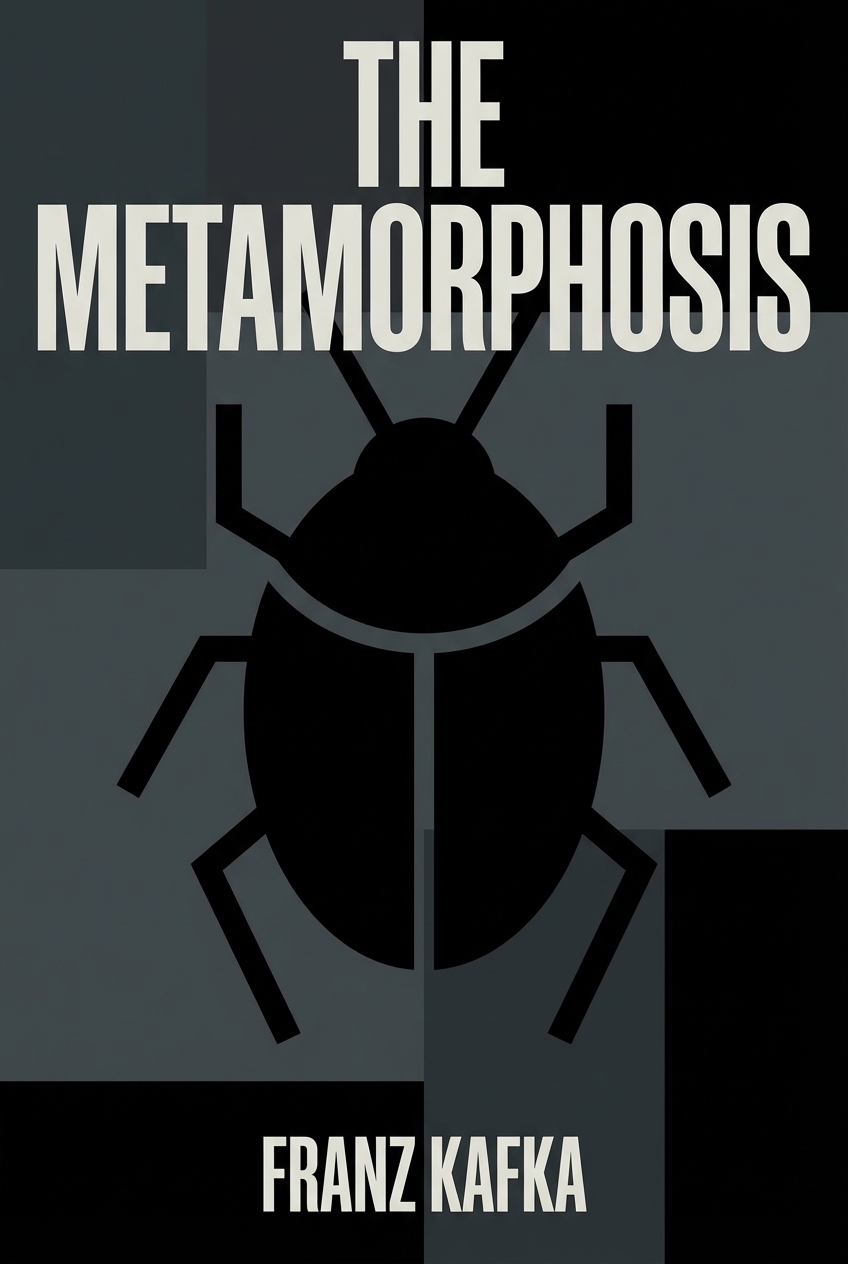
The Metamorphosis
What's it about
Have you ever felt like a burden to your family or trapped by your job? What if one morning, you woke up to find your worst anxieties had become your physical reality? This summary explores the ultimate nightmare of losing your identity and becoming unrecognizable to those you love. You'll discover how one man's shocking transformation into a giant insect exposes the fragile nature of family ties and the cold, transactional reality of human relationships. Learn how this bizarre tale serves as a powerful metaphor for alienation, burnout, and the struggle to find meaning when society deems you useless.
Meet the author
Franz Kafka is widely regarded as one of the most influential writers of the 20th century, whose work explores themes of alienation, bureaucracy, and existential anxiety. A German-speaking Jewish lawyer from Prague, Kafka's own feelings of isolation and powerlessness in a complex world profoundly shaped his unique literary vision. He wrote largely in private, publishing very little during his lifetime, yet his posthumously released stories and novels like The Metamorphosis have left an indelible mark on modern literature.
The Script
We tend to think of disgust as a simple, primal emotion—a biological alarm system triggered by rot, disease, or filth. It’s a feeling to be managed, overcome, or ignored. But this view misses the true power of disgust. It is a profound social and psychological force that draws the lines of our communities. Disgust is the emotion that defines 'us' by defining 'them.' It’s the invisible ink used to write the rules of who belongs and who must be cast out. When we feel disgust toward a person, we are participating in a ritual of exclusion that dehumanizes them, turning them from a person into a problem to be disposed of. This quiet, often unacknowledged, emotion is one of the most powerful tools for social control, capable of justifying neglect and cruelty far more effectively than overt hatred.
This chilling insight into the social power of disgust wasn't born in a sociology lab but in the mind of a German-speaking Jewish insurance clerk in Prague, a man acutely sensitive to the precariousness of belonging. Franz Kafka, working a bureaucratic job by day and wrestling with his literary demons by night, was obsessed with themes of alienation, arbitrary power, and the absurdity of human systems. In 1912, he scribbled a bizarre idea in his diary about a man who inexplicably transforms into a monstrous insect. This became the ultimate thought experiment for exploring what happens when a person suddenly triggers the profound, dehumanizing disgust of their own family. Through the story of Gregor Samsa, Kafka set out to dissect the chillingly normal reactions of the people around him, revealing how quickly the bonds of love and duty dissolve when faced with the intolerable.
Module 1: The Sudden Crisis and the Tyranny of the Mundane
Imagine waking up one day fundamentally changed. Not just sick, but transformed into something unrecognizable. This is Gregor Samsa’s reality. He wakes up as a "horrible vermin." But the truly shocking part is his reaction to it. His first thoughts are about his job. He's worried about missing the 7:15 train. He's anxious about his boss's reaction. He rationalizes his new, squeaky voice as just "the first sign of a serious cold."
This reveals a profound insight. When crisis hits, our minds often cling to routine as a defense mechanism. Gregor’s focus on work is a desperate attempt to maintain control in a situation that is utterly out of his control. He believes if he can just get out of bed, get dressed, and catch the next train, everything will somehow reset. He’s a high-performer programmed for duty. His identity is so fused with his role as a traveling salesman that he cannot process a reality outside of it. For the modern professional, this is a chilling mirror. How much of your identity is tied to your title, your performance metrics, your next deliverable? Kafka suggests that this fusion makes us incredibly fragile.
From this foundation, we see how modern labor can hollow out our humanity. Gregor reflects on his "strenuous career." It's a life of constant travel, bad food, and shallow relationships. He calls it a "curse." He only endures it to pay off his parents' debt. Economic obligation can trap us in dehumanizing cycles, making us cogs in a machine. He would have quit long ago, he thinks, if not for his family. This is a sentence. His value is purely transactional. He provides money, and in return, he receives a place within the family. The moment that transaction is threatened, his position becomes precarious.
This brings us to the arrival of the chief clerk from his office. The clerk doesn't ask if Gregor is okay. He accuses him of poor performance and hints at financial dishonesty. This interaction is critical. It shows that impersonal systems prioritize productivity over people, and they have no language for genuine human suffering. The clerk represents the cold, bureaucratic logic that governs Gregor’s life. He speaks of "business concerns" and "duty," while Gregor is on the other side of the door, trapped in a monstrous body, unable to even communicate his plight. His squeaks and squeals are just noise to the system. The system cannot process his new reality, so it rejects him. For anyone who has ever felt like a case number, a ticket, or a line item on a spreadsheet, this scene is painfully familiar. The institution you serve often has no mechanism to understand you as a human being, especially when you are broken.