All Books
Self-Growth
Business & Career
Health & Wellness
Society & Culture
Money & Finance
Relationships
Science & Tech
Fiction
Topics
Blog
Download on the App Store

The Quartet

Orchestrating the Second American Revolution, 1783-1789

16 minJoseph J. Ellis

What's it about

Ever wonder how the United States truly became a nation? The Articles of Confederation were failing, and the dream of a united country was dying. Discover the untold story of the four political masterminds who orchestrated America's second revolution, saving it from chaos and collapse. You'll learn the secret strategies of George Washington, Alexander Hamilton, John Jay, and James Madison. Uncover how this "Quartet" maneuvered behind the scenes, defied popular opinion, and masterfully shaped the Constitution to forge the strong, centralized government we know today.

Meet the author

Joseph J. Ellis is a Pulitzer Prize-winning historian and one of the nation’s foremost scholars of the American founding, renowned for his insightful and character-driven narratives. His lifelong study of the revolutionary generation provides the unique perspective for The Quartet, revealing how a few key leaders reshaped a fledgling confederacy into a true nation. Ellis masterfully combines deep archival research with a compelling storytelling style to bring the pivotal, and often overlooked, post-revolutionary years to life for a modern audience.
Listen Now

Opens the App Store to download Voxbrief

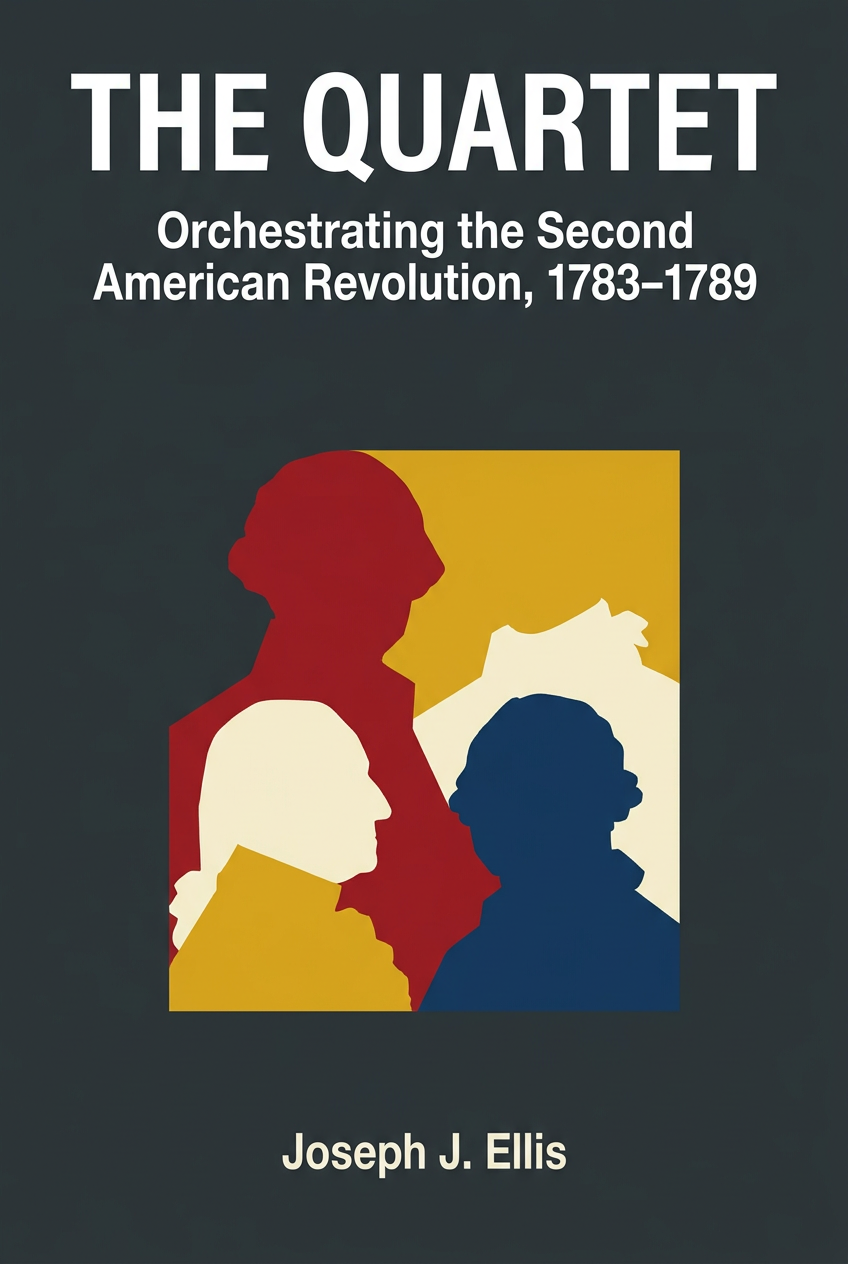
The Quartet book cover

The Script

A successful revolution that fails to create a stable state is a catastrophic act of self-destruction. We tend to view the American Revolution as a single, triumphant arc that concludes with the British surrender at Yorktown. This tidy narrative suggests a natural, almost inevitable progression from colonial rebellion to a unified nation. But this view is a dangerous fiction. The truth is that the war's end in 1783 didn't secure a country; it created a vacuum. The celebrated victory birthed a loose, dysfunctional confederation of thirteen rival states on the verge of splintering into irrelevance or, worse, being reabsorbed by European powers. The real, second revolution was fought with arguments in quiet rooms, and its outcome was far from guaranteed.

The historical blind spot surrounding this precarious period—the 1780s—is precisely what propelled historian Joseph J. Ellis to write this book. A Pulitzer Prize-winning scholar of America's founding generation, Ellis noticed that the most crucial political achievement in American history was being treated as a mere epilogue to the war. He saw that the true challenge was consolidating independence, not just winning it. To uncover this hidden drama, he focused on the four key political figures—George Washington, Alexander Hamilton, John Jay, and James Madison—who recognized the impending national collapse and orchestrated a second, political revolution that culminated in the Constitution. Ellis tells the story of the nation's deliberate, and highly contested, creation from the brink of failure.

Module 1: The First Revolution's Paradox

The American Revolution began with a paradox. It was a movement for independence that explicitly rejected the idea of a strong national government. The colonists had just fought a war against a powerful, distant authority in London. They had no interest in creating another one in Philadelphia.

This leads to the first major insight: The original goal of the Revolution was state sovereignty, not national unity. The Declaration of Independence didn't create the United States of America as we know it. It created thirteen "Free and Independent States." Each state saw itself as a sovereign entity, like a small country. Their first governing document, the Articles of Confederation, reflected this perfectly. It was described as a "firm league of friendship." Think of it as a treaty, like a pre-modern NATO, rather than a constitution. The central government, the Confederation Congress, had very little power. It could request money from the states, but it couldn't tax. It could ask for troops, but it couldn't raise an army on its own.

So what happened next? The system began to fail, which brings us to the second core idea. The Articles of Confederation were designed to be weak, and this weakness nearly cost America the war and the peace. George Washington, as Commander-in-Chief of the Continental Army, experienced this failure firsthand. He sent a constant stream of letters to Congress, a "litany of lamentations," begging for supplies. His soldiers were starving. They lacked shoes, clothes, and pay. Why? Because the states were not meeting their obligations. They prioritized their own local militias and interests. Washington warned that unless Congress was given real power, the entire revolutionary cause was lost. He called the thirteen states a "many-headed Monster."

After the war, things only got worse. The government was bankrupt. It couldn't pay its debts to foreign lenders or its own soldiers. States began to fight with each other over trade and territory. European powers like Britain and Spain circled like vultures, waiting for the young country to fall apart. This chaos is what set the stage for the second revolution—the one fought in the halls of power.

Module 2: The Quartet's Continental Vision

While most Americans were focused on their local towns and states, a small group of leaders had a different perspective. They had served the revolution on a national stage. This experience gave them a unique, "continental" vision. They saw the big picture. This group is the "Quartet" of the book's title: George Washington, Alexander Hamilton, John Jay, and James Madison.

This brings us to a crucial point: The shift to a national government was a top-down, elite-driven project. It was not a popular movement bubbling up from the people. In fact, it went against the prevailing public opinion. Most citizens were happy with the weak central government. They saw any attempt to strengthen it as a betrayal of the Revolution's principles. But the Quartet saw that the "state-based" system was a dead end. It would lead to anarchy and foreign domination.

Now, let's turn to how they pulled it off. Each member of the Quartet played a critical role.
First, there was George Washington. He was the "one-man embodiment" of the revolutionary cause. His reputation was untouchable. Washington's personal legitimacy was the key to making radical change acceptable. When he endorsed the push for a new government, it gave the movement a crucial "veneer of legitimacy." It signaled to the public that this was an effort to rescue the Revolution.

Next, Alexander Hamilton was the engine of nationalist thought. An immigrant from the Caribbean, he had no deep loyalty to any single state. His loyalty was to the idea of America. As a young aide to Washington and later as a delegate to Congress, he was a fierce critic of the Articles. He argued that the fear of a strong government had gone too far, leading to chaos. Hamilton provided the intellectual firepower and relentless drive for a powerful central government. He wrote essays, lobbied politicians, and aligned with the influential financier Robert Morris to argue for a national bank, a national tax, and a strong national credit system. He believed that a shared national debt could bind the states together.

Then, there was John Jay. As the nation's chief diplomat, he saw America's weakness on the world stage. He negotiated the Treaty of Paris, which ended the war and secured a vast western territory. But he also had to negotiate with Spain over control of the Mississippi River. That debate devolved into bitter sectional conflict, with northern and southern states pitted against each other. It showed him that the Confederation Congress was incapable of managing foreign policy or national interests. Jay's diplomatic failures convinced him that only a strong national government could command respect abroad and mediate disputes at home.

Finally, there was James Madison. He was the strategist and the scholar. He was younger than the others, but he became the intellectual architect of the new government. Madison did his homework. He conducted a deep study of history, analyzing why all previous confederacies had failed. He documented the "Vices of the Political System" under the Articles. He arrived at the Constitutional Convention in Philadelphia with a plan already in hand: the Virginia Plan. This plan became the blueprint for the Constitution. Madison's meticulous preparation and strategic thinking set the agenda for the convention and shaped the final document.

So here's what that means for us. These four men, using their unique skills and positions, manipulated the political process. They called for a convention to "revise" the Articles of Confederation, knowing full well their true goal was to replace them entirely.

Read More