All Books
Self-Growth
Business & Career
Health & Wellness
Society & Culture
Money & Finance
Relationships
Science & Tech
Fiction
Topics
Blog
Download on the App Store

The Resilience Factor

7 Keys to Finding Your Inner Strength and Overcoming Life's Hurdles

14 minKaren Reivich

What's it about

Ever wonder why some people bounce back from setbacks while others get stuck? What if you could learn the secret to navigating any challenge with confidence? This summary unlocks the science-backed skills you need to build unshakeable inner strength and turn adversity into your greatest advantage. Discover the seven essential keys to resilience, based on decades of psychological research. You'll learn practical, easy-to-implement techniques to reframe negative thoughts, manage your emotions, and leverage your signature strengths. Start building your resilience factor today and learn to thrive, no matter what life throws your way.

Meet the author

Karen Reivich, Ph.D., is a world-renowned positive psychology expert and the Director of Resilience and Positive Psychology Training Programs at the University of Pennsylvania. Her decades of research on resilience, optimism, and grit form the foundation of her work, providing scientifically-backed strategies to help people overcome adversity. Dr. Reivich translates complex psychological concepts into practical, accessible tools, empowering individuals from soldiers to schoolchildren to build their inner strength and thrive in the face of life's challenges.
Listen Now
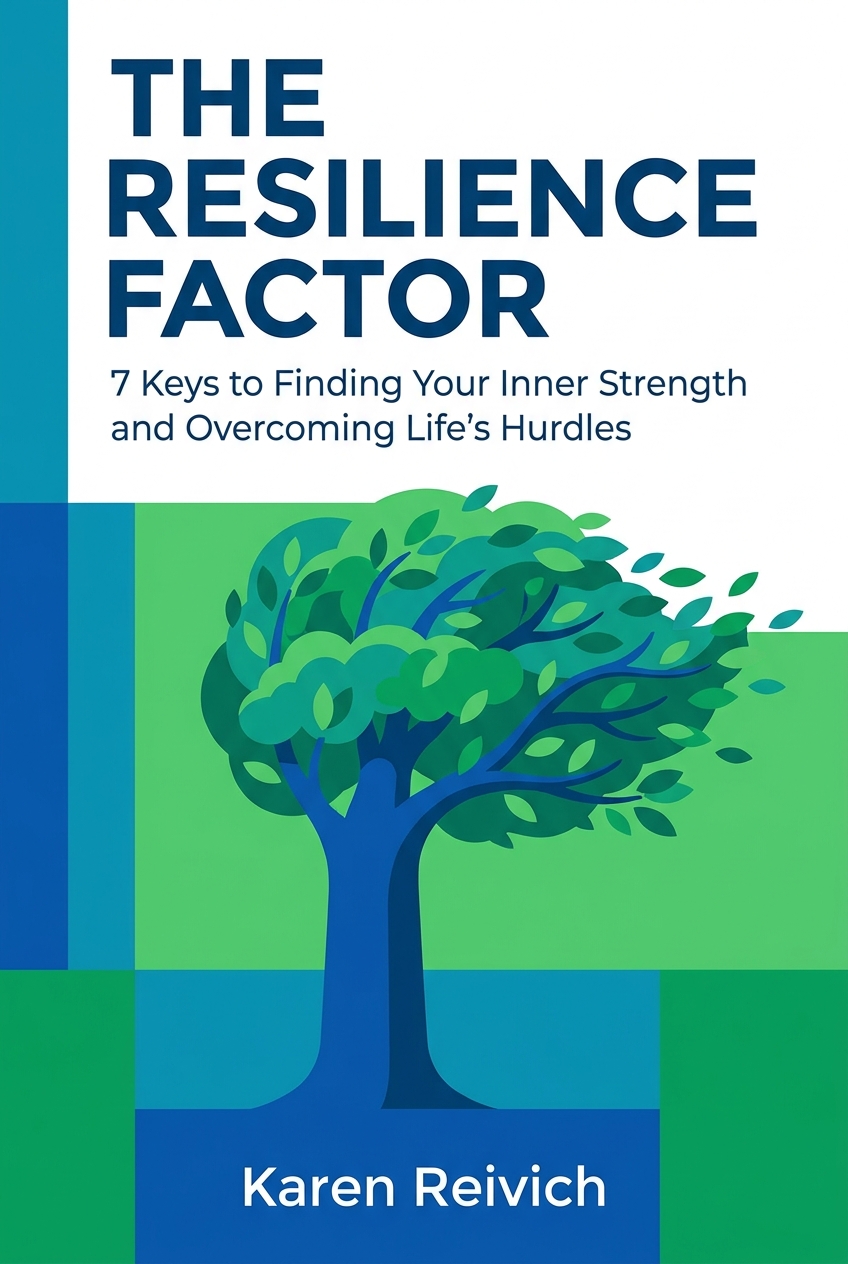
The Resilience Factor book cover

The Script

Two novice sailors are caught in a sudden squall. Their boats are identical, their training from the same school. The first sailor fights the storm. He grips the tiller, muscles straining, cursing the wind and the waves crashing over the bow. Every gust feels like a personal attack; every lurch of the boat, a sign of imminent failure. He’s exhausted, angry, and his boat is taking on water fast. The second sailor, facing the exact same squall, does something different. She works with the wind. She eases the sails, adjusts her course, and uses the swells to her advantage. She still feels the fear, the cold spray, but her thoughts are a quiet, focused checklist: ‘Check the rigging. Watch the next wave. Adjust rudder.’ She sees the storm as a set of problems to be solved, one at a time. Both sailors face the same external reality, but their internal responses create entirely different outcomes. One is sinking, the other is finding a way through.

This difference—the internal dialogue that separates panic from perseverance—is what fascinated psychologist Karen Reivich. For years, as a lead researcher at the University of Pennsylvania's Positive Psychology Center, she saw this pattern everywhere: in military training, in corporate boardrooms, and in schools. She noticed that some people seemed to have an innate ability to weather life’s squalls, while others were swamped by them. But was it innate, or could it be learned? Reivich and her colleagues embarked on groundbreaking research, sponsored by the U.S. Army, to deconstruct this very ability. They wanted to see if the skills of the second sailor—the resilient mindset—could be systematically taught. "The Resilience Factor" is the result of that work, offering the specific cognitive tools they discovered that allow anyone to navigate their own storms by changing how they sail.

Module 1: The Foundation — Your Thinking Style

The central premise of the book is simple but profound. Your thoughts about events determine your feelings. This is the ABC model. A is for Adversity, the event that happens. B is for your Beliefs, the immediate, often unconscious thoughts that run through your mind. And C is for the Consequences, your emotional and behavioral reactions.

Let's use an example. Your boss sends you a one-line email: "Call me as soon as you can." That's the Adversity. If your Belief is, "I'm in trouble, I must have screwed something up," the Consequence will be anxiety and procrastination. But if your Belief is, "She must have an urgent update on the project," the Consequence is focus and prompt action. The event is identical. The outcome is entirely different.

This brings us to the first critical insight: Resilience is built by mastering your internal dialogue. Your "thinking style" is the lens through which you see the world. It’s a set of mental habits that are so automatic, you probably don't even notice them. But these habits directly control your emotional state and your ability to solve problems. Non-resilient people often have automatic thoughts that are self-critical, like "I'm screwing this up," or that deflect responsibility, like "It's not my fault, the market is impossible."

Now, let's turn to the next idea. The book argues that we use resilience in four key ways. We use it to overcome past struggles, to bounce back from major setbacks, and to proactively reach out for a richer life. But for most of us, the most critical application is steering through daily adversity. This is where self-efficacy comes in. True self-confidence is earned through demonstrated competence. The authors are clear: you can't talk yourself into feeling effective. You build self-efficacy, the belief in your ability to solve problems, by actually solving problems. Their approach is about giving you the tools to get small wins, which build a track record of success. As you solve more problems, your belief in your own capability naturally returns.

Read More