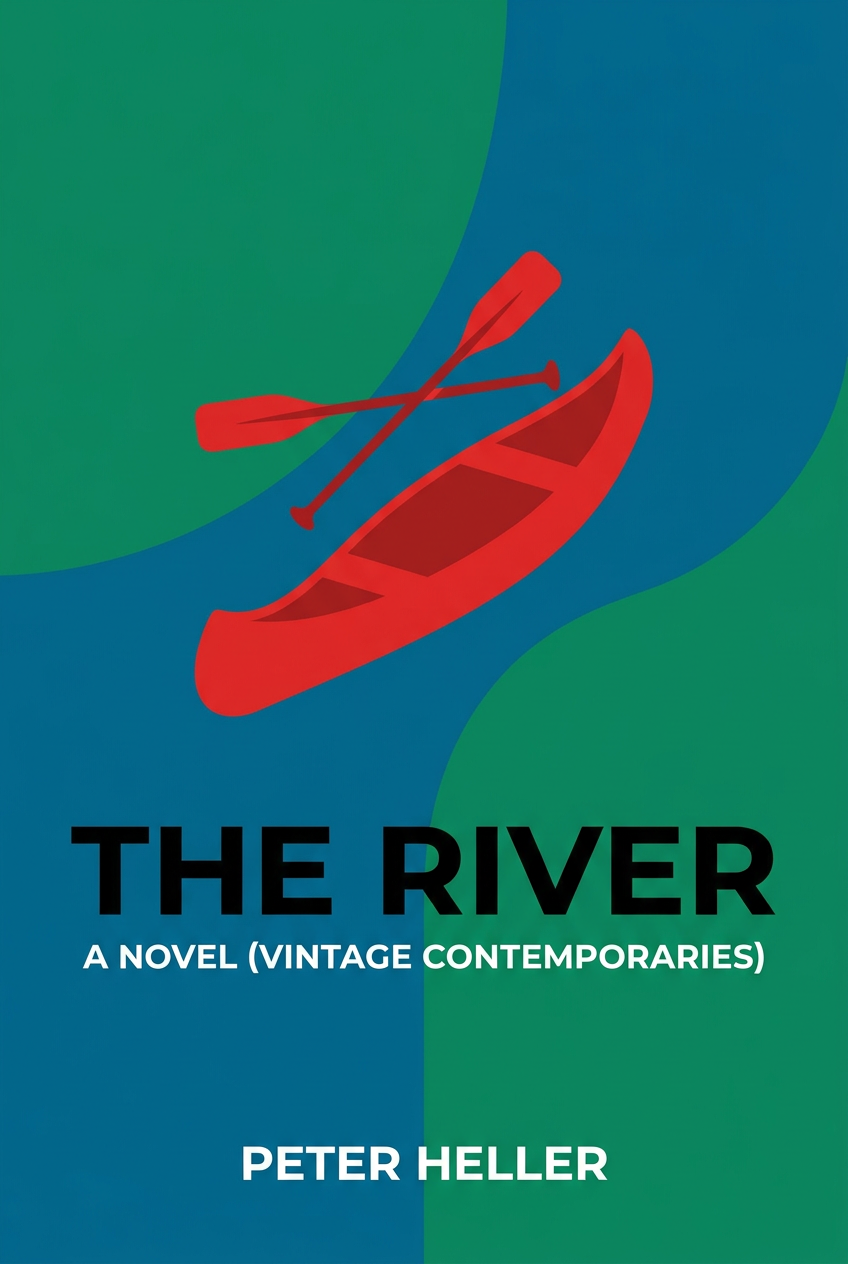
The River
A novel (Vintage Contemporaries)
What's it about
Ever wondered if your closest friendship could survive the ultimate test? Imagine a peaceful canoe trip that suddenly spirals into a desperate fight for survival, where every decision you make could be your last and the person you trust most might be all you have left against a raging wildfire and an even more terrifying human threat. This isn't just a wilderness adventure; it's a deep dive into the heart of loyalty and instinct. You'll discover how two friends navigate a landscape as beautiful as it is deadly, forcing them to confront not only the dangers around them but also the moral lines they're willing to cross for each other when civilization is miles away and a terrible secret floats down the river.
Meet the author
Peter Heller is an award-winning adventure writer and a contributing editor at Outside magazine, Men's Journal, and National Geographic Adventure, renowned for his immersive and authentic storytelling. His extensive experience navigating remote and dangerous rivers, including a first descent of a river in Tibet, directly informs the visceral and gripping narrative of The River. This deep-seated knowledge of the wilderness, combined with his lyrical prose, allows him to explore the profound bonds and hidden dangers that surface when humanity confronts the wild.
Opens the App Store to download Voxbrief

The Script
Two men, each an expert in his craft, stand before the same problem. One holds a set of precision calipers, the other, a lump of beeswax. The problem is a door that won't quite close, a subtle warp in the frame that lets in a whisper of cold air. The first man measures every angle, calculates the torsion, and drafts a plan to re-plane the jamb and reset the hinges. His approach is one of absolute technical correctness, of imposing a perfect solution onto an imperfect world. The second man watches the first, then takes his lump of beeswax and simply rubs it along the sticking point of the frame. He works it into the wood, feeling for the friction, letting the material itself guide his hand. The door closes with a soft click. One man solved the problem; the other coaxed it into solving itself.
This is the quiet tension at the heart of any true partnership in the wild. It’s the difference between knowing the river and listening to it. For two friends on a remote canoe trip, this difference is everything. One paddles with the metronomic precision of a trained athlete, his mind a steel trap of logistics and survival data. The other moves with the current, his senses attuned to the whisper of the wind in the pines and the subtle shift in the water's color. Their bond is forged in this balance. But when a wildfire appears on the horizon, and a woman stumbles out of the woods with a story of violence, their two ways of knowing are put to the ultimate test. The calipers are not enough, and the beeswax may not be either.
The man who so vividly captures this elemental tension is Peter Heller, an author whose own life has been a long negotiation between precision and intuition. A celebrated adventure writer and journalist for publications like Outside magazine and National Geographic Adventure, Heller has spent decades in the world's most remote and dangerous places. He didn't just research the skills of canoeing, fishing, and survival; he lived them. He wrote The River to explore a question that has followed him from river rapids to mountain peaks: when civilization's rules fall away, what truly keeps us alive? Is it the knowledge we carry in our heads, or the older, wilder wisdom we carry in our bones?
Module 1: The Anatomy of Addiction and Codependency
This story begins with a deep dive into the intertwined nature of addiction and codependency. They are two heads of the same beast, feeding off secrecy, shame, and a desperate need for relief.
The author frames addiction as a universal human struggle. Addiction is a survival strategy for unbearable pain. What we call an "addict" is often a highly sensitive person trying to cope with overwhelming feelings. For the author's partner, Rayya, heroin was a buffer she needed to survive a traumatic childhood. This perspective shifts the focus from judgment to compassion. It allows us to see the shared humanity in the search for escape, whether through substances, work, or relationships.
This brings us to the core of the author's own struggle: love addiction. She describes it as a life-or-death process addiction, distinct from substance use but just as deadly. It's a compulsive, insatiable need for external validation, what she calls "LAVA"—Love, Attention, Validation, and Approval. The brain of a love addict overproduces reward hormones, creating a euphoric high that removes all perception of risk. Infatuation becomes a neurological event. The partner becomes a drug. This leads to a predictable cycle. First comes craving. Then, tolerance builds, requiring bigger and bigger "hits" of validation. Finally, when the "supply" is withdrawn, a devastating crash follows, often leading to severe depression or worse.
And here's the thing. This dynamic is supercharged by codependency. The author defines it bluntly: "The belief that by healing them, you will be healed." It’s the certainty that you can get all the love you need by pouring your own into someone else's broken heart. Codependency is a pattern of self-abandonment disguised as care. Initially, it feels like "You complete me!" But it always ends in rage, emptiness, and despair. After her bestselling book Eat Pray Love, the author's codependency manifested as manic generosity. She tried to give away her money to local businesses, a desperate attempt to buy love and approval that ultimately contaminated her relationships. This reveals how even seemingly positive actions can be driven by a deep, unmet need for validation, creating chaos instead of connection.
Module 2: The Perilous Journey of Friendship and Love
The narrative explores the profound, and often dangerous, depths of human connection. It introduces a powerful metaphor for friendship, one that defines the entire story.
Rayya had a framework for her friendships, based on a map of New York City. "Fifth Avenue friends" are superficial. "Alphabet City friends" know your struggles; they're the ones you call from jail. But the deepest bond is an "all the way to the river friend." This is the person who knows everything, who will walk with you through the darkest, ugliest parts of life. True intimacy is measured by your willingness to walk with someone "all the way to the river"—to the absolute end. For the author and Rayya, this was a literal promise. The author promised to walk Rayya to her death, "the river" of mortality.
This journey to the river is never clean. It mirrors the actual East River in New York, a tidal estuary that is both salty and fresh, polluted and unpredictable. It's a "slurry of sewage and plastic" with sunken cars below. This powerfully illustrates that deep love involves navigating the muck. It means enduring the unbeautiful, the painful, and the destructive parts of another person and the relationship itself.
And it doesn't stop there. The book shows how even the most profound love can be entangled with dysfunction. The author's love for Rayya was sincere. It made her a more courageous and kind person. Yet, she admits it was also marked by manipulation and denial. Genuine love and toxic dysfunction can, and often do, coexist. She hid her growing feelings for Rayya from her husband, creating a secret life. Rayya, in turn, hid her drinking, claiming sobriety while secretly consuming Angostura bitters, a mixer with 44.7% alcohol. They lived in a state of shared cognitive dissonance, propping up a distorted reality to protect their emotional needs. This demonstrates a critical insight: secrecy is the greenhouse for addiction. It allows destructive patterns to flourish in the dark, shielded from the light of accountability.