The Road to Character
What's it about
Are you focused on winning a promotion but neglecting to build your inner strength? This summary reveals why prioritizing your character over your career is the true path to a fulfilling life, helping you shift from chasing external success to cultivating internal virtues. Discover the difference between "résumé virtues" and "eulogy virtues." You'll learn how historical figures like Dwight D. Eisenhower and Dorothy Day overcame their weaknesses and built profound moral character. Uncover timeless strategies to develop humility, self-restraint, and a deeper sense of purpose in a world obsessed with achievement.
Meet the author
David Brooks is a distinguished New York Times columnist and bestselling author renowned for his insightful commentary on culture, politics, and the American social fabric. His exploration of character was sparked by a personal realization that society, and he himself, overvalued worldly success while neglecting inner virtues. This journey led him to study historical figures and moral traditions, culminating in his deeply researched and personal quest to understand how we can all build richer inner lives and stronger moral character.
Opens the App Store to download Voxbrief

The Script
In 1995, the great film director Michael Mann released ‘Heat,’ a crime epic famous for putting Al Pacino and Robert De Niro on screen together for the first time. The film’s real power is in the quiet, central scene where these two titans—a driven cop and a master thief—sit across from each other in a diner. They don’t fight. They talk. They recognize in each other a shared, monastic dedication to their respective crafts, a code that isolates them from the rest of the world. Each has achieved the pinnacle of professional success, but they confess a deep personal hollowness. Their lives are, as De Niro’s character puts it, “a shambles.” They are kings of their respective worlds, yet their inner lives are barren. This moment captures a profound modern dilemma: we have become incredibly skilled at building our careers, but we often neglect the person who lives that career.
This tension, the gap between our public accomplishments and our inner moral core, is precisely what fascinated New York Times columnist David Brooks. For years, he observed this pattern in public figures and in himself—a relentless focus on résumé-building at the expense of character-building. Brooks realized that our culture provides a clear playbook for achieving external success but offers very little guidance on how to cultivate humility, grace, and inner depth. He embarked on a deeply personal and intellectual journey, studying the lives of historical figures who weren't just successful, but were profoundly good. He wrote 'The Road to Character' as someone wrestling with his own shortcomings, seeking to understand how we can shift our focus from the virtues that make a great career to the ones that make a great life.
Module 1: The Two Adams and the Crooked Timber
Brooks argues that we all have two competing natures inside us. He borrows a framework from Rabbi Joseph Soloveitchik and calls them Adam I and Adam II.
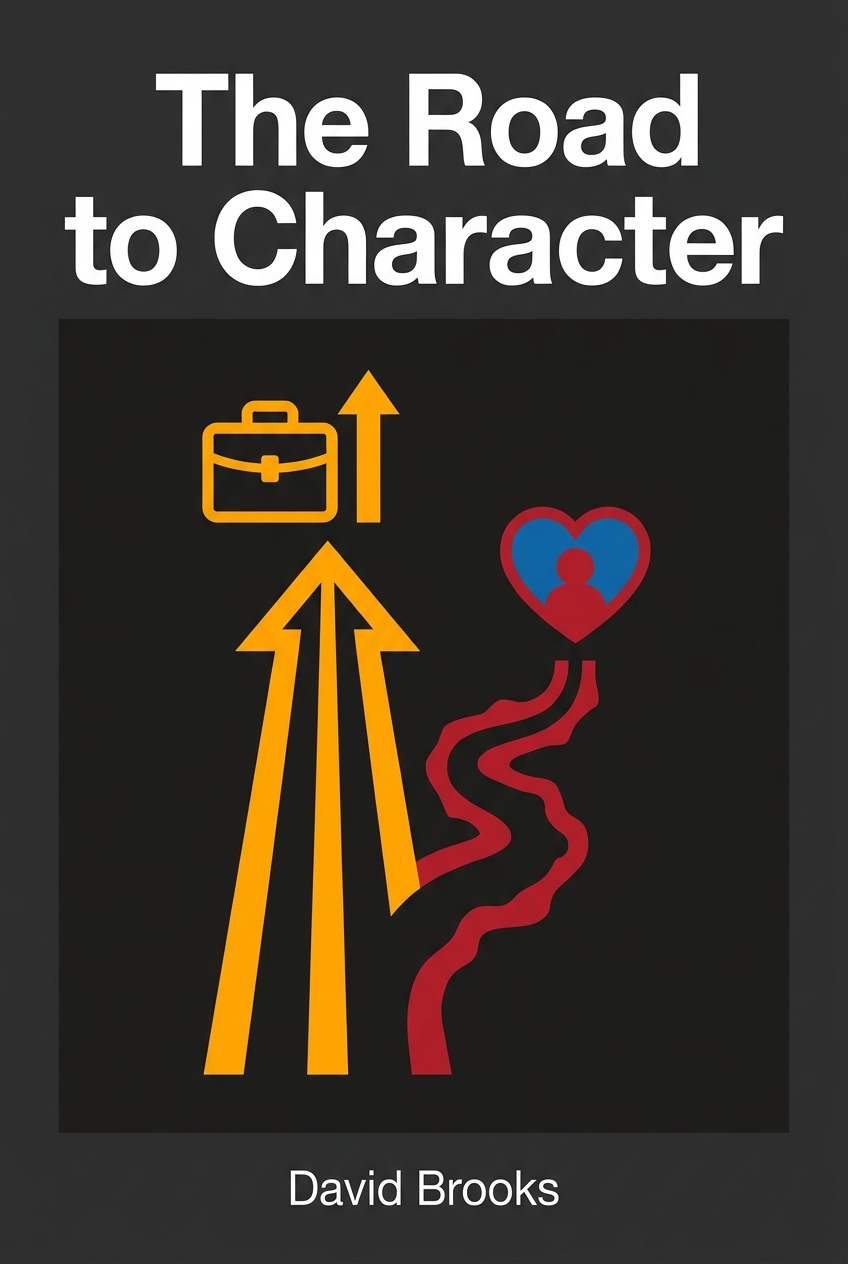
Adam I is the career-driven, external self. The résumé-builder. Adam I wants to conquer the world. He is ambitious, strategic, and creative. He asks, "How do things work?" His logic is economic. Effort leads to reward. This is the Adam our culture celebrates. It's the Adam that thrives in Silicon Valley.
But there's another side. Adam II is the internal, moral self. The eulogy-virtue-builder. Adam II wants to serve the world. He lives for a higher purpose. He asks, "What are we here for?" His logic is moral and often inverse. You must give to receive. You must surrender to gain strength. You must confront your weakness to find your power. The central tragedy of modern life, Brooks suggests, is that we have built a world that nurtures Adam I while starving Adam II.
This leads to a critical insight. Our culture's obsession with self-esteem is a trap. It encourages us to constantly seek validation. To polish our external image. But it leaves our inner core hollow. Brooks contrasts this with an older tradition he calls the "crooked timber" school of thought. This name comes from the philosopher Immanuel Kant. He wrote, "Out of the crooked timber of humanity, no straight thing was ever made." This tradition starts by acknowledging our inherent flaws. We are not perfect. We are selfish. We are proud. We are broken.
And here's the thing. This is a realistic view, and it's the starting point for building real character. The crooked timber tradition says that moral growth comes from confronting your weaknesses head-on. Thomas Merton, a Trappist monk, put it perfectly. He said souls are like athletes. They need worthy opponents to be pushed to their full power. Your flaws are your worthy opponents. The daily struggle against your own selfishness, your own pride, your own laziness—that is the workout that builds character.
So how does this work in practice? Brooks points to a friend who ends each day by reviewing his mistakes. Was I inattentive in a meeting? Did I talk too much, trying to impress someone instead of listening? He doesn't beat himself up. He diagnoses his patterns. Then he develops small strategies to do better the next day. This is the essence of the crooked timber approach. Character is a process of moral formation. It’s built through thousands of small moral actions. It's about winning small victories over the weaknesses in yourself.
So we've established this internal conflict. But how do you choose a path in life that serves your deeper self, Adam II? This brings us to our second module.