All BooksSelf-GrowthBusiness & CareerHealth & WellnessSociety & CultureMoney & FinanceRelationshipsScience & TechFiction
Download on the App Store

The Sacred Mushroom and the Cross

A Study of the Nature and Origins of Christianity Within the Fertility Cults of the Ancient Near East

12 minJohn Marco Allegro

What's it about

What if the story of Jesus was never about a man, but a mushroom? Prepare to have your understanding of Christianity and the Bible completely upended by this explosive theory that connects the New Testament to ancient fertility cults and psychedelic experiences. Dive into the controversial linguistic evidence suggesting that early Christian stories were a secret code for the Amanita muscaria mushroom. You'll uncover how the names, parables, and even the cross itself might be symbols for a powerful hallucinogen used in sacred rituals.

Meet the author

John Marco Allegro was one of the original scholars appointed to decipher the Dead Sea Scrolls, granting him unparalleled access to the earliest Christian-era texts. His unique philological expertise and deep immersion in ancient Semitic languages allowed him to uncover provocative connections between early Christianity and Near Eastern fertility cults. This controversial background led him to challenge conventional history, culminating in his groundbreaking thesis presented in The Sacred Mushroom and the Cross, a work that remains a landmark of dissident scholarship.
Listen Now
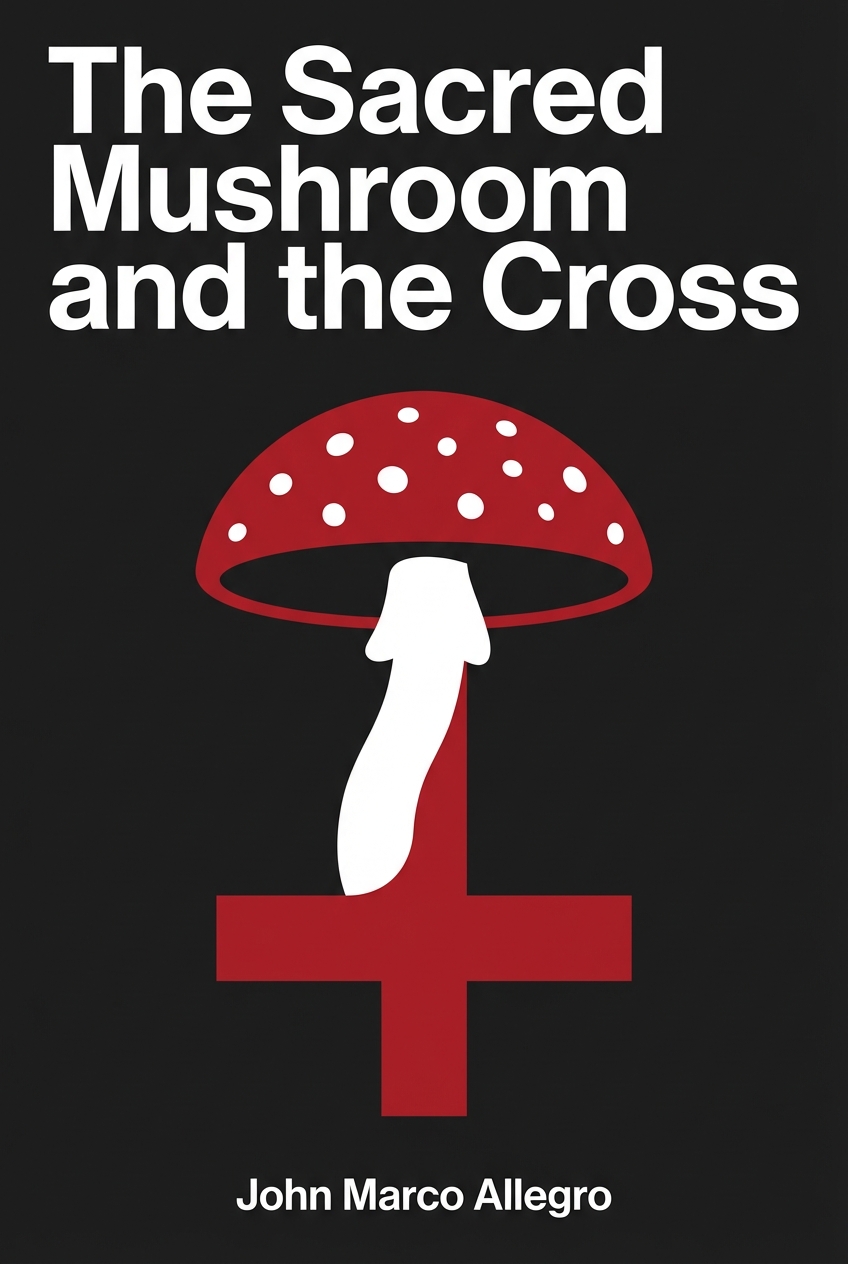
The Sacred Mushroom and the Cross book cover

The Script

We treat language as a neutral tool for describing the world, a simple container for ideas. But what if the words we inherit are artifacts—fossilized clues pointing to a reality so strange we’ve collectively agreed to forget it? Consider the possibility that the most foundational stories of Western civilization are literal, coded descriptions of something far more primal. Imagine that the roots of words, the very building blocks of our most sacred texts, hold a secret history of ecstatic ritual, altered states of consciousness, and a deep, biological connection to the earth itself. This is the suggestion that the most revered spiritual narratives are, in fact, a detailed botanical field guide to a powerful hallucinogen.

This startling re-reading of ancient texts was the life's work of John Marco Allegro, a scholar whose credentials made his conclusions impossible to ignore and equally impossible to accept. As one of the original philologists appointed to decipher the Dead Sea Scrolls, Allegro was a brilliant linguist, a specialist in ancient Semitic languages, and an expert in the etymological roots that connect seemingly disparate cultures. It was his forensic, word-by-word analysis of these ancient manuscripts and biblical texts that led him down a path far from mainstream theology. He was following the literal, linguistic trail left behind by words themselves, convinced they were pointing to a single, explosive origin point for Judaism and Christianity: a fertility cult centered on the sacred mushroom.

Module 1: The Fertility Cult and Its Sacred Fungus

Allegro’s journey begins not in the 1st century AD, but thousands of years earlier. He proposes that at the root of all Near Eastern religion lies a simple, powerful impulse: the desire to understand and influence the forces of life and fertility. Early humans saw the world through a lens of cosmic sexuality. Rain was the semen of a sky god. The earth was a receptive womb. Their survival depended on this cycle, and so their worship was designed to participate in it.

Out of this worldview, Allegro argues, arose a network of fertility cults. The core secret of these cults was the ritual use of a psychoactive mushroom, Amanita muscaria. This specific fungus, with its vibrant red cap and white flecks, was seen as a physical manifestation of the god himself. It grew without seed, appearing magically after a storm. Its phallic shape was a clear replica of the fertility deity. For these cults, the mushroom was the “son of God,” a direct link to divine power. Consuming it was an act of communion that provided ecstatic visions and a glimpse of heaven.

This brings us to a crucial point. The language of religion is built on the physical characteristics of this mushroom. Allegro asserts that ancient names for gods, heroes, and places are descriptive epithets for the fungus. The mushroom's shape was likened to a bolt or a key, giving it names that symbolized its power to unlock the gates of heaven. Its red, spotted cap inspired names related to panthers and precious stones. Its slimy juice was equated with divine semen or spittle, a source of healing and knowledge. The act of anointing with oil, which creates a "Christ" or "Messiah," was a ritual re-enactment of being covered in this sacred, life-giving substance.

So, here's what that means for our understanding of religious history. Judaism and Christianity are evolved forms of this ancient mushroom cult. Allegro isn't suggesting a direct, unbroken line of worship. Instead, he argues that the ideas, the symbols, and most importantly, the language of the mushroom cult were so foundational that they were absorbed and repurposed by later religions. The focus might have shifted from agricultural fertility to spiritual wisdom, but the underlying symbolic structure remained. The Christian concept of God the Father, for instance, is traced back to the pre-Semitic idea of a heavenly penis impregnating Mother Earth. The "Word of God" was the visible "semen" of the storm god—the rain that brings life.

Read More