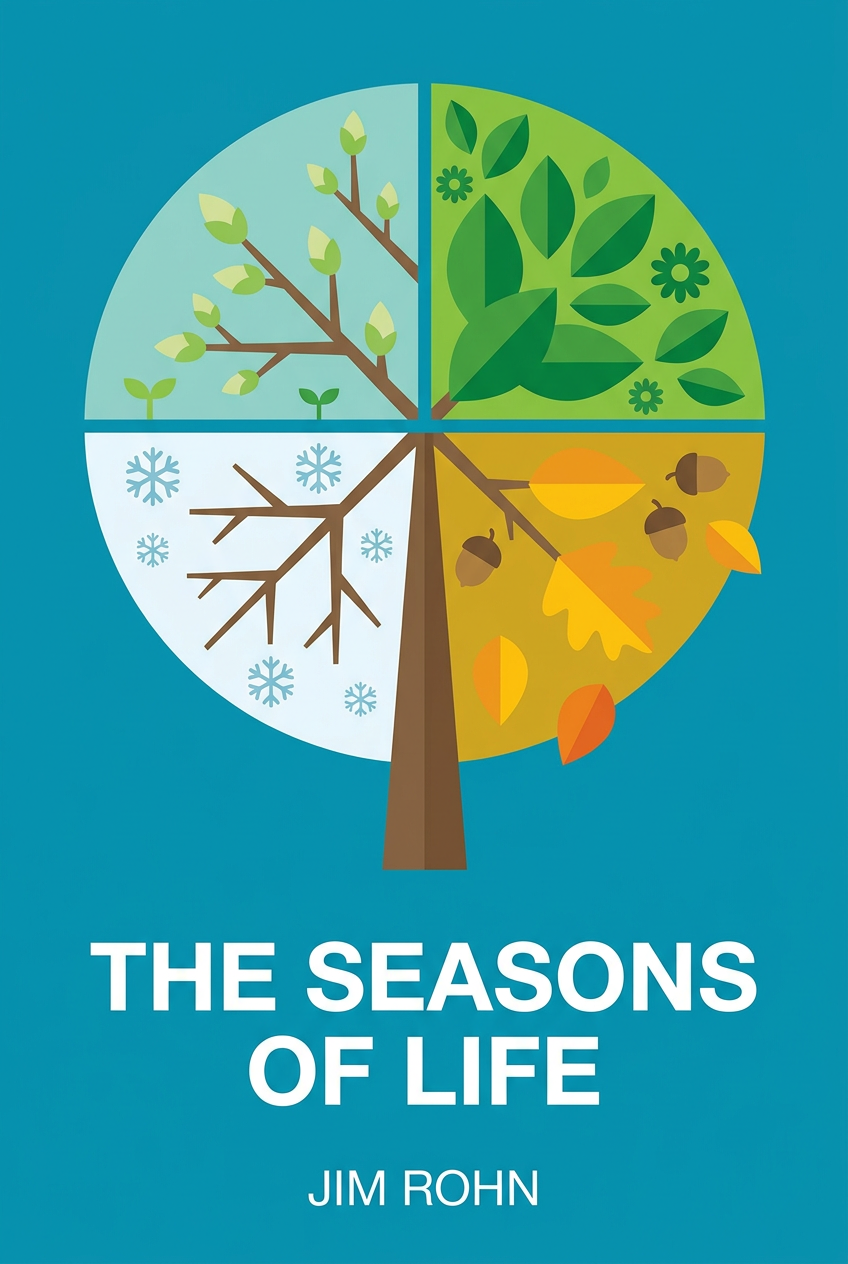
The Seasons of Life
What's it about
Feeling stuck in a rut, wondering why your hard work isn't paying off? What if you could master the natural cycles of success and failure just like a farmer masters the seasons? Learn to plant the right seeds for your future and reap a harvest of abundance. Discover Jim Rohn’s timeless wisdom on navigating life's inevitable ups and downs. This summary reveals how to survive the harsh "winters" of disappointment, diligently work through the "spring" of opportunity, protect your progress in the "summer," and finally enjoy the rewards of your efforts in the "autumn" of achievement. Stop fighting against the current and start flowing with the seasons of life.
Meet the author
Widely regarded as America's foremost business philosopher, Jim Rohn mentored a generation of personal development leaders, including Tony Robbins, and influenced millions worldwide. His journey from a humble Idaho farm boy to a renowned speaker was fueled by a simple yet profound philosophy learned from his mentor Earl Shoaff. Rohn translated these life-changing principles, centered on personal responsibility and seasonal change, into timeless wisdom that continues to inspire audiences to cultivate a life of abundance and achievement.
Opens the App Store to download Voxbrief

The Script
Two farmers stand before identical plots of land at the start of the planting season. Each is given the same high-quality seed, the same sturdy tools, and access to the same water source. The first farmer, eager and optimistic, immediately gets to work. He tills the soil, plants the seeds, and waters them, then steps back, satisfied with his effort, assuming the predictable sun and rain will do the rest. He spends the summer celebrating the coming harvest, making plans for the wealth it will bring. The second farmer, however, understands a deeper truth. He also tills and plants, but he knows that planting is just the beginning. He spends his summer diligently pulling weeds that threaten to choke his young sprouts, building fences to protect them from pests, and continuing to water through the unexpected dry spells. He knows that the season of opportunity is always followed by the season of inevitable difficulty.
When autumn arrives, the first farmer is met with a field of withered stalks and invasive weeds, his potential harvest lost to neglect and unforeseen challenges. He curses his bad luck, the poor quality of the seed, the harshness of the season. The second farmer, however, stands before a field bursting with life, ready for a bountiful harvest. He reaps the rewards not just of his initial planting, but of his sustained effort through the difficult summer. It was this fundamental, agricultural wisdom—the understanding that life unfolds in predictable cycles of opportunity and adversity—that a young Jim Rohn learned while working on a farm in Idaho. He saw firsthand how the laws of nature applied directly to human ambition and potential. After achieving financial independence by age 31, Rohn dedicated his life to teaching this simple but profound philosophy. He wrote "The Seasons of Life" as a return to the foundational principles he observed in the fields: you cannot change the seasons, but you can change yourself and how you prepare for them.
Module 1: The Law of the Sower and the Soil
The foundational idea of the book is that your life is a direct result of what you've planted in the past. This is a law of cause and effect. Rohn argues that we are the sum of our influences. Every book we read, every conversation we have, and every choice we make acts as a seed planted in the soil of our mind.
This brings us to a critical insight. You must actively manage your environment to enable growth. Think of your mind as a garden. Without intentional effort, weeds will grow automatically. These weeds are the negative influences in your life. They can be gossiping colleagues, cynical friends, or even the constant stream of discouraging news. Rohn gives the example of friendships with people who constantly complain. Their pessimism acts like a slow poison, killing your ambition and enthusiasm. You can't expect a healthy harvest if your soil is contaminated. The first step is to start pulling the weeds. This means having the courage to change conversations, end unproductive relationships, and curate the information you consume.
From this foundation, Rohn insists you must take full responsibility for your harvest. It's easy to blame external factors for our lack of progress. We blame the economy, the traffic, or our boss. But Rohn is blunt. A farmer with a barren field can't blame the weather or the soil. Why? Because the farmer chose the seed and the farmer chose the soil. In the same way, an empty bank account or a stalled career is an undeniable confession of ineffective past effort. You are the sower. You are accountable for your results. This is about empowerment. Once you accept this, you gain the power to change your future harvest.
So what happens next? You have to move from defense to offense. Invest your past experiences to build a better future. The past is fixed. You can't change it. Its only value is as a source of intelligence. A business failure is a masterclass in what not to do next. Rohn suggests we need to break off the "rear-view mirror" of life. Dwelling on past mistakes only keeps you anchored to them. Instead, analyze what happened, extract the lesson, and invest that knowledge into your next move. This is how you turn the hard soil of the past into fertile ground for the future.
Module 2: The Urgency of Spring
Now, let's move to the first season: Spring. This is the season of opportunity, and it's where the real work begins. Spring is a brief, fleeting window for intense and immediate action.
The core lesson here is that you must plant the seed when the opportunity appears. Spring doesn't wait. It doesn't care if you're still dwelling on last year's failures or celebrating last year's success. It simply arrives and presents a chance to plant. Rohn warns against being lulled into inactivity by spring's beauty. You might pause to "smell the flowers" for too long, only to find the season has passed and your seeds are still in the bag. For a professional, this means enrolling in that class, having that difficult conversation, or making that career change now. The opportunity won't last forever.
Building on that idea, it's crucial to understand that human effort is the catalyst for spring's potential. The season provides the fertile ground, but it's your discipline and choice that make things grow. Rohn notes that we have free will. We can choose to plant with commitment, or we can choose to rest, make a half-hearted effort, and create excuses for a meager harvest later. He offers a powerful framing: the pain of discipline required to plant in spring weighs ounces, but the pain of regret you'll feel in the fall weighs tons. You have to do the work.
And here's the thing. Planting is hard. There will be obstacles. This is why you must cultivate faith to overcome negativity. Before you can plant seeds in the world, you have to prepare the soil of your own mind. This means removing the rocks of worry and the weeds of doubt. It means ignoring the "bearers of discouraging words" who will tempt you to rest when you should be working. These are the bugs and weeds that will attack your crop. Rohn argues that the essence of springtime is faith woven together with massive human effort. You need both to succeed. You must believe in the harvest to have the strength to plant the seed.
Module 3: The Diligence of Summer
We've covered Spring. Next up: Summer. After the intense labor of spring, summer arrives. This is the season of growth and cultivation. The seeds are in the ground, but the work isn't over. Summer is a time of active protection and nurturing.
The primary lesson of summer is that all good things will be attacked. This is a fundamental law of nature and of life. Once you plant your seeds of effort, the world sends its challenges. Rohn calls them the "weeds, bugs, rocks, and storms" of life. Weeds of doubt will try to choke your confidence. Bugs of discouragement will feed on your enthusiasm. These adversities are nature's qualifying test. They are designed to separate those who are committed from those who are merely interested. Complaining about the unfairness of these challenges is a waste of energy. The weeds will simply laugh. Your job is to protect your crop.
This brings us to another key point. Summer requires active cultivation, not passive enjoyment. It's tempting to relax once you see the first signs of growth. A business starts getting traction. A project is going well. But complacency is the enemy of summer. A business owner enjoying a profitable period must still innovate, manage cash flow, and nurture customer relationships. An athlete at the peak of their career must maintain a rigorous training schedule. If you simply rest on your laurels, you risk losing everything you worked for in the spring. You must constantly tend to your goals, pulling the weeds of distraction and fertilizing your efforts with continued focus.
Finally, summer's abundance creates a new responsibility. This is the season to share your growth and contribute to others. As your crops begin to mature, you have more resources at your disposal—more knowledge, more influence, more capital. Rohn suggests that a true measure of success is using this abundance to help others. A seasoned professional can mentor a junior colleague who is still in their "spring." A successful company can invest in its community. This act of giving is a strategic part of the cycle. By helping others plant their own fields, you strengthen the entire ecosystem and create a legacy that extends far beyond your own harvest.