All Books
Self-Growth
Business & Career
Health & Wellness
Society & Culture
Money & Finance
Relationships
Science & Tech
Fiction
Topics
Blog
Download on the App Store

The Silo Series Boxed Set

Wool, Shift, Dust, and Silo Stories

13 minHugh Howey

What's it about

What if the last remnants of humanity were living a lie? In a vast underground silo, you're told the outside world is toxic and deadly. But when the sheriff breaks the ultimate taboo—going outside—you'll discover the terrifying truth is far more complex than you ever imagined. This complete collection takes you from the silo's mysterious origins to its explosive future. You'll uncover the secrets behind the uprising, the shocking history of the architects who built the silos, and the fate of those brave enough to question their reality and fight for freedom.

Meet the author

Hugh Howey is the New York Times bestselling author whose self-published phenomenon, Wool, became a global sensation and inspired the hit Apple TV+ series, Silo. A former yacht captain who lived at sea for years, Howey wrote his breakout novel during early morning hours while working in a bookstore. His journey from indie author to international success story proves the power of a single, compelling idea, much like the ones his characters fight for within their own confined world.
Listen Now

Opens the App Store to download Voxbrief

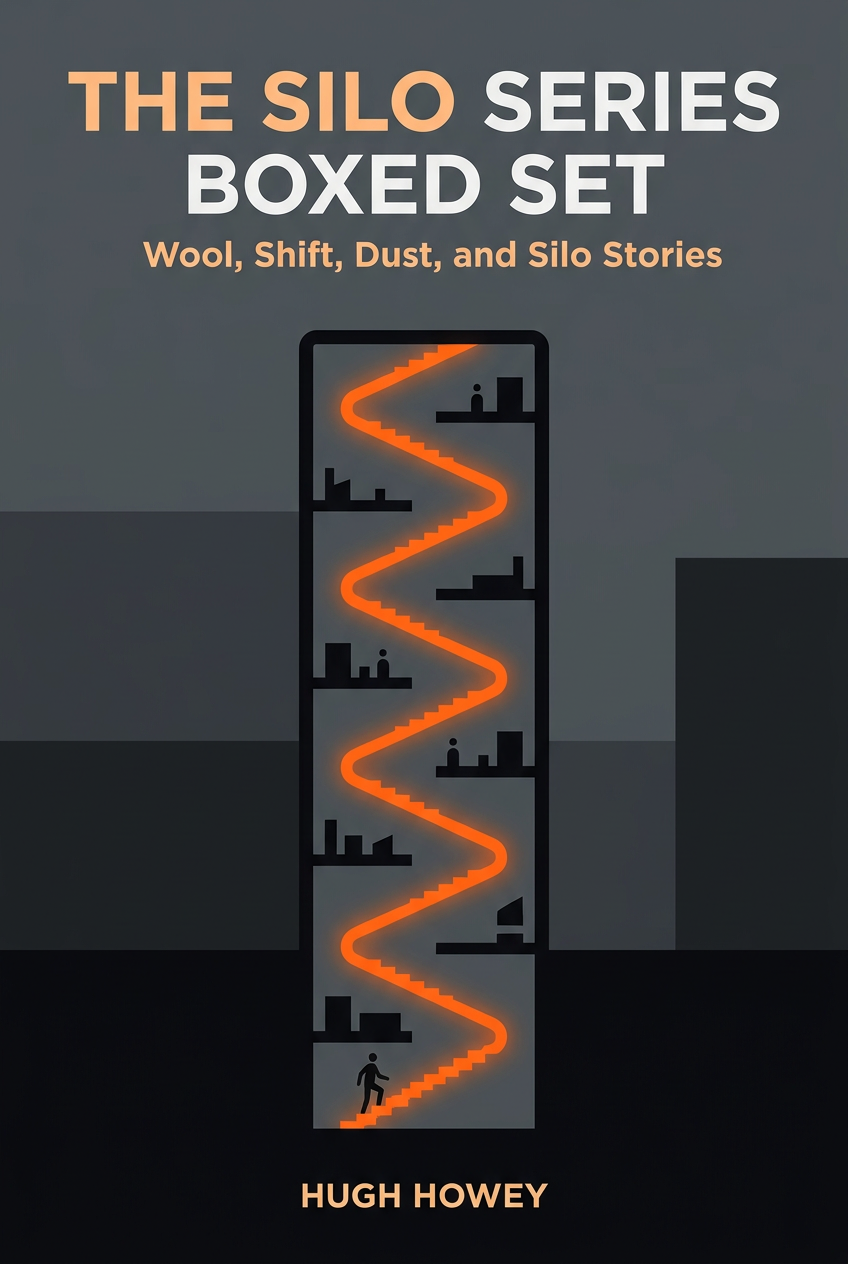
The Silo Series Boxed Set book cover

The Script

The ship’s janitor knows things the captain doesn't. He knows the ship’s true condition. He feels the subtle shudder in the deck plates that precedes a bearing failure. He smells the faint, acrid tang of an electrical short long before any alarm sounds. While the bridge crew studies pristine readouts showing a perfectly functioning vessel, the janitor is tightening a loose bolt on a rattling pipe deep in the engine room, a pipe that doesn't officially exist on any schematic but whose vibration tells the story of the ship’s real, lived-in history. The official story is one of flawless engineering; the janitor’s story is one of constant, quiet, necessary repair.

This gap between the official, clean narrative and the messy, vital truth is the world of the Silo. The people inside know only the story they’ve been told: the world outside is toxic, the silo is their salvation, and to question the rules is to invite disaster. But what happens when someone starts noticing the rattling pipes? What happens when a sheriff is asked to polish a lens that shows a beautiful, thriving world, just for a moment, before the familiar toxic wasteland returns? These are the questions that began to obsess a former yacht captain and boat cleaner named Hugh Howey. While working a day job in a bookstore, he started writing a short story about this janitor’s-eye-view of a society sealed off from its own history, exploring what happens when the official story begins to fray. That short story, originally self-published, became the explosive first part of a series that would redefine a genre.

Module 1: The Architecture of Control

The world of Silo is built on a simple, terrifying premise: humanity lives in a massive underground silo, 144 stories deep. The outside world is toxic, a wasteland of gray hills and poisonous air. This "truth" is enforced by a single, blurry view projected onto a massive wallscreen in the cafeteria. The silo's physical structure is a masterpiece of social engineering.

The first critical insight is that the environment is designed to enforce conformity and suppress curiosity. The silo's very architecture—a single, grueling spiral staircase—discourages travel between levels. This physical separation creates social stratification. The "Up Top" administrators are disconnected from the "Down Deep" mechanics. This is a deliberate feature. When people are isolated in their roles and levels, they are less likely to question the bigger picture. The silo is a carefully calibrated prison where the walls are made of routine and distance.

From this foundation, we see how this control is maintained. The society uses ritualized punishment to reinforce its core beliefs. The ultimate crime in the silo is to say the words, "I want to go outside." The punishment is "cleaning." The condemned is put in a protective suit and sent out to clean the external camera sensors before succumbing to the toxic air. This public spectacle serves a dual purpose. It refreshes the community's only view of the outside, and it brutally reinforces the narrative that the outside means death. The ritual is so ingrained that the condemned almost always clean the sensors, a puzzling act of compliance that haunts the silo's inhabitants.

But here’s the thing. The system isn't perfect. Cracks in the official narrative are the seeds of rebellion. A young IT worker named Allison discovers that the silo’s historical records have been deliberately wiped. The official story is that rebels destroyed the records during a past uprising. Allison theorizes that the authorities themselves wiped the data to break a cycle of generational rebellion. What if the truth wasn't what they were told? This singular doubt is so dangerous that it leads her to question everything, ultimately resulting in her "cleaning." Her husband, Sheriff Holston, is left to grapple with her discovery, setting the entire story in motion.

Finally, this module reveals a profound truth about human nature. Even in a world of total control, the desire for a better reality can't be extinguished. Characters find themselves drawn to forbidden artifacts from the past—children’s books with pictures of blue skies, green grass, and colorful animals. These vibrant images feel more real, more true, than the gray, blurry world on the wallscreen. This innate yearning for something more is the spark that drives individuals to risk everything. It suggests that no system of control can completely erase the human spirit's demand for truth and beauty.

Module 2: The Unraveling—Truth, Lies, and Leadership

Now, let's turn to how this tightly controlled world begins to fall apart. The second module of the series explores what happens when the official truth is challenged, not by a single person's doubt, but by irrefutable evidence.

The central discovery is staggering: the world presented to the silo's inhabitants is a layered, technological deception. When Sheriff Holston follows his wife outside, his helmet visor displays a beautiful, vibrant world—green grass, blue skies, soaring birds. This is the "reward" for cleaning. It’s a final, beautiful lie designed to motivate the condemned to wipe the sensors for those still inside. But it’s just a projection. The real world outside the visor is just as toxic and dead as the silo's wallscreen shows. However, the wallscreen itself is also a lie. It's a digitally altered feed. The real world is toxic, but the view on the screen is manipulated to look even worse, to remove any signs of life or hope. This multi-layered deception—a lie within a lie—is the ultimate tool of control.

This brings us to a crucial point about power. Authority is maintained by a small, secretive group that weaponizes information. The IT department, led by the calculating Bernard Holland, holds the keys to this deception. They are the architects of reality. They control what people see and, therefore, what people believe. But even their control is not absolute. They operate based on "the Pact," a set of rigid, ancient rules they themselves may not fully understand. Their power comes from being the guardians of a system, not necessarily its masters. This creates a tense dynamic where they must suppress any threat to the established order with ruthless efficiency, because a single crack could bring the whole structure down.

And here's the thing about a system built on lies. When the truth emerges, it forces leaders to choose between order and morality. Mayor Jahns, a decent leader burdened by her duties, travels down to the depths of the silo to find a new sheriff. She chooses Juliette, a brilliant and stubborn mechanic from the "Down Deep." Juliette is an outsider. She doesn't trust the "Up Top" authorities and is driven by a practical, truth-seeking mindset. Her appointment is a direct threat to the established order. Bernard and IT see her as a variable they can't control. This sets up the core conflict of the story: the clash between a leader who wants to maintain a fragile, deceptive peace and a new leader who is determined to uncover the truth, no matter the cost.

This dynamic reveals a powerful lesson about leadership. The most effective leaders are often those driven by competence and a sense of duty. Juliette has no interest in being sheriff. She accepts the role only because she sees the silo as a complex machine that is breaking down. Her motivation is to fix it. This contrasts sharply with Bernard, who is focused on preserving his own power and the stability of the system. Juliette’s reluctance to lead is precisely what makes her the right person for the job. She is motivated by solving problems, not by maintaining status.

Read More