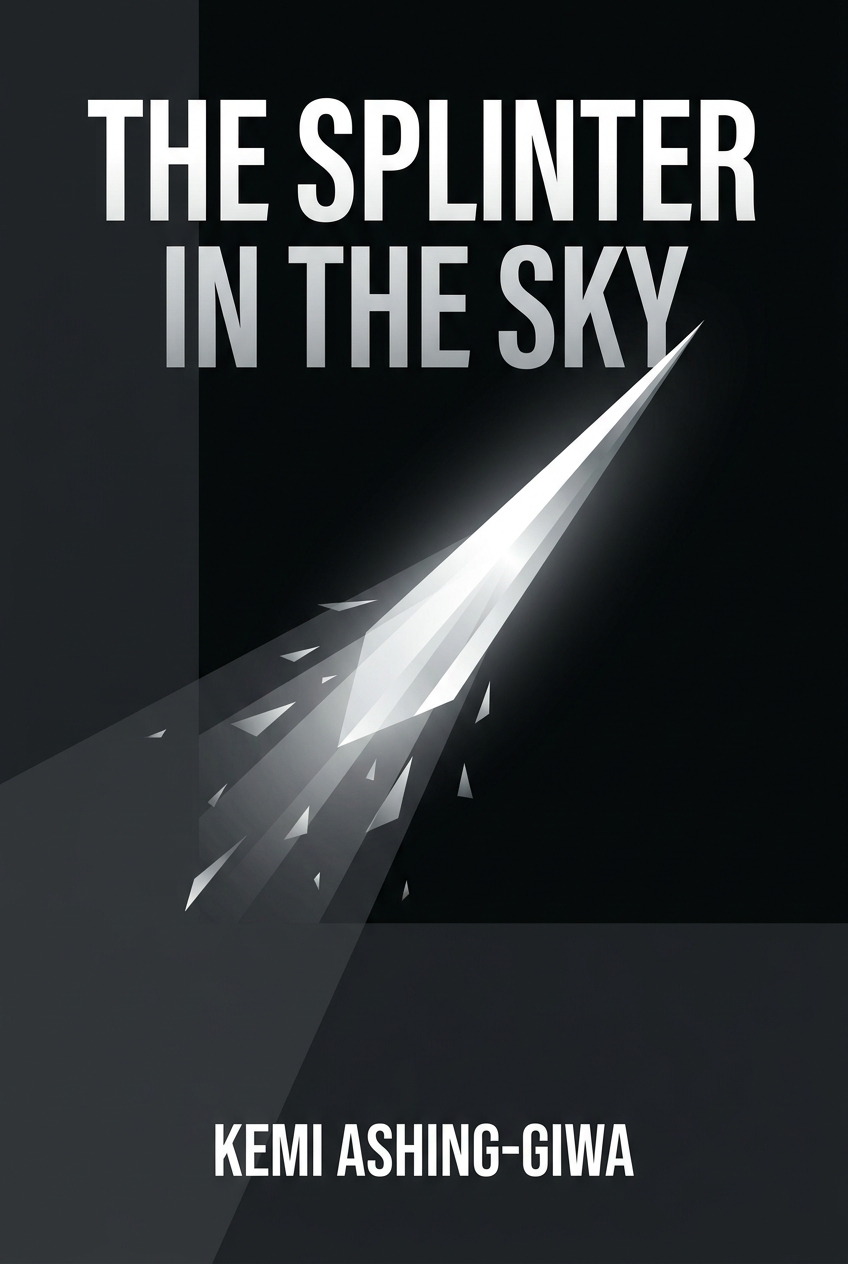
The Splinter in the Sky
What's it about
What if the only way to save your people was to betray them? Get ready to navigate a universe of political intrigue and rebellion, where you'll learn the high-stakes game of espionage from a young scribe turned reluctant spy. See how one person's loyalty is tested when caught between a crumbling empire and a desperate fight for freedom. Discover the secrets of survival and resistance in a hostile galaxy. You'll explore how to leverage knowledge as a weapon, build alliances in the shadows, and make impossible choices when love and duty collide. Uncover the strategies needed to spark a revolution from within, even if it means sacrificing everything you hold dear.
Meet the author
Kemi Ashing-Giwa is a biology student at Harvard University whose research on West African empires and climate change directly inspired her acclaimed debut novel, The Splinter in the Sky. Her unique academic background in both the sciences and humanities allows her to build intricate, politically charged worlds grounded in real-world history and ecological principles. This fusion of disciplines informs her powerful storytelling, exploring themes of colonialism, identity, and survival through the lens of speculative fiction.
Opens the App Store to download Voxbrief

The Script
Two scribes are given the exact same ink, the exact same brush, and a single, perfect sheet of papyrus. They are tasked with documenting a glorious imperial victory. The first scribe, trained in the capital's finest academies, dips his brush and begins to paint the official history. His strokes are clean and confident, depicting the emperor's wisdom, the general's valor, and the enemy's inevitable defeat. His finished work is a masterpiece of propaganda, a story of righteous conquest fit for the imperial archives.
The second scribe, however, comes from a conquered province. The ink feels foreign in her hand, the brush a clumsy tool of a foreign power, the papyrus a stark white that erases the memory of her own people's paper-making traditions. As she paints, she records the same events, but her brushwork reveals the things the first scribe left out: the tremor in a soldier's hand, the hollow look in a prisoner's eyes, the smell of ash that lingers long after the victory celebrations end. Her finished work, to a casual observer, looks identical to the first. But to someone who knows how to look, it is a secret history, a story of survival whispered between the lines of a conqueror's tale.
This subtle act of resistance, of embedding a personal truth within an official narrative, is the puzzle that drove Kemi Ashing-Giwa to write The Splinter in the Sky. As a student of public policy and a lifelong reader of science fiction, she was fascinated by the ways empires attempt to erase the cultures they conquer, not just with armies, but with stories. Ashing-Giwa wanted to explore what it means to be the one chosen to write that story, to be handed the oppressor’s pen and tasked with chronicling your own people’s subjugation. The result is a deeply personal look at the quiet rebellions and impossible choices that define life under the shadow of a monolithic power.
Module 1: The Architecture of Oppression
The story introduces us to a world where oppression is built into the very architecture of society. The Vaalbaran Empire has annexed Koriko, the home of our protagonist, Enitan. This is a complete cultural overwriting.
The first insight here is that systemic oppression works by making the native culture irrelevant or inaccessible. Xiang, Enitan’s sibling, is an aspiring architect. They want to study traditional Korikese design. But the local university now only teaches one style: Vaalbaran. The curriculum is filled with how to build the massive, intimidating monoliths favored by the Empire. To study their own heritage, Xiang would have to apply to an Imperial university. There, they would be segregated into "ancillary schools," taught in a simplified provincial language, Akyesi, because the Vaalbaran tongue is considered too pure for outsiders. The system offers a path to advancement, but the price is assimilation and humiliation.
This leads to a chilling realization. Oppressive systems often mask their cruelty with a veneer of meritocracy. The Empire’s university entrance exams are supposedly "perfectly meritocratic." But this fairness only applies if you can afford top-tier Imperial tutors and rare textbooks. It’s a classic Silicon Valley problem scaled up to a galactic level. Access to opportunity is gated by economic and cultural capital. For provincial applicants like Xiang, there’s another catch: a surprise essay. They must critique a design that appears flawless. Enitan suspects the test is "impossible on purpose." It's designed to filter out those who weren't groomed for success from birth.
And here’s the thing. Even when you play by the rules, the system finds ways to remind you of your place. Small acts of cultural preservation become a form of quiet defiance. Enitan is a tea specialist. She notes that her tea traditions remain "untainted" only because the Vaalbarans happen to appreciate good tea. The natural beauty of their gas giant, Jilessa, is preserved only because Imperial technology isn't advanced enough to destroy it. Every small joy, every piece of enduring culture, exists by the grace of the Empire’s whims or its technological limits. It’s a constant, suffocating reminder of who holds the power. This forces characters to find meaning in the simple, shared ritual of a cup of tea on a rooftop, a quiet space carved out of a hostile world.
Module 2: The Psychology of Survival
We've seen the system. Now, let's explore how you survive it. The book masterfully shows that survival is about psychological warfare, both with the oppressor and with yourself.
The core principle is this: in a hostile environment, emotional control is a primary weapon. When Enitan’s sibling, Xiang, disappears, she finds a bloodstain in their home. Her first instinct is a rising cry of despair. But she grinds it "to dust between her teeth." She knows she doesn't have the luxury of emotion. In a world where provincial subjects vanish without a trace, panic is a death sentence. This is a calculated, strategic suppression of emotion to enable clear-headed action. You can't afford to break down when you need to be breaking in.
Building on that idea, the narrative shows that survival demands leveraging the oppressor's blind spots and prejudices. Enitan secures an audience with the provisional governor, Ajana, because the Imperial sentinels recognize her. They know her as "Lady Ajana’s tea specialist." Her proximity to power gives her a temporary, fragile shield. Later, in the heart of the Empire, she is recruited as a spy for a rival power, Ominira. Why? Because the Vaalbaran court sees her as an "unenlightened savage." No one would suspect her of espionage. Her perceived inferiority becomes her greatest camouflage. She learns to perform the role they expect—docile, harmless, and simple—while gathering intelligence that could bring the Empire to its knees.
But this constant performance takes a toll. That brings us to a tough lesson. You must weaponize your oppressor's language and culture against them. Enitan is a scribe, fluent in both her native Akyesi and the Imperial language, Orin. The Vaalbarans see learning Akyesi as debasing, so they need intermediaries like her. A monk protests her role, calling her "a desecration walking," unfit to handle their "divine script." Yet, when Enitan confronts a high-ranking official who dismisses her people as subhuman, she switches from Akyesi to flawless, accentless Orin. The official is stunned into silence. By mastering the very tool of cultural dominance, she shatters his prejudice and seizes control of the interaction. This is subversion.
So what happens next? This constant battle for survival creates deep internal conflicts. You start to see how even your personal passions become sites of resistance and identity. Enitan's tea craft is more than a hobby. She calls it "something untouched by Vaalbara." It's a space of autonomy, a piece of her culture she can cultivate and control. In a world that tries to strip everything away, holding onto one pure, uncorrupted thing becomes an act of profound defiance.