All Books
Self-Growth
Business & Career
Health & Wellness
Society & Culture
Money & Finance
Relationships
Science & Tech
Fiction
Topics
Blog
Download on the App Store

The True Measure of a Man

How Perception of Success, Achievement & Recognition Fail Men in Difficult Times

15 minRichard E. Simmons III

What's it about

Are you chasing a version of success that always feels out of reach? Discover how society's definition of achievement sets men up for failure and find a more fulfilling path. This summary reveals why tying your worth to wealth, status, and recognition is a losing game, especially when life gets tough. You'll learn how to break free from the pressure of external validation and build your identity on a stronger foundation. Explore a timeless, faith-based perspective on true significance that offers lasting peace and purpose, no matter your circumstances. Redefine what it means to be a truly successful man.

Meet the author

Richard E. Simmons III is the founder and executive director of The Center for Executive Leadership, a not-for-profit ministry focused on helping men navigate life's challenges. After achieving significant success in the corporate world, he recognized a deep need for men to find their worth beyond worldly metrics of achievement and recognition. His work is dedicated to providing a more durable, faith-based framework for identity and purpose, especially during difficult times, drawing from decades of mentoring business and community leaders.
Listen Now

Opens the App Store to download Voxbrief

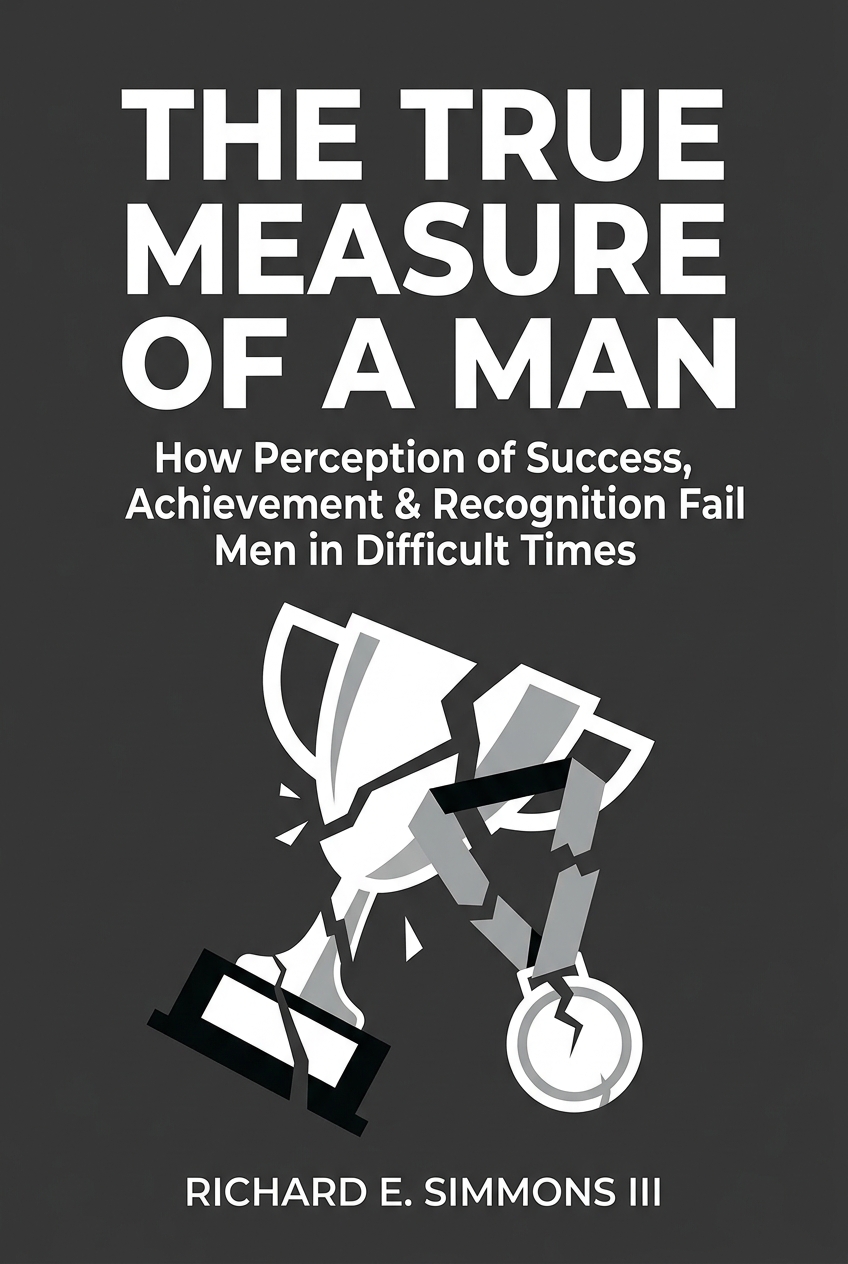
The True Measure of a Man book cover

The Script

The modern man is caught in a subtle but powerful performance. From the boardroom to the backyard barbecue, he’s handed a script with two conflicting roles. The first demands ruthless ambition, a relentless drive for more—more status, more wealth, more control. It’s a game of external scorekeeping, where his worth is tallied on a public ledger of achievements. The second role, however, demands he be a sensitive, present, and emotionally available partner, father, and friend. He’s told to be tough but tender, driven but grounded, a provider who is also deeply connected. The strain of trying to be both at once doesn’t just lead to burnout; it creates a quiet crisis of identity. This internal fracture, the feeling of being pulled apart by competing ideals, is often mistaken for a personal failing. It’s not. It’s the predictable outcome of chasing a definition of success that was designed to be unattainable.

For over two decades, Richard E. Simmons III has dedicated his work to helping men navigate this very fracture. As a speaker and the executive director of The Center for Executive Leadership, he found himself in countless conversations with highly successful men who, despite their external accomplishments, felt a profound sense of emptiness and confusion. They had won the game but felt like they had lost themselves. Simmons realized the core problem was a flawed definition of the prize, not a lack of effort. He wrote 'The True Measure of a Man' to dismantle the faulty framework altogether and propose a more integrated, meaningful standard for a man's life rooted in timeless truths about purpose, identity, and significance.

Module 1: The Persona and the Storm

Many successful men live a double life. There’s the public persona, the bulletproof executive who is always in control. Then there’s the private reality, a world often filled with insecurity, fear, and loneliness. The author argues that this gap is unsustainable. Your external image is no substitute for internal strength.

This idea is captured in a powerful parable about a man who builds a magnificent yacht named "The Persona." He obsesses over its visible features. He wants the most colorful sails, the finest teak decks, and the shiniest brass fittings. He wants everyone at the boat club to admire him. But he completely neglects the keel and the ballast. Why? Because "no one would ever see the underside." When a fierce storm hits, the beautiful boat capsizes instantly. The man drowns. His fellow club members later realize he built less than half a boat. He was a fool who valued vanity over seaworthiness. This is the fate of a life built on image. It looks impressive in calm waters. But it cannot withstand the inevitable storms of life.

So what's the next step? You must confront the reality that life is inherently difficult. M. Scott Peck famously opened his book The Road Less Traveled with this exact line. It’s a universal truth. Yet, modern culture, especially in high-achieving circles, encourages us to deny this. We are told to project strength, to maintain a "corporate happy face," even when we are struggling. This denial has a high cost. Research shows that men account for 80% of suicides in the United States. They often outnumber women 8 or 9 to 1 in drug and alcohol recovery centers. These are symptoms of unaddressed pain, not signs of strength.

And here’s the thing. This performance is driven by a deep, often unconscious question: "What will people think of me?" The fear of shame drives inauthentic behavior. The author shares a personal story. His wife suggested they see a marriage counselor. He agreed, but then panicked. He was terrified of being seen entering the counselor's office. What if someone he knew saw him? What would they think? This fear of judgment, this fear of appearing weak, almost prevented him from getting help that ultimately proved invaluable. This drive for approval turns us into performers for an audience whose applause is always fleeting.

But flip the coin. What happens when the performance fails? What happens when the mask cracks? Moments of exposure are opportunities for transformation. An economic crisis, a professional failure, or a personal struggle can feel devastating. It’s painful. But according to author Bill Thrall, these struggles can be the best things that ever happen to us. They force us to stop performing. They prevent us from missing out on the authentic life we were meant to live. The crisis that strips away the persona can be the very thing that reveals the man.

Read More