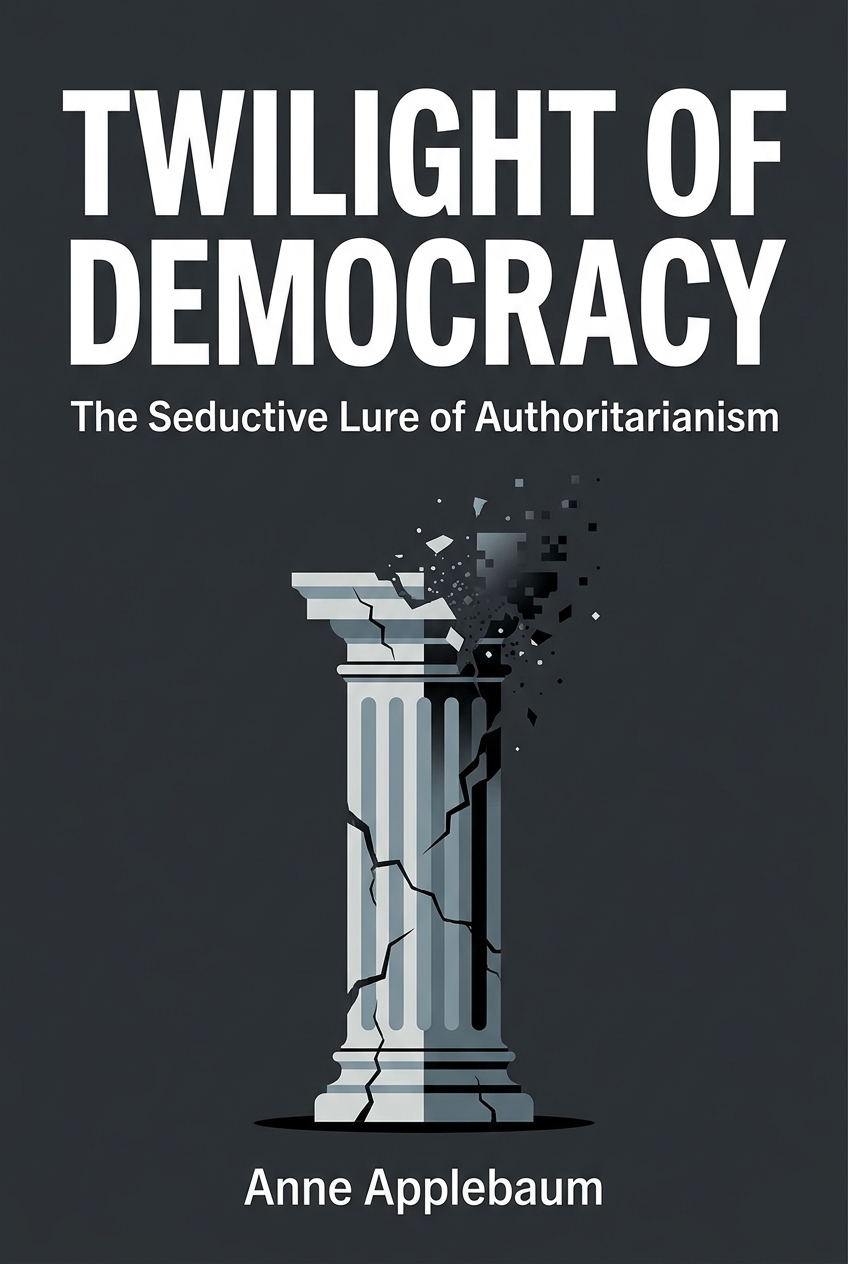
Twilight of Democracy
The Seductive Lure of Authoritarianism
What's it about
Why do democracies suddenly falter, and why do people who once championed freedom now embrace authoritarian rule? This summary unpacks the alarming shift of political elites and voters toward one-party states, revealing the psychological and social forces seducing them away from democratic ideals. You'll discover the specific tactics authoritarians use to exploit nostalgia, sow division, and create alternate realities. Learn to recognize the warning signs in modern political discourse, from conspiracy theories to the rejection of objective truth, and understand how once-stable nations can quickly spiral into chaos.
Meet the author
Anne Applebaum is a Pulitzer Prize-winning historian and staff writer for The Atlantic, whose work has long chronicled the complex transition from communism to democracy in Europe. Drawing from her personal experience of witnessing Poland’s democratic rise and recent authoritarian turn, she possesses a rare, first-hand perspective on the fragility of liberal institutions. This unique vantage point, blending rigorous historical analysis with on-the-ground reporting, allows her to dissect the seductive appeal of authoritarianism for a modern audience with unparalleled clarity.
The Script
On New Year’s Eve, 1999, you throw a party. The house is filled with friends from different countries, different professions, all united by a shared sense of optimism. The Cold War is over, freedom seems to be winning, and the future feels like an open road. You laugh, you argue about politics in a friendly way, you toast to the new millennium. Now, fast forward two decades. You decide to throw the same party, inviting the same people. But something has changed. Some of your old friends won't speak to each other anymore. Others refuse to even be in the same room. The easy camaraderie has been replaced by a tense, brittle silence or, worse, open hostility. The people who once shared your core beliefs now inhabit a completely different political and emotional reality. They aren't just your political opponents; they feel like strangers. What happened to them? What happened to you?
The person who lived through this exact experience is Anne Applebaum. The party she threw at the turn of the millennium wasn't a hypothetical; it was a real gathering at her home on the Polish-German border, filled with friends who were celebrating a new democratic era. Two decades later, she found that many of those same guests had embraced authoritarianism, nationalism, and conspiracy theories—ideas that would have been unthinkable to them in 1999. As a journalist and historian who has spent her career documenting the fall of communism and the Gulag, Applebaum was uniquely positioned to recognize the patterns. She wrote Twilight of Democracy as an urgent attempt to understand how her friends, and the societies they lived in, could change so profoundly, and why the allure of authoritarianism was proving so powerful once again.
Module 1: The New Clerics and the Allure of the One-Party State
The first thing to grasp is that modern authoritarianism isn't about jackbooted thugs seizing power overnight. It's a quieter, more insidious process. And it’s often led by intellectuals and elites. The author calls them the new "clercs," a term from Julien Benda's 1927 classic, The Treason of the Intellectuals. These are the journalists, academics, and strategists who provide the intellectual justification for dismantling democracy.
Their goal is often the creation of a modern one-party state. This is a flexible mechanism for holding power. The core function of a modern one-party state is to replace meritocracy with loyalty. Advancement in government, business, and culture is based on allegiance to the ruling party. We saw this model pioneered by Lenin in Russia. It was later adapted in Apartheid South Africa. Now, we see echoes in Hungary's Fidesz party and Poland's Law and Justice party. They systematically weaken independent courts, media, and civil service. Then they fill the vacancies with loyalists, friends, and family.
But why would anyone support this? The book suggests a powerful motivator. Illiberal movements are often fueled by personal resentment, envy, and a sense of unfairness. It’s about personal ambition. Consider Jacek Kurski, the director of Polish state television. He believed he was unjustly denied a great career. This frustration led him to transform the state broadcaster into a crude propaganda machine. He spread lies and stoked division, all to get ahead in the new system. This pattern repeats. People who feel the existing system has failed them personally are often the most eager to tear it down.
And here's the thing. This new system has a seductive appeal. Anti-competitive systems are attractive because they offer an alternative to the perceived unfairness of meritocracy. Leaders like Hungary's Viktor Orbán and Poland's Jarosław Kaczyński argue that free markets and open competition are rigged. They claim the system allows former elites or "enemies" to succeed. Their solution? A state controlled by "true patriots" where loyalty is the ultimate virtue. This provides a clear path to power and wealth for those who join the club. It’s a compelling offer for anyone who feels left behind by the complex, competitive nature of liberal democracy.