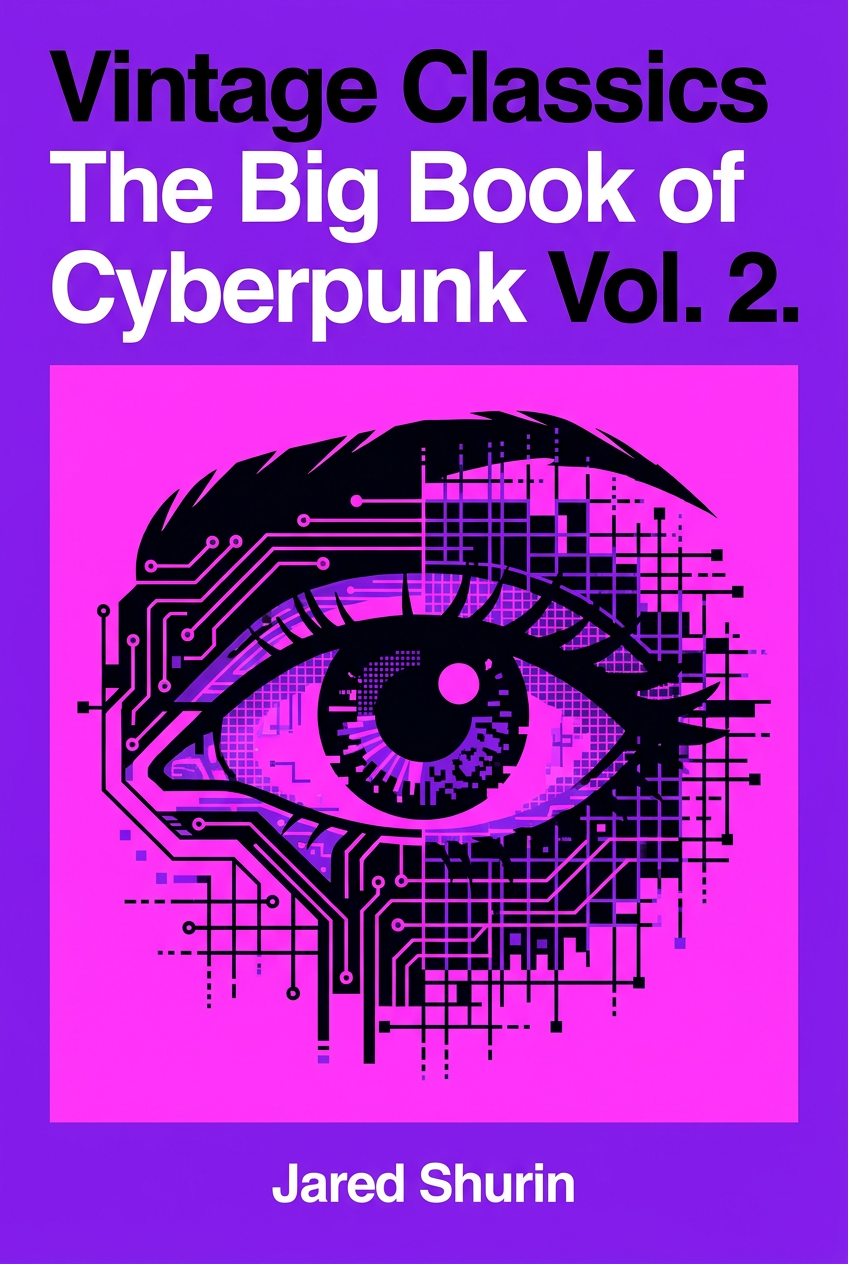
Vintage Classics The Big Book of Cyberpunk Vol. 2.
What's it about
Ready to jack into the future of science fiction? Explore the bleeding edge of cyberpunk, where humanity and technology collide in a neon-drenched, rain-slicked landscape. This collection goes beyond the classics to showcase the genre's evolution and its most provocative new voices. You'll discover stories that question what it means to be human in a world of artificial intelligence, corporate espionage, and digital ghosts. From gritty noir tales on rogue planets to mind-bending explorations of virtual reality, get ready to plug into the vibrant, dangerous, and exhilarating future that cyberpunk continues to build.
Meet the author
Jared Shurin is the multi-award-winning editor of The Big Book of Cyberpunk, the definitive anthology of the genre published by Vintage Classics and Penguin Random House. His passion for speculative fiction began as a way to understand our rapidly changing world, leading him to co-found the British Fantasy Award-winning press, Jurassic London. This unique background, blending a fan's curiosity with an editor's critical eye, has made him a leading voice in mapping the past, present, and future of cyberpunk.
Opens the App Store to download Voxbrief

The Script
Two identical drones are delivered to a clandestine workshop. One is for an engineer, the other for a storyteller. The engineer disassembles their drone, meticulously cataloging each component, analyzing the firmware, and mapping its operational limits. They draft schematics for enhanced propellers and extended battery life, seeing the machine as a set of solvable problems and optimizable functions. The storyteller, meanwhile, takes their drone to the city's highest point. They launch it to see what it sees—to capture the flicker of neon on wet pavement, the lonely figures crossing empty plazas at midnight, the ghost-like trains sliding into darkened stations. The engineer's drone becomes a blueprint for a better machine. The storyteller's drone becomes the first chapter of a new myth.
This is the core tension of cyberpunk: the cold, hard logic of technology colliding with the messy, unpredictable pulse of human stories. It’s a space where a circuit board can be as poetic as a verse and a line of code can be as devastating as a bullet. One editor who has spent his career navigating this intersection is Jared Shurin. As the co-founder of the acclaimed independent press, Jurassic London, and an editor of numerous award-winning anthologies, Shurin has a unique eye for the stories that thrive in the shadows of gleaming megacorporations and digital ghosts. With this second volume, he was continuing the story, showing how the genre’s foundational ideas have mutated and evolved, proving that cyberpunk is about the myths we tell ourselves about the machines we build.
Module 1: Cyberpunk as a Critical Mirror
The first thing to grasp is that cyberpunk is a powerful tool for critical thinking. The stories in this collection serve a much deeper function. Cyberpunk forces us to interrogate our unexamined faith in technology. It acts as a necessary counterbalance to the techno-optimism that often dominates conversations in tech and business. The genre, as Shurin presents it, is like a "snarky guardian angel." It probes the utopian promises of post-singularity equality or seamless virtual realities. It asks the hard questions we often forget to ask.
For instance, in Greg Egan’s "Axiomatic," technology allows beliefs to be installed or deleted like software. You can literally purchase an implant to believe that life is cheap. This is a direct challenge to our notions of free will and morality. If you can buy a conviction, what does it mean to have one? The story pushes us to consider the ethical foundations of a world where core human values are commodified. It’s a stark reminder that technological progress doesn't automatically equal moral progress.
And here’s the thing. This critique is deeply personal. The genre's enduring appeal comes from its relatable, flawed human characters. They are people like us. They are seedy corporate schemers, grieving parents, and burned-out hackers. Take the protagonist in Lisa Mason’s "Arachne." She's a corporate mediator, completely dependent on a virtual reality system for her job. She's desperately trying to keep her position, clinging to her status within a dehumanizing system. Her struggle is relatable because it reflects the anxieties many feel in a competitive, tech-driven workplace.
This leads to a crucial insight. Cyberpunk is defined by its transgressive and provocative nature. Shurin deliberately selected stories that might feel offensive or shocking. But the offense is a tool. It's meant to jolt us out of complacency. For example, the story "Smear" by Brian Aldiss features augmented mercenaries, or "chromeheads," whose bodies are fused with grotesque weaponry. The violence is described in industrial, almost culinary terms. People are "diced like carrots" or "ground into tofu." This language strips away humanity to make a point about the commodification of the body in a hyper-violent economy. It forces us to confront the dehumanizing logic that can underpin systems of power.
Ultimately, the power of cyberpunk as a critical mirror lies in its ability to be both progressive and problematic. The stories often challenge societal norms around identity, class, and power. Yet, they can also reflect the biases and stereotypes of the era in which they were written. Shurin doesn't hide this. He encourages us to engage with these contradictions. This is how we sharpen our critical thinking. By examining these flawed visions of the future, we become better equipped to navigate the complexities of our own present.
Module 2: The Architecture of Control
Now, let's turn to the core theme of this volume: systems. A system is any framework of interacting parts. A family is a system. An online community is a system. And cyberpunk is obsessed with how these systems control us.
The book reveals that technology acts as an amplifier and disruptor of systems. It magnifies existing human behaviors, for better or for worse. A great example is Neal Stephenson’s "The Great Simoleon Caper." A new private digital currency, the Simoleon, is introduced. It’s meant to be a stable alternative to government money. But its launch is built on insecure technology. The government easily intercepts the data for a promotional sweepstakes, planning to sabotage the currency and discredit the whole idea. Here, technology creates a new battlefield for the old war between centralized control and decentralized freedom.
This brings us to a central conflict in the genre. Cyberpunk stories explore the tension between the outsider and the insider. It’s the classic hacker versus the corporation, but with more nuance. In Bruce Bethke’s original story "Cyberpunk," the protagonist is a young hacker who rebels for the thrill of it. He represents the classic outsider, using technology to find agency. But flip the coin. We also see insiders, like the protagonist of Yun Ko-eun’s "P." He lives in a corporate-run city where his entire life is dictated by the company. His struggle is to conform, to fit in, to not be seen as disposable. His story is just as much a cyberpunk narrative as the hacker’s. It shows how systems exert control not just through force, but through the promise of belonging.
And it doesn't stop there. The physical environment itself becomes a tool of control. Cyberpunk settings are systems designed to shape behavior and reinforce power. In James Lovegrove’s "Britworld™," the entire nation of Britain has been turned into a corporate-owned theme park. History and culture are commodified. Tourists experience a sanitized, simulated version of British life, complete with fake rain and robotic historical figures. The corporation, USACorp, controls everything. They even have visitors sign liability waivers at the entrance. The environment is an active participant in the system of control, prioritizing profit over authenticity.
But here’s the hopeful part. Even within the most oppressive structures, there’s a persistent, chaotic human element. Human nature—with all its flaws, instincts, and desires—constantly disrupts even the most efficient systems. In Ken Liu’s "Thoughts and Prayers," a grieving mother uses technology to create a virtual tribute to her daughter, who was killed in a mass shooting. But she also uses it to hunt down the online trolls who harass her. The story powerfully shows that technology can't just smooth over deep human emotions like grief and rage. These primal forces persist. They push back. They find ways to break the system or bend it to their will. This is the "punk" in cyberpunk. It’s the assertion that no matter how total the control, the human spirit remains a wild card.