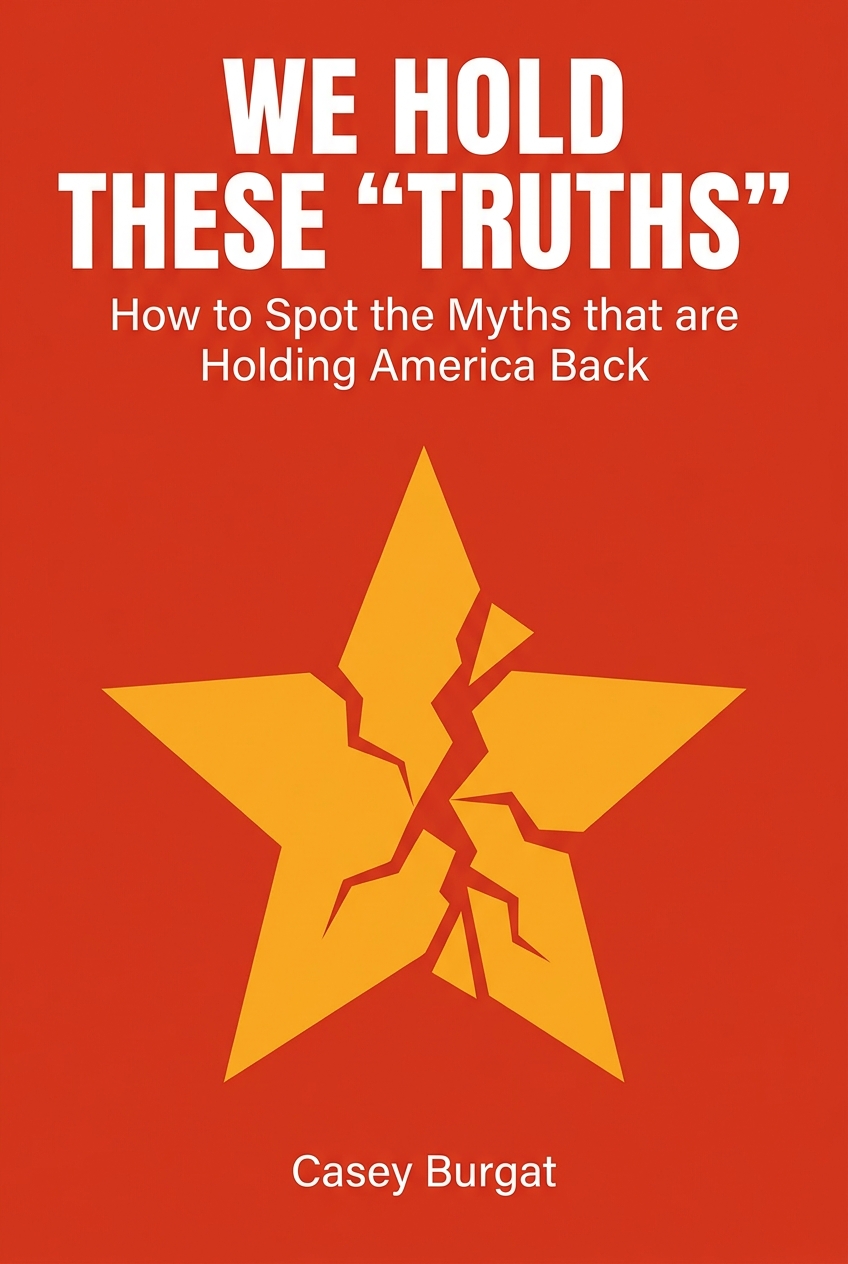
We Hold These "Truths"
How to Spot the Myths that are Holding America Back
What's it about
Do you ever feel like the American political system is rigged, but you can't quite put your finger on why? This book summary reveals the common myths we're taught about our government and how they prevent real progress, giving you the tools to see through the noise. You'll learn to spot the flawed "truths" that politicians and media use to their advantage. Discover why bipartisanship isn't always the answer, how term limits could actually make things worse, and what truly needs to change for your voice to finally be heard in Washington.
Meet the author
Casey Burgat is the director of the Legislative Affairs program at George Washington University's Graduate School of Political Management, where he teaches and researches the U.S. Congress. A former congressional staffer, he combines academic rigor with firsthand experience to dissect the political narratives shaping the nation. This unique blend of scholarship and practical insight provides a powerful framework for understanding and challenging the myths that are holding America back.
Opens the App Store to download Voxbrief

The Script
In the world of high-stakes poker, there's a phenomenon known as 'playing the player, not the cards.' A master can sit down with a novice holding a losing hand and, through sheer force of will, psychological pressure, and a deep reading of their opponent's tells, bluff their way to winning the pot. It’s a captivating display of individual skill over statistical probability. But what happens when you scale that idea? What if instead of one-on-one, the table had hundreds of players, all with different rules, motivations, and loyalties? Suddenly, the individual bluffs and tells become less important than the overall structure of the game itself—the betting limits, the payout structure, the very rules that govern how hands are played and pots are awarded. The system, not the star player, dictates the most likely outcomes.
This is the exact dynamic that fascinated Casey Burgat. For years, he watched brilliant, charismatic individuals enter the complex world of Washington D.C., armed with powerful ideas and immense personal drive, only to find their efforts blunted by a system that seemed designed to produce gridlock. It wasn’t a failure of individual talent, but a collision with an intricate, often invisible, set of institutional rules. As a senior fellow and director at the Legislative Affairs program at the Graduate School of Political Management at The George Washington University, Burgat had a front-row seat to this frustrating reality. He wrote "We Hold These 'Truths'" to demystify the game itself, revealing the structural forces that truly shape power and progress in America.
Module 1: The Myth of the Perfect Constitution
We often hear that the Founders got everything exactly right. That the Constitution is a sacred, perfect document. Politicians use this idea to end debates. They claim their position is the one the Founders intended. But this idea is a dangerous fantasy. It stifles innovation and prevents us from adapting our government to modern challenges.
The truth is, the Founders designed the Constitution to be an imperfect, evolving document. They knew it wasn't flawless. Benjamin Franklin admitted he didn't approve of every part. But he signed it, calling it the best compromise possible. George Washington privately expressed disappointment. He hoped future generations would amend it. The delegates who created it knew it was a starting point. It was a practical deal to hold a fragile nation together.
This leads to a critical insight. The Constitution's ambiguities were deliberate, not accidental. The Framers knew they couldn't predict the future. So they used vague language on purpose. Phrases like "high crimes and misdemeanors" or "necessary and proper" were left undefined. This was a genius move. It gives future generations the flexibility to interpret the rules based on contemporary needs. Think about it. The process for "advice and consent" on presidential appointments is not spelled out. President Washington had to invent the Cabinet because the Senate proved too slow for timely advice. The system was designed to be filled in through practice.
Furthermore, the document was born from messy, uncomfortable compromises. The Constitution’s most difficult compromises—especially over slavery—reveal its practical, pragmatic origins. The Three-Fifths Compromise, which counted enslaved people as partial persons for representation, was a moral horror. But it was a pragmatic deal to keep Southern states from walking out. The Great Compromise created a two-chamber Congress to balance the power of large and small states. These were gritty negotiations to prevent the entire experiment from collapsing before it began.
So what's the takeaway? Worshipping the Constitution as a perfect, static blueprint is not only historically wrong—it's profoundly un-American. The true genius of the Founders was their humility. They knew they didn't have all the answers. They built a system designed for revision. Our job is to emulate their spirit of innovation and adapt our institutions to the challenges of today.