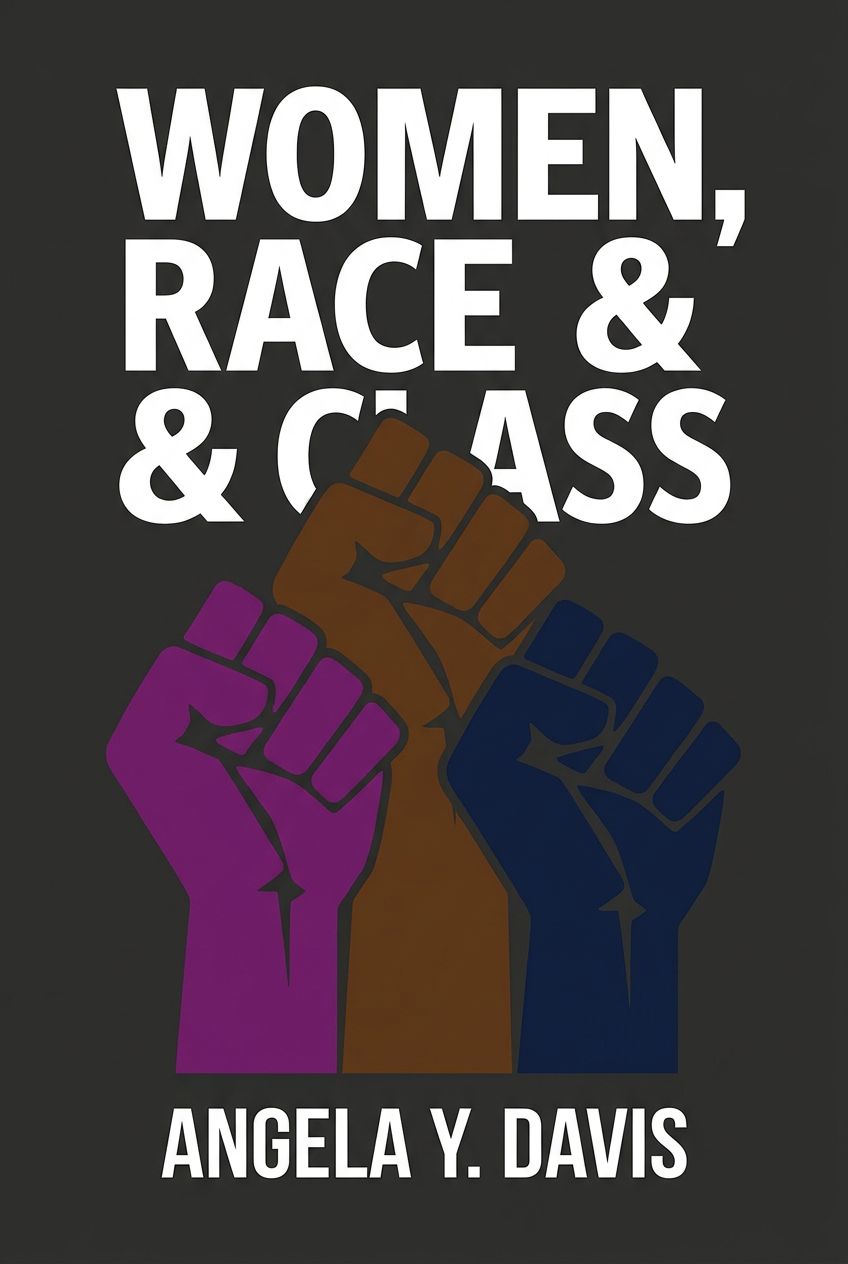
Women, Race & Class
What's it about
Ever wondered why the fight for women's rights hasn't always included all women? Get ready to uncover the uncomfortable truths about how the movements for abolition, women's suffrage, and Black liberation often worked against each other, leaving Black women behind. You'll explore the hidden history of how race and class were used to divide women and weaken their collective power. This summary reveals the critical, often-ignored stories of the women who fought on multiple fronts, offering essential lessons for building truly inclusive movements today.
Meet the author
Angela Y. Davis is a world-renowned scholar, activist, and public intellectual whose work has profoundly shaped contemporary discussions on feminism, race, and the prison-industrial complex. As a political activist with the Communist Party USA and the Black Panther Party in the 1960s and 70s, her lived experiences of struggle and resistance directly informed her groundbreaking analysis. This unique synthesis of rigorous academic inquiry and frontline activism gave her the critical perspective necessary to write this foundational text on the interwoven histories of oppression.
Opens the App Store to download Voxbrief

The Script
A celebrated alliance, like two rivers merging, is often hailed as a doubling of strength. But what if the merger is actually an act of erasure? What if one river, carrying its own unique history and momentum, is simply swallowed by the other, its color and current vanishing into a more powerful, dominant stream? We often assume that movements for justice, when joined, create a broader, more inclusive current of change. This optimistic arithmetic—that unity always equals addition—blinds us to a more unsettling possibility: that one group's liberation can be built on the quiet, unacknowledged subordination of another, all under the banner of a shared cause.
This is a historical pattern Angela Y. Davis saw repeating with devastating clarity. As a philosopher and activist deeply involved in liberation struggles, she witnessed how the mainstream feminist movement often sidelined the concerns of Black and working-class women, and how anti-racist movements could be blind to the unique burdens of sexism. The official stories celebrated unity, but the reality on the ground was one of fracture and hierarchy. To understand why these alliances so often failed the very people they claimed to represent, Davis went back to the archives. She began a meticulous historical investigation, tracing the intertwined, and often conflicting, paths of the abolitionist, women's suffrage, and labor movements in America to expose the fault lines that have defined these struggles from the very beginning. The result was "Women, Race & Class," a work born from the urgent need to understand why the currents of justice so rarely flow together as one.
Module 1: The Original Sin of the Suffrage Movement
The American women's suffrage movement is often celebrated as a heroic struggle for equality. But Davis reveals a more complicated and troubling history. The movement was born from the anti-slavery campaign, but it quickly abandoned its principles of universal liberation. This module unpacks that critical failure.
The fight to end slavery in the 19th century was the political training ground for the first generation of white women activists. Figures like Sarah and Angelina Grimké, born into a slaveholding family, became powerful abolitionist speakers. When they were attacked for speaking in public, a role considered "unnatural" for women, they were forced to defend their own rights. This sparked a revelation. True liberation requires fighting all forms of oppression. The Grimké sisters argued that women needed to win their own freedom in order to effectively fight for the freedom of enslaved people. The two struggles were inextricably linked.
This spirit of solidarity, however, did not last. After the Civil War, the government proposed the 15th Amendment, which would grant voting rights to Black men but not to any women. This created a bitter split. Instead of seeing it as a partial victory, key suffrage leaders like Elizabeth Cady Stanton and Susan B. Anthony saw it as a betrayal.
And here’s the thing. Their response was rooted in open racism. Stanton argued it was better for "the Saxon race" to be enfranchised before "Sambo." She and Anthony actively campaigned against the 15th Amendment. They chose to prioritize the votes of white women over the rights and safety of Black men. This was a pivotal moment. They made a strategic calculation that sacrificing solidarity with Black people was a necessary price for their own advancement.
This decision had devastating consequences. To win support in the South, the mainstream suffrage movement began to adopt the language of white supremacy. At a 1903 convention, a speaker argued that enfranchising white women was the best way to ensure "durable white supremacy." The movement that began with a cry for universal human rights was now using the logic of racial hierarchy to make its case.
So what’s the lesson here? When movements compromise on their core principles for political expediency, they lose their moral authority and sow the seeds of their own failure. The suffragists got the vote in 1920, but the movement was fractured. It had betrayed its Black allies, who were then left to fight alone against Jim Crow laws that stripped them of the very voting rights the suffragists had opposed. This history shows that a "win" for one group at the expense of another is a strategic and moral dead end.
Module 2: The Hidden History of Black Women's Resistance
Now, let's turn to the story that was largely erased from the mainstream accounts: the unique struggle and resistance of Black women. Davis argues that their experience under slavery was fundamentally different from that of Black men or white women. Understanding this difference is key to understanding the real meaning of strength and equality.
Under slavery, the concept of "womanhood" as a delicate, domestic role did not apply to Black women. They were, first and foremost, units of labor. The slave system largely imposed a genderless equality in exploitation. Enslaved women worked the same grueling hours in the fields as men, picking cotton or cutting sugarcane. Their productivity was measured by the same brutal standards. Yet, they also faced a unique, gender-specific terror: systematic sexual violence. Rape was an institutionalized tool of domination, an assertion of the slaveowner's power. Women were also valued as "breeders," their reproductive capacity exploited to produce more laborers for the system.
But flip the coin. Within the slave quarters, a different kind of equality emerged. Because both men and women endured the harsh reality of forced labor, the artificial gender roles of white society held little meaning. Domestic work was often shared more equitably. Men might hunt or garden, while women cooked or sewed. This created a foundation of mutual respect and partnership. Black women forged a new standard of womanhood, one rooted in resilience, self-reliance, and a deep-seated demand for equality. This was a legacy of strength born from survival.
This legacy of resistance was not just passive endurance. It was active. It was strategic. Harriet Tubman is the most famous example, a military strategist and leader who guided hundreds to freedom. But countless other women resisted every day. They sabotaged equipment. They organized slowdowns. They ran secret schools at night, like Milla Granson, who risked brutal punishment to teach her fellow slaves to read.
So here’s what that means for us today. When we talk about leadership and resilience, this is the history we should draw from. True strength is about agency in the face of vulnerability. Black women's history provides a powerful model of leadership that is collaborative, defiant, and relentlessly focused on community survival. It challenges the narrow, often masculine, definitions of power we've inherited. It shows that the most effective resistance often comes from those who are forced to fight on multiple fronts at once.