Thought-Provoking Books
Wondering how to build thought provoking habits? It starts by engaging with ideas that challenge your assumptions. Our curated list of the best thought provoking books will help you do just that. More than just information, these are tools to reshape your worldview, from understanding human nature to questioning the fabric of society. Dive into these essential thought provoking book recommendations designed to expand your mind and spark new insights. Curated by the VoxBrief team.
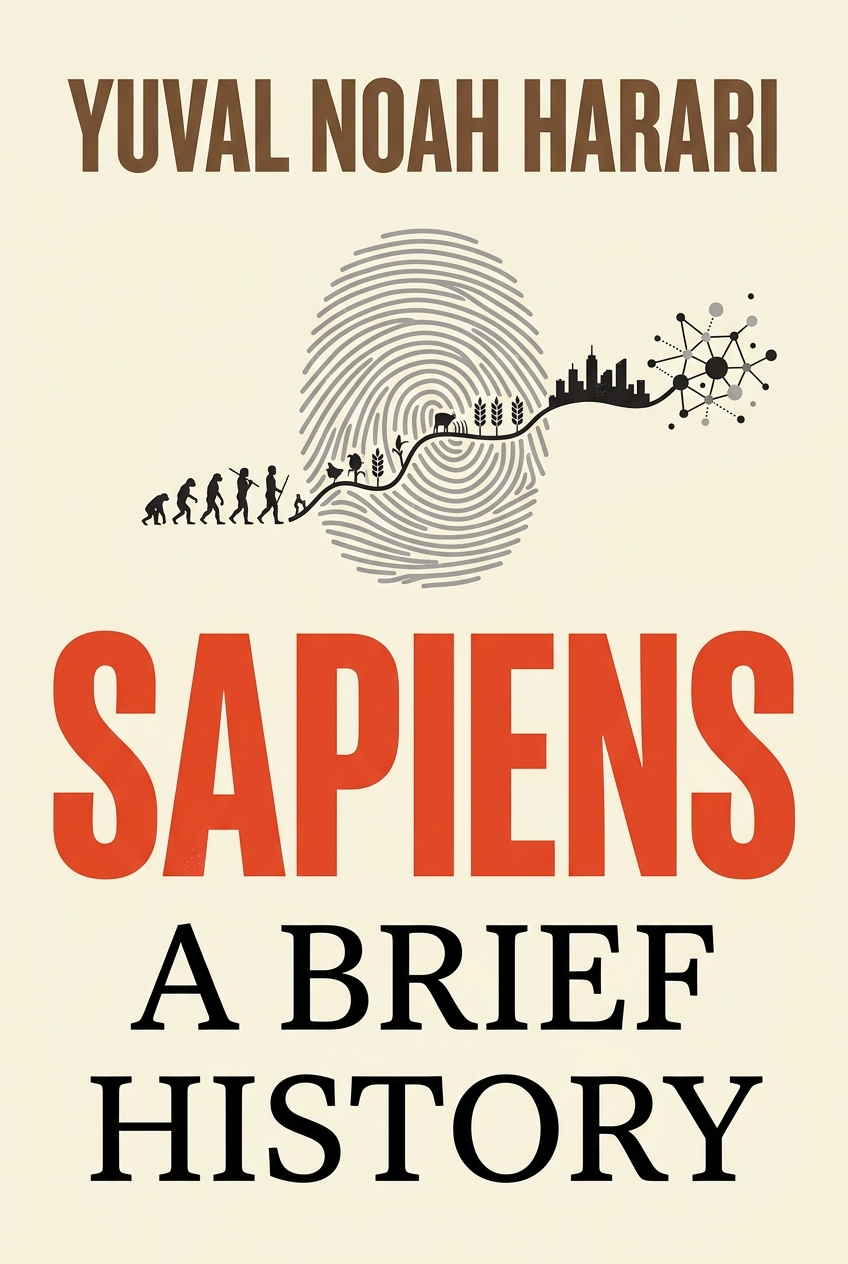
Sapiens
Discover how our unique ability to believe in shared stories made us rulers of Earth.
- Shared myths like money, nations, and laws allow large-scale human cooperation.
- History moved through Cognitive, Agricultural, and Scientific Revolutions.
- Humans went from insignificant apes to the planet's dominant species.
Anyone curious about the deep history of humanity and civilization.
Discover how our unique ability to believe in shared stories made us rulers of Earth.
The Laws of Human Nature
Decode the hidden drivers of human behavior to gain a strategic edge in life.
- Master 18 laws to understand people's true motivations and intentions.
- Learn to identify toxic personalities and manage difficult relationships.
- Develop empathy and emotional intelligence for greater influence.
Professionals and leaders seeking to understand and influence others.
Decode the hidden drivers of human behavior to gain a strategic edge in life.
Enlightenment Now
Counter pessimism with data showing how the world is actively getting better.
- Reason, science, and humanism have led to massive global progress.
- Health, wealth, safety, and happiness are improving worldwide.
- Use facts and data to combat the media's pervasive negativity bias.
Optimists needing data or pessimists needing a solid reality check.
Counter pessimism with data showing how the world is actively getting better.
Thinking, Fast and Slow
Uncover the two systems of thought and the cognitive biases that rule your mind.
- Your mind uses fast, intuitive System 1 and slow, logical System 2.
- Cognitive biases and mental shortcuts lead to common errors in judgment.
- Recognize these biases to make smarter, more rational decisions.
Anyone looking to improve their decision-making and critical thinking skills.
Uncover the two systems of thought and the cognitive biases that rule your mind.

Man's Search for Meaning
Find unshakable purpose by transforming suffering into strength and meaning.
- Your primary drive in life is the search for personal meaning.
- Find meaning through work, love, and courage in the face of suffering.
- Even in the worst conditions, you always have the freedom to choose your attitude.
Individuals facing adversity or searching for a deeper sense of purpose.
Find unshakable purpose by transforming suffering into strength and meaning.
Meditations
Use the private journal of a Roman Emperor to build unshakeable inner peace.
- Focus only on what you can control and accept what you cannot.
- View obstacles not as barriers but as opportunities for growth and virtue.
- Practice reason and self-discipline for a tranquil and purposeful life.
People feeling overwhelmed by modern chaos and seeking mental clarity.
Use the private journal of a Roman Emperor to build unshakeable inner peace.
Antifragile
Learn how to use stress, chaos, and uncertainty to become stronger and better.
- Antifragile systems gain from disorder, while fragile ones simply break.
- Trying to eliminate all risk and volatility ultimately makes you weaker.
- Build optionality in your life to thrive on shocks and randomness.
Investors and entrepreneurs who want to thrive in an uncertain world.
Learn how to use stress, chaos, and uncertainty to become stronger and better.
The Structure of Scientific Revolutions
Discover the hidden pattern of "paradigm shifts" behind every great breakthrough.
- Science progresses through disruptive "paradigm shifts," not linear accumulation.
- "Normal science" operates within a paradigm until anomalies force a crisis.
- Scientific revolutions change the very rules and standards of a field.
Innovators and thinkers interested in how big ideas change the world.
Discover the hidden pattern of "paradigm shifts" behind every great breakthrough.

The Denial of Death
Uncover how the unconscious fear of death drives human ambition and culture.
- The terror of our mortality is a primary motivator for human action.
- We create "immortality projects" (career, legacy) to feel heroic.
- Understanding this denial explains our deepest anxieties and desires.
Philosophers exploring the deep motivations behind human behavior.
Uncover how the unconscious fear of death drives human ambition and culture.
Frequently Asked Questions
These titles are considered great intellectual books because they fundamentally challenge your perspective. They explore complex systems—from psychology to societal structures—and provide new frameworks for understanding the world, prompting deep reflection long after you've finished.
It's hard because it forces us to confront our biases. Our brains prefer efficient shortcuts over deep, analytical thinking. Engaging with challenging ideas requires significant mental effort and a willingness to be wrong, which is uncomfortable but essential for growth.
Build habits around curiosity. Schedule regular time to read challenging books or discuss big ideas with others. Keep a journal to reflect on what you've learned and actively question your own assumptions. Consistency comes from making it a deliberate, regular practice.
It is a skill that can be developed, not just an innate talent. While some people may have a natural curiosity, anyone can learn to ask better questions and think more critically. Like any skill, it improves with consistent practice and exposure to new ideas.