All Books
Self-Growth
Business & Career
Health & Wellness
Society & Culture
Money & Finance
Relationships
Science & Tech
Fiction
Topics
Blog
Download on the App Store

$100M Money Models

How to Make Money

16 minAlex Hormozi

What's it about

Tired of trading your time for a paycheck? What if you could build a system that makes money for you, even while you sleep? Discover the four fundamental "money models" that the ultra-wealthy use to generate and multiply their fortunes, and learn how to apply them to your own life. This summary breaks down Alex Hormozi's powerful framework for achieving financial freedom. You'll get the exact blueprints for creating scalable income streams, whether you're starting a business, investing, or just want to escape the 9-to-5 grind. Stop guessing and start building your $100M future today.

Meet the author

Alex Hormozi is an entrepreneur, investor, and philanthropist who scaled his portfolio of companies to over $200 million in annual revenue by his early thirties. After achieving financial freedom, he shifted his focus from building his own businesses to helping others build theirs. This book distills the exact business models and monetization strategies he used to generate hundreds of millions, making his hard-won knowledge accessible to a new generation of entrepreneurs seeking to create their own wealth.
Listen Now

Opens the App Store to download Voxbrief

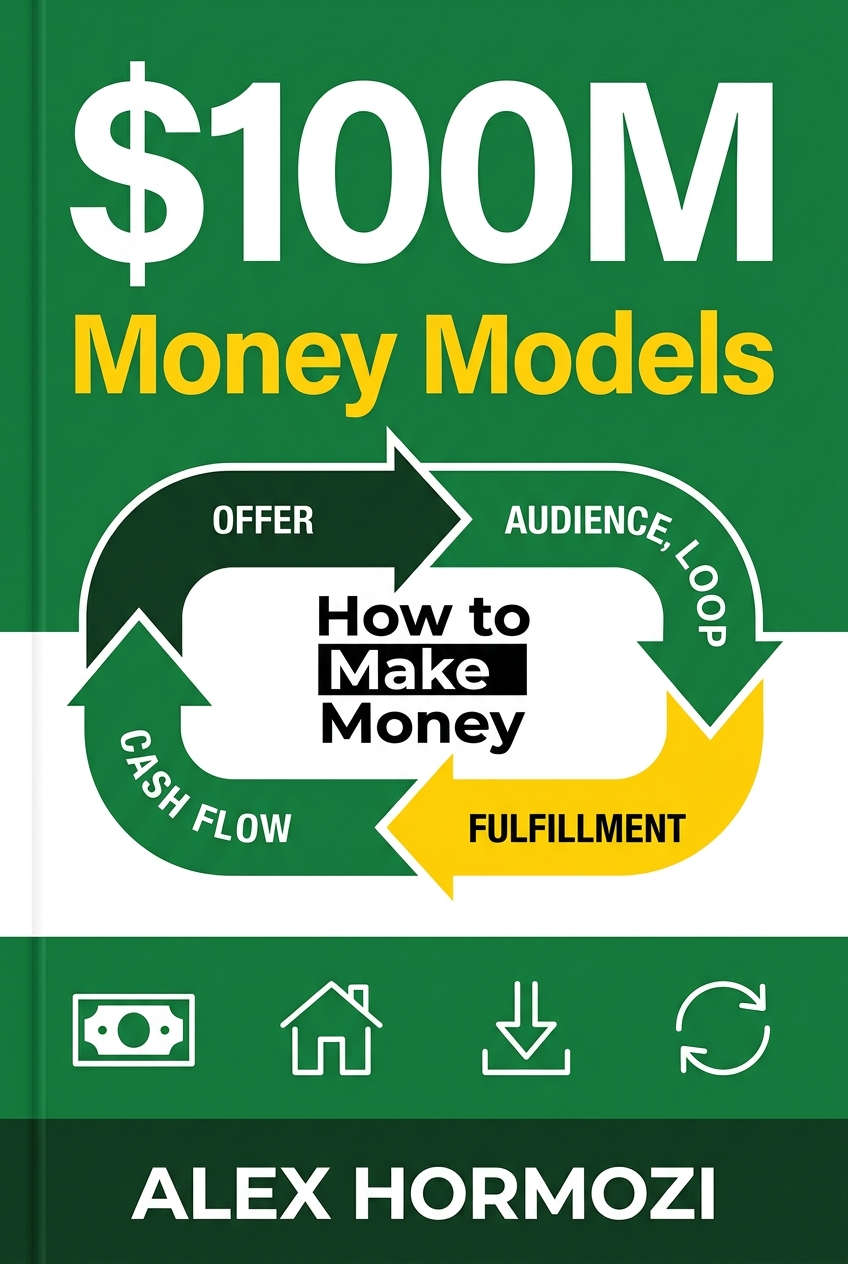
$100M Money Models book cover

The Script

Financial success is often depicted as a summit to be conquered, a single peak reached through one heroic, sustained effort. But what if wealth isn't a mountain at all? What if it's a series of interconnected rooms, and the real skill is finding the right keys? Many entrepreneurs exhaust themselves trying to scale a single wall, believing that more force, more hours, and more grit will eventually break them through to the top. They treat a problem of architecture like a problem of altitude. They don't realize that the person in the room next door, who seems to be moving faster with less effort, didn't get stronger—they simply used a key to walk through a door.

This realization—that the highest-paid people don't work harder, but think differently—is the puzzle Alex Hormozi dedicated himself to solving after building and selling multiple companies for tens of millions of dollars. He noticed that the same fundamental business problems appeared at every stage of growth, yet his ability to solve them depended entirely on the mental model he applied. Frustrated by the lack of a clear collection of these high-leverage 'keys,' he decided to create one. After synthesizing the frameworks that took his own portfolio of companies to over $200 million in annual revenue, Hormozi documented the most potent money models to give other entrepreneurs the blueprints he wishes he’d had.

Module 1: The Core Philosophy of a Money Model

The central idea of the book is that your business's growth speed is a direct result of your "Money Model." A Money Model is the entire sequence of offers you present to a customer. A weak model slowly drips cash back over months or years. A strong model extracts significant profit upfront.

This brings us to the first major insight. Your goal is to make more profit from one customer in 30 days than it costs to acquire and service two. This is the Hormozi standard for a scalable business. When you achieve this, cash is no longer a bottleneck. You have a self-funding engine for customer acquisition. You can outspend your competitors on advertising. You can hire better talent. You can grow at an exponential rate because your customer economics are sound.

To illustrate, Hormozi contrasts two businesses. The "bad" model spends $100 on ads to get a customer who pays $50 upfront. That business is now in a $50 hole. It might take two years to make that money back. The "good" model spends the same $100 but generates $300 in profit within the first 30 days. That business now has its original $100 back, plus an extra $200. It can immediately reinvest that to acquire two more customers, creating a virtuous cycle of growth.

So how do you build this engine? The key is to stop thinking in terms of single transactions. A Money Model is built from four distinct types of offers working in concert.

  1. Attraction Offers are your front door. They turn strangers into customers, often using free or deeply discounted hooks to get them in.
  2. Upsell Offers get existing customers to spend more money, right after their initial purchase.
  3. Downsell Offers convert people who say "no" by offering a more accessible alternative.
  4. Continuity Offers create recurring revenue by keeping customers engaged over the long term.

A business might start with just one type. But a truly powerful Money Model strategically combines all four. This leads to the final core principle of this module. Optimizing your Money Model has a multiplicative effect on growth. Hormozi presents a simple but powerful mental model. If you double customer value, double the number of customers you acquire, and double the speed at which you get them, your business grows 8 times faster. That’s two times two times two. If you triple each of these variables, your growth accelerates 27 times. This shows how small, strategic improvements across your entire offer sequence can lead to explosive results.

Module 2: Attraction Offers — Getting Customers in the Door

Now, let's turn to the first and most critical component: Attraction Offers. Most businesses fail right here. They can't acquire customers profitably. Attraction Offers are designed to solve this by making your deal so compelling that it efficiently converts ad spend into cash flow.

The first strategy is one of the most powerful. Use a "Win Your Money Back" offer to lower customer risk and drive action. Here’s the structure. A customer pays you upfront for a product or service. They get a full refund if they complete a specific set of actions. For a gym, this might be a "Free 6-Week Challenge." A customer pays a deposit, say $500. They get it all back if they attend every session and track their progress. This offer is brilliant for three reasons. First, it eliminates the customer's financial risk, which skyrockets conversions. Second, the required actions are designed to ensure the customer gets results, making them a perfect candidate for future upsells. Third, the business gets the cash upfront, solving cash flow problems.

Building on that idea, another effective Attraction Offer is the Giveaway, which turns a single grand prize into many sales. You advertise a high-value Grand Prize, like a "Free Year of Service." This generates a flood of leads. Only one person wins the Grand Prize. But here's the magic. You then contact every other entrant and offer them a "Promotional Offer," like a significant gift card or a "partial scholarship" toward the same service. Because they were already interested enough to enter, conversion rates on this promotional offer are incredibly high. You leverage the excitement for the big prize to close dozens or hundreds of smaller, profitable sales.

And here's the thing. Sometimes the simplest offers are the best. A "Decoy Offer" uses contrast to make your premium option a no-brainer. You advertise a very basic, low-cost or free offer—the decoy. When the lead comes in, you present it alongside a much more valuable "premium" offer. For example, a gym offers a free weekly session. But when the person shows up, they also present the "Ultimate" package for $399. This premium option includes unlimited sessions, coaching, and a guarantee. The stark contrast in value makes the premium offer look far superior. Hormozi found that around 80% of leads chose the paid premium option over the free decoy, dramatically improving profitability.

Finally, you can reframe discounts into something more psychologically powerful. The "Buy X Get Y Free" model increases perceived value and drives larger purchases. A boot store in a tourist town sold boots with a "Buy 1 Pair, Get 2 Pairs Free" offer. They simply marked up the price of the first pair to cover the cost of all three. The total price was the same, but the feeling of getting two "free" pairs was an irresistible hook. For services, this works just as well. An 18-month contract can be framed as "Buy 12 Months, Get 6 Free." Or even better, "Buy 6 Months, Get 12 Free." The more you give away for free, the more compelling the offer becomes.

Read More