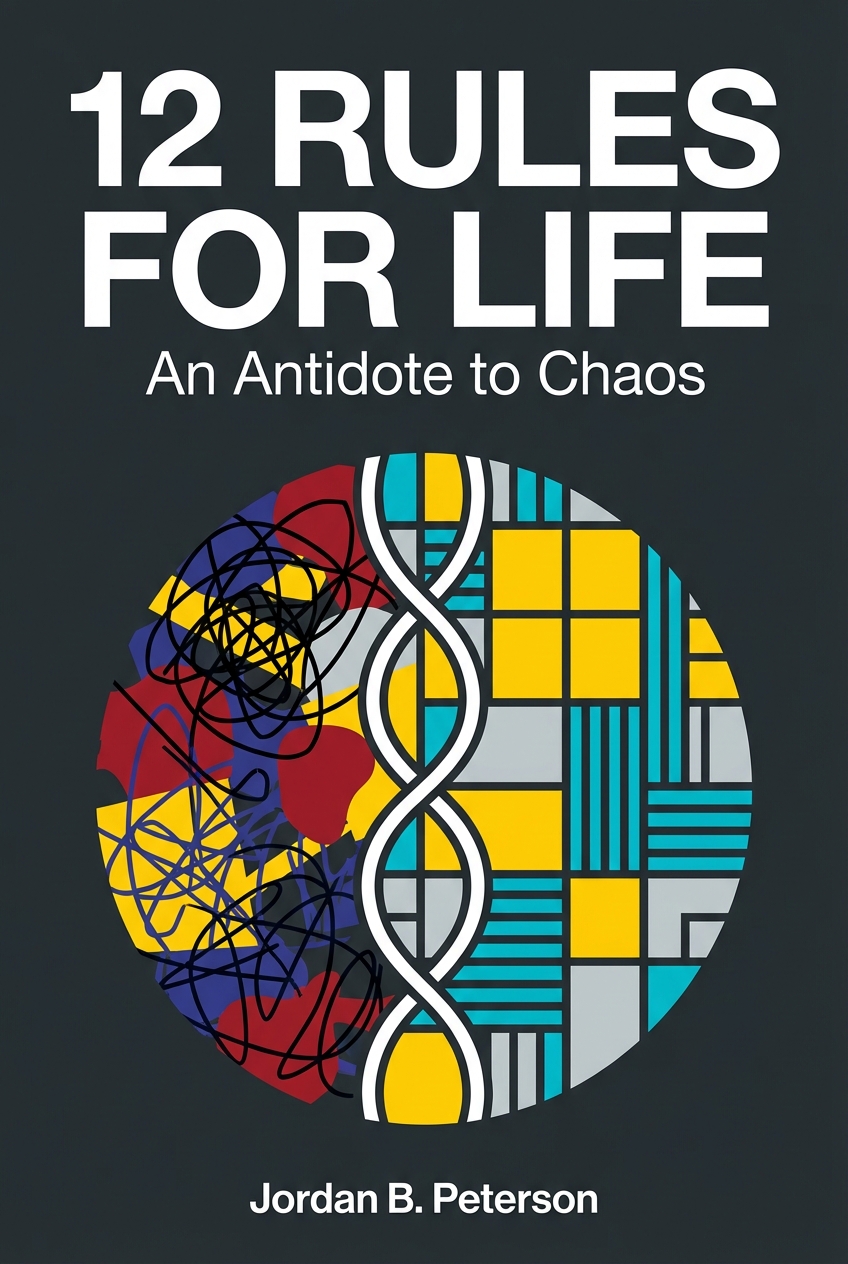
12 Rules for Life
An Antidote to Chaos
What's it about
Feeling adrift in a world of chaos? Discover how to take control of your life, find meaning, and build a more ordered existence. This summary distills ancient wisdom and modern science into a powerful guide for personal responsibility and self-improvement. You'll learn twelve profound yet practical rules for navigating life's biggest challenges. From standing up straight to pursuing what is meaningful, not what is expedient, these principles offer a concrete roadmap to discipline, freedom, and a more fulfilling future.
Meet the author
Dr. Jordan B. Peterson is a renowned clinical psychologist and professor emeritus at the University of Toronto, whose lectures on mythology and psychology have reached hundreds of millions. Drawing from decades of clinical practice and deep academic research into the world's greatest stories, he distilled timeless wisdom into practical, modern principles for navigating life's inherent chaos. His work synthesizes science, faith, and philosophy to offer a compelling guide for finding meaning and taking responsibility in a complex world.
Opens the App Store to download Voxbrief

The Script
Think of the most resilient, ancient living things on Earth—a bristlecone pine twisted by millennia of wind, or a deep-sea lobster patrolling the dark, crushing depths. They don’t survive by being the strongest or fastest. They survive because they are tuned to a fundamental, unchanging reality. The pine grows toward the sun, its roots gripping the rock. The lobster scours the ocean floor for sustenance, its shell a fortress against pressure. They follow a simple, brutal, and effective set of internal directives honed over eons. We, too, live within a similar, unforgiving reality, but we often try to negotiate with it, ignore it, or wish it were different. We build lives on shaky ground, surprised when they tremble, and wonder why we feel adrift in a world of our own making. What if the oldest wisdom is about rediscovering the non-negotiable principles we’ve forgotten?
This very question began to surface in the comment sections of the internet. A clinical psychologist and professor named Jordan B. Peterson had been posting his lectures and thoughts online, expecting to reach a niche academic audience. Instead, his direct, uncompromising answers to questions about meaning, responsibility, and suffering struck a chord with millions. He was connecting modern anxieties to the oldest stories and biological truths he had studied his entire career. The flood of responses revealed a deep, unspoken hunger for guidance—for solid principles to stand on. “12 Rules for Life” was his response to that demand, an attempt to distill a lifetime of research and clinical practice into a set of foundational ideas for navigating the inherent chaos of existence.
Module 1: The Biology of Winning and Losing
We often think of success and failure as purely social or economic outcomes. But what if they are wired into our biology? Peterson argues they are. He starts with a surprising example: lobsters. Lobsters have been around for over 350 million years. They compete fiercely for territory, mates, and status.
This leads to a critical point. Dominance hierarchies are an ancient and inescapable feature of life. They are biological realities. When two lobsters fight, the winner’s brain chemistry changes. Serotonin levels rise. This makes it stand taller and act more confidently. It's more likely to win its next fight. The loser’s brain chemistry also changes. Its serotonin drops. It becomes timid and is more likely to lose again. This creates a feedback loop. Winning begets winning. Losing begets losing.
So what's the lesson here? Your posture and mindset signal your status and influence your outcomes. Peterson is talking about the physical embodiment of your psychological state. Standing up straight, with your shoulders back, is a command to adopt the posture of someone who is ready to engage with the world. It’s a signal to your own nervous system, and to others, that you are competent and prepared to face challenges. Expecting the world to treat you well just because you are a nice person is a recipe for disappointment. You must project competence. You must signal that you are ready to take on responsibility.
This brings us to a harsh but useful reality. A small number of people produce the majority of the output in any given field. This is known as Price's Law. In science, a handful of researchers publish most of the papers. In music, a few composers create the enduring classics. In business, a tiny fraction of companies capture most of the market value. This pattern of unequal distribution is a natural feature of complex systems. Recognizing this is about understanding the game you're playing. The world is competitive. Your position in the hierarchy matters. And it is determined, in part, by how you carry yourself.
So here's what that means for you. Stop slouching. Physically and metaphorically. Take personal responsibility for your mindset, as it is a critical determinant of your success. If you carry yourself like a loser, the world will treat you like one. Your own neurochemistry will conspire against you. But if you adopt the posture of someone who is competent and ready, you can start to shift that internal feedback loop. You begin to signal to yourself and others that you are a force to be reckoned with. This is about embodying the person you want to become.
Module 2: The Architecture of a Meaningful Life
We've established that life is a hierarchy. It's competitive. But what gives it meaning? How do we navigate the chaos? This is where Peterson's next set of rules comes into play.
Let's start with a simple observation. Many of us are better at caring for others than for ourselves. We'll make sure our dog gets its medicine. We'll push our friends to follow their doctor's advice. But when it comes to our own well-being, we often fall short. This leads to the second rule: Treat yourself like someone you are responsible for helping. This is a call for radical self-respect. You know what is good for you. You know you should eat better, exercise, and get enough sleep. The rule asks you to take that knowledge seriously. It suggests you have a moral obligation to care for yourself, just as you would for a child or a loved one you were responsible for. You are a vessel of potential. Neglecting yourself is a betrayal of that potential.
Building on that idea, Peterson introduces a core model for understanding existence. He argues that all human experience can be understood through the interplay of two fundamental forces: Order and Chaos. Order is structure, predictability, and safety. It's your calendar, your job description, and the traffic laws. Chaos is the unknown, the unexpected, and the source of all new things. It’s a sudden job loss, a new relationship, or a creative breakthrough. We need both. Too much Order leads to stagnation and tyranny. Too much Chaos leads to anxiety and collapse. A healthy life is found on the border between Order and Chaos. This is where we are secure enough to feel grounded, but challenged enough to grow. The goal is to have one foot firmly planted in what you know, while cautiously extending the other foot into the unknown.
But you can't walk this path alone. The people you surround yourself with will either pull you up or drag you down. It's that simple. Peterson is unflinching on this point. Choose friends who want the best for you. This sounds obvious, but it's incredibly difficult in practice. It’s easy to befriend people who make us feel comfortable in our mediocrity. It’s tempting to try and "rescue" friends who are on a downward spiral. Peterson argues this is a mistake. Rescuing someone who does not want to be saved is impossible. It will only pull you under with them. Instead, surround yourself with people who hold you to a higher standard. People whose success inspires you, and who celebrate your own.
Now for the final piece of this module. It's a game-changer. Compare yourself to who you were yesterday, not to who someone else is today. In the age of social media, this is revolutionary. Constant comparison is the thief of joy. You see someone else's highlight reel and compare it to your behind-the-scenes struggles. It's a losing game. You don't know their story, their advantages, or their secret pains. The only fair comparison is with your past self. Are you a little better today than you were yesterday? Did you learn something? Did you fix a small flaw? That is the only metric that matters. This approach allows for incremental, sustainable progress. It turns the daunting task of "self-improvement" into a manageable daily practice. Aim for a 1% improvement each day. The compound interest on that is staggering.