All Books
Self-Growth
Business & Career
Health & Wellness
Society & Culture
Money & Finance
Relationships
Science & Tech
Fiction
Topics
Blog
Download on the App Store

A Kingdom of Flesh and Fire

A Blood and Ash Novel

20 minJennifer L. Armentrout

What's it about

What if everything you thought you knew about your destiny was a lie? Discover how to navigate a world of betrayal and forbidden desire when the man you love is also your kingdom's greatest enemy. Your life, and your heart, hang in the balance. You'll learn how to harness newfound powers and question deep-seated loyalties. Uncover the secrets of a kingdom built on deception and decide whether to fight for the world you were raised in or the one your heart now belongs to. Your choices will either save two kingdoms or destroy them both.

Meet the author

Jennifer L. Armentrout is a 1 New York Times and international bestselling author celebrated for her captivating blend of fantasy, romance, and paranormal fiction. A prolific writer, she has penned over sixty novels, driven by a lifelong passion for storytelling that began in her childhood algebra classes. Armentrout's ability to create immersive worlds and complex characters, like those in the Blood and Ash series, stems from her dedication to exploring themes of strength, love, and survival, connecting deeply with millions of readers worldwide.
Listen Now

Opens the App Store to download Voxbrief

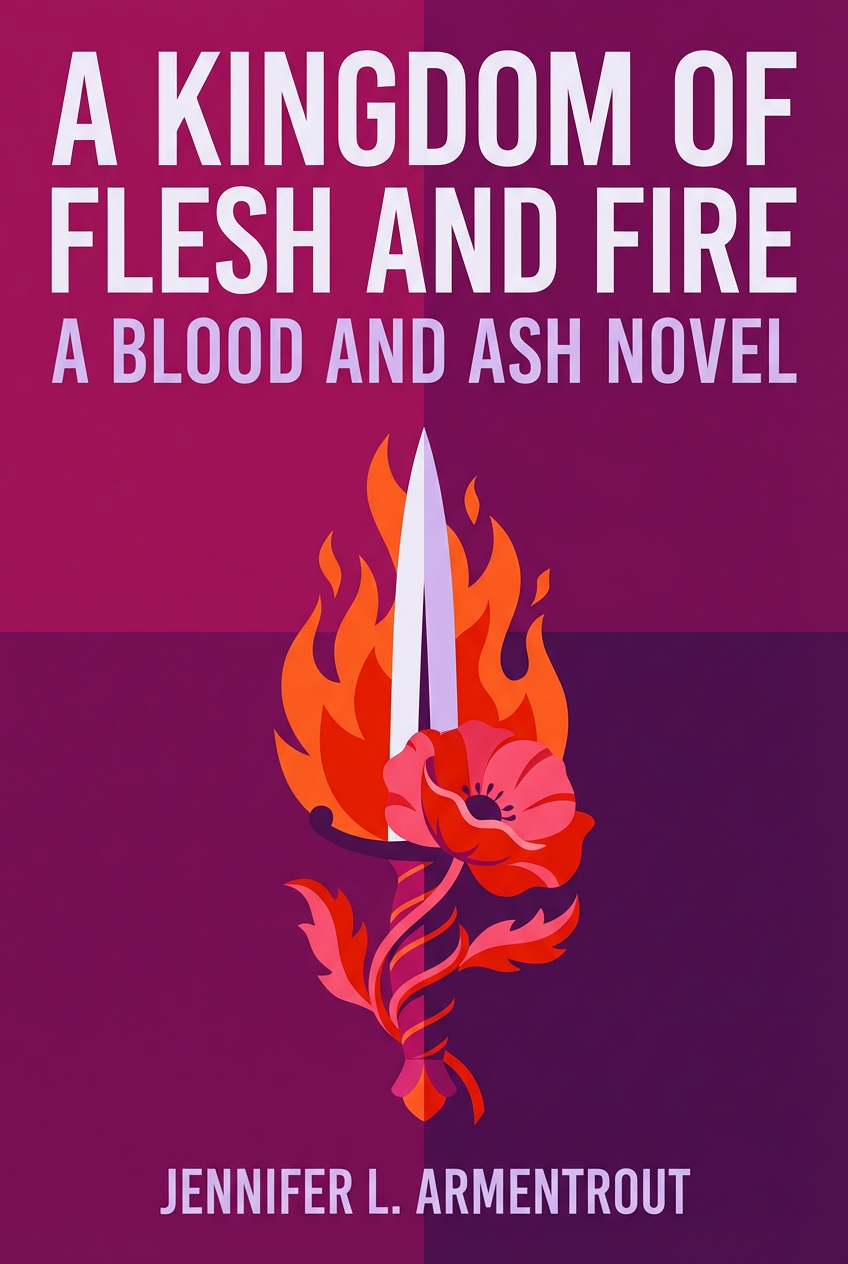
A Kingdom of Flesh and Fire book cover

The Script

Consider a family heirloom, a finely wrought silver locket, passed down through generations. To the world, it is a symbol of a noble lineage, a testament to enduring love and loyalty. It is polished and presented as proof of an unbreakable bond. But for the one who wears it, the locket is a constant, cold weight against their skin. They know that what looks like a hinge is actually a seam, that what appears to be a clasp is a lock. They know the locket is sealed shut, its hollow interior holding not a cherished portrait, but a damning secret—a truth so corrosive it would shatter the family’s legacy if ever revealed.

This is the terrible space Poppy Balfour now occupies. She is the Maiden, a revered figurehead, but she is also a prisoner, bound to a dark and captivating prince who has just revealed that everything she believed about her life, her purpose, and her kingdom was a meticulously crafted lie. The locket of her identity has been pried open, and the truth inside is a declaration of war. She is now trapped in a hostile kingdom, surrounded by people who despise her, yet inexplicably drawn to the very man who orchestrated her downfall. Her entire existence has become a tightrope walk between simmering rage and a forbidden, undeniable passion, where every step risks a fatal fall.

That feeling—of being caught between a devastating betrayal and an impossible attraction—is the engine that drives Jennifer L. Armentrout’s work. A prolific author known for crafting high-stakes paranormal romance and fantasy, Armentrout specializes in creating worlds where love and danger are deeply intertwined. With A Kingdom of Flesh and Fire, she wanted to explore the messy, complicated aftermath of a world-shattering revelation. Instead of a simple story of revenge, she delves into the psychological chaos of a young woman forced to reconcile her duty to her people with the magnetic pull of her heart's greatest enemy, creating a story where the most dangerous battlefield is the one within.

Module 1: The Anatomy of Betrayal and Identity Collapse

The story opens on a knife's edge. Poppy, once revered as the Maiden, a sacred figure in her kingdom, has been taken. Her captor is the man she knew as Hawke, a loyal guard she was falling in love with. But Hawke was a lie. He is actually Prince Casteel Da’Neer, the feared leader of an enemy kingdom. This single revelation detonates her entire world.

The first crucial insight is that betrayal shatters your fundamental sense of self. Poppy's identity was built on her role as the Maiden. This role dictated her every action, her every belief. When Casteel reveals his true identity, he doesn't just break her heart. He erases the person she thought she was. She is no longer the Chosen One. She is a political prisoner, a pawn in a war she barely understands. This forces her to confront a terrifying question: without her title, without her purpose, who is she? This is a powerful parallel for anyone whose career or role has defined them. When that role is stripped away, what remains? Armentrout suggests that this void is both a crisis and an opportunity.

This leads to the next point. True autonomy begins when you reject the roles others have assigned you. Poppy’s life as the Maiden was one of extreme control. Simple things like holding hands were forbidden. Her body, her choices, her future—none of it was her own. In captivity, she makes a defiant declaration. "I was no longer the Maiden," she says. "I would no longer be controlled." This marks a profound psychological shift. Even as a prisoner, she begins to assert her agency. She challenges Casteel's authority. She secretly procures a weapon. She refuses to be a passive victim. The lesson here is clear. Your circumstances don't define your agency. Your response to them does.

But what happens when the source of your betrayal is also your only path forward? This is the core tension of the book. Poppy must work with Casteel to find her missing brother. This forces her into a dangerous alliance. Navigating adversarial relationships requires you to separate emotion from strategy. Poppy is intensely attracted to Casteel. She also hates him for his deception. She can't trust him. Yet she needs him. This forces a level of emotional discipline. She must constantly weigh his actions against his words. She must analyze his motives. Is he manipulating her? Or is there a sliver of the man she thought she knew, Hawke, still there? This dynamic is a masterclass in managing high-stakes relationships where trust is a liability, but cooperation is a necessity.

Finally, the story shows that rebuilding your identity requires confronting uncomfortable truths about your own history. Poppy learns that the history of her kingdom, the nature of its rulers, and even the monsters she was taught to fear are all based on lies. The "evil" Atlantians are not mindless beasts. The "blessed" rulers of her kingdom are vampiric parasites. Accepting these truths is painful. It means admitting she was complicit in a system of oppression, even if unknowingly. But this acceptance is what allows her to forge a new moral compass. It’s a reminder that personal growth is impossible without the courage to question our most deeply held beliefs.

Module 2: The Currency of Power in a World of Conflict

As Poppy navigates her new reality, she quickly learns that power is not just about physical strength or political titles. It’s a complex interplay of violence, perception, and strategic vulnerability.

First, the book makes a stark argument: in a world of high stakes, protection is absolute and often enforced with brutal violence. Early in the story, an Atlantian wolven named Landell publicly insults and threatens Poppy. Casteel’s response is immediate and shocking. He rips out Landell's heart with his bare hands. This is a calculated act of power. Casteel declares, "No one speaks of you or to you like that and lives." He establishes a non-negotiable boundary. This act serves two purposes. It eliminates an immediate threat. And it sends a chilling message to anyone else who might challenge his authority or his claim over Poppy. This demonstrates that in some environments, decisive, ruthless action is the clearest form of communication.

But flip the coin. Power is also about recognizing and validating the strength in others. Poppy is covered in scars from a childhood attack. Her society taught her to view them as a mark of shame. Duke Teerman, a figure from her past, called one side of her face a "masterpiece" and the scarred side a "nightmare." But Casteel, when he first saw her scars, told her, "There is no side of you that is not as beautiful as the other half." This radical acceptance had a profound impact. It was the first time she felt beautiful. Even after his betrayal, she holds onto the truth of his words. The takeaway is powerful. Recognizing and affirming someone's value, especially where they feel most vulnerable, is a potent form of influence. It can forge a bond that even betrayal cannot completely sever.

Now, let's turn to the political landscape. Poppy is no longer just a person. She's a symbol. Individuals are often instrumentalized as political pawns, their humanity secondary to their strategic value. To some Atlantian factions, Poppy is simply "the Queen's favorite." She's a bargaining chip to be traded for Casteel's brother. To others, she is a living symbol of the enemy kingdom, a threat to be eliminated. Her unique abilities and heritage only make her more valuable and more dangerous. This dehumanization is a constant battle. The book forces us to consider how often we see people as resources or obstacles rather than as individuals with their own agency. Poppy's fight is for her very personhood.

And here's the thing. This leads to a fascinating paradox. The most dangerous person in the world can also be your only source of safety. Kieran, Casteel's closest confidant, confirms that Casteel has earned his fearsome reputation as "the Dark One." He is a killer. He is ruthless. But Kieran tells Poppy, "He’s the one thing in all the kingdoms that you, and only you, never have to fear." This establishes an exclusive, protective bond. Casteel's violence is a storm that rages against the world, but Poppy stands in its calm, protected eye. This dynamic explores the idea that loyalty and protection are not always gentle. Sometimes, they wear the face of a monster.

Module 3: The Intimacy of Conflict and Unraveling Truths

The relationship between Poppy and Casteel is a constant storm of conflict and attraction. Their interactions are a high-stakes negotiation of power, desire, and truth, often playing out through physical and verbal sparring.

One of the most compelling insights is that conflict can be a form of charged, intimate communication. Early on, Casteel offers Poppy a deal. If she can defeat him in a sword fight, she can go free. He knows she can't win. The fight is a controlled outlet for her rage. During the fight, he taunts her, challenges her, and engages her intellect. This pushes her to focus her anger and frustration on him, paradoxically creating a moment of intense, shared focus. Their physical struggle becomes a language of its own, a way to communicate when words are laden with lies and mistrust.

This intense dynamic reveals a deeper truth. Beneath layers of hostility, moments of raw vulnerability can forge unexpected connections. In the middle of their fight, Casteel’s arrogance slips. He asks her, "Did I frighten you tonight? With Landell?" He's asking if his act of violent protection drove her away. This moment reveals his fear of her perception of him. He later explains the murder of Landell was an act of pure protective fury. He tells her, "you never need to fear me. Never." This vulnerability, emerging from a place of conflict, complicates their relationship. It suggests that his antagonism and his protection are two sides of the same coin.

So what happens next? The story uses external threats to force internal revelations. Confronting a shared enemy can dismantle long-held propaganda and reveal personal truths. During their fight, they are attacked by the Craven, mindless vampiric creatures. Poppy watches them attack Casteel and realizes the foundational lie she was taught—that Casteel, the Dark One, controls them—is false. The physical evidence dismantles the lie in real time. More importantly, Poppy has been bitten by Casteel and did not turn into a Craven. This proves another piece of propaganda is false. It forces her to ask the critical question: "It’s because I’m part Atlantian, isn’t it?" The shared crisis becomes a catalyst for truth, unraveling the lies of her past.

Building on that idea, confronting past trauma through present action is a powerful path to empowerment. When facing the Craven, Poppy is momentarily paralyzed by a flashback to the childhood attack that scarred her. But she breaks free by asserting her present strength. "I wasn’t a small child now," she thinks. "I wasn’t weak. I wasn’t prey." She then kills the creature with a rage-filled shout. She is killing the memory that held her captive. She reclaims her agency by confronting the echo of her past trauma and destroying it. The fight becomes a cathartic act of self-liberation.

Read More