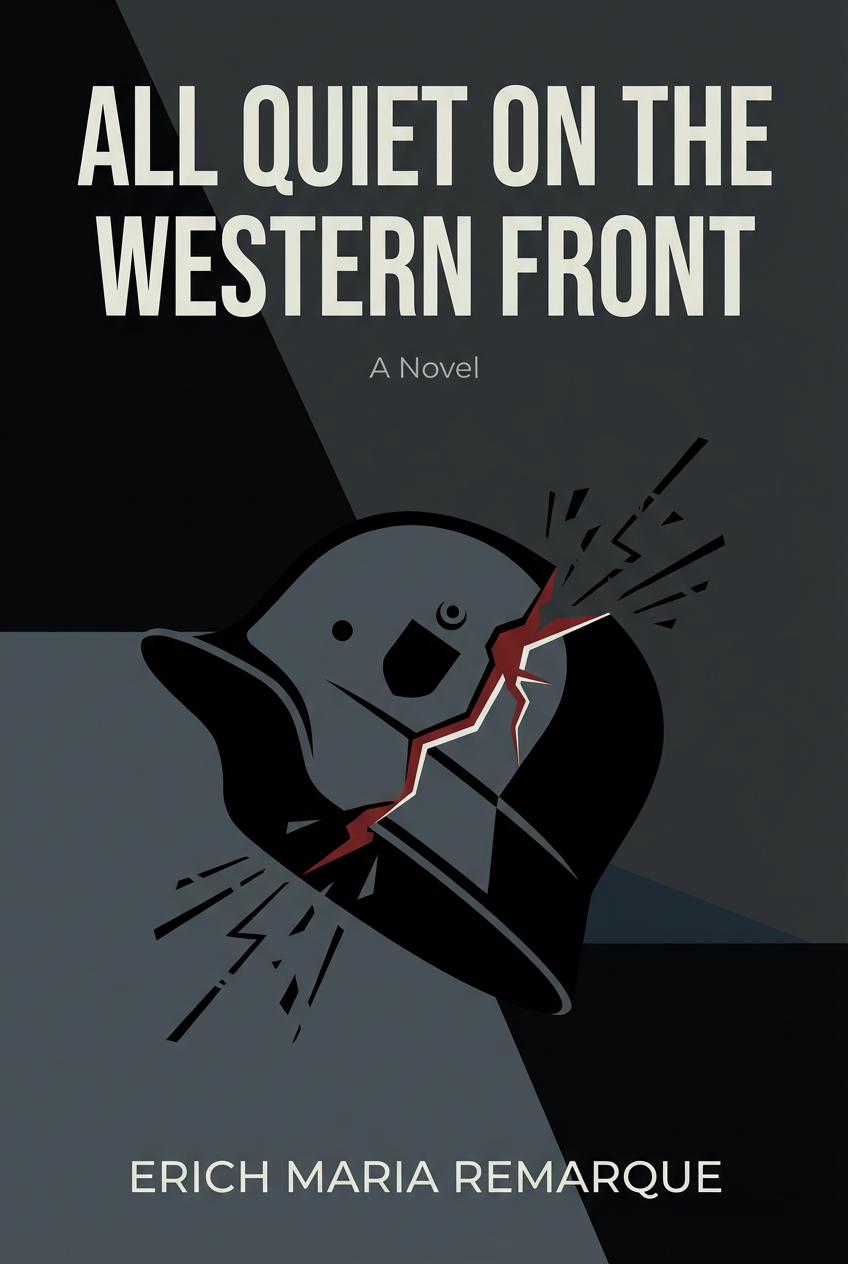
All Quiet on the Western Front
A Novel
What's it about
Ever wondered what war truly does to the human spirit, beyond the headlines and history books? Get ready to step into the trenches of World War I and experience the brutal, unfiltered reality of a soldier's life, where youthful idealism is shattered by the horrors of combat. You'll follow Paul Bäumer, a young German soldier, as he and his comrades navigate the terrifying chaos of the Western Front. Discover how the intense bonds of friendship become the only lifeline in a world of constant danger, and learn why the "lost generation" felt so disconnected from a home they could no longer recognize.
Meet the author
A German veteran of World War I, Erich Maria Remarque was conscripted into the army at age 18, experiencing firsthand the brutal realities of trench warfare. His seminal novel, All Quiet on the Western Front, draws directly from his harrowing service on the Western Front, where he was wounded multiple times. This profound personal experience gave him the unique authority to expose the immense physical and psychological trauma inflicted upon the "lost generation" of soldiers, creating one of history's most powerful anti-war statements.
Opens the App Store to download Voxbrief

The Script
Think of a young, enthusiastic apprentice signing up for a masterclass in a revered craft—say, metalworking. He arrives on the first day, filled with stories of honor and glory, imagining the noble art of forging shining armor. His teacher, however, doesn't hand him a hammer and a glorious blueprint. Instead, he’s given a bucket and a shovel and told to spend his days digging trenches for a new drainage system. The work is muddy, exhausting, and utterly devoid of artistry. His hands, which he dreamed would shape steel, are instead raw from hauling dirt. The initial pride he felt in joining the workshop curdles into a bleak, day-to-day struggle for survival against the mud, the rain, and the gnawing pointlessness of the task.
He is no longer an apprentice learning a craft; he is merely a body, a tool for moving earth from one place to another. The grand narrative of becoming a master craftsman has dissolved, replaced by the immediate, animal reality of hunger, exhaustion, and the desperate need for a dry place to sleep. This profound disconnect—between the glorious promise of a calling and its brutal, dehumanizing reality—is the exact chasm that Erich Maria Remarque sought to bridge. Having been conscripted into the German Army at eighteen, Remarque experienced firsthand how the patriotic fervor of war propaganda shattered against the horrific, visceral truth of trench warfare. He wrote All Quiet on the Western Front as a testament, an attempt to simply report what it was like to have one's generation and one's very soul destroyed by a war they were told was their glorious duty.
Module 1: The Great Severing
The war’s first casualty wasn't a soldier. It was the soldier's past. For Paul Bäumer and his comrades, enlisting meant a violent severing from everything they knew. Their youthful dreams, their education, their very identities were rendered obsolete overnight. This is the foundational trauma of the book. It’s about having your life erased before it has even begun.
The most brutal lesson is that pre-war knowledge and ideals are worthless at the front. The boys recall their schoolmaster, Kantorek, who filled their heads with patriotic fervor. He convinced them to enlist, calling them the "Iron Youth." But this romanticism shatters with the first death. They quickly learn that knowing how to light a cigarette in the rain is more valuable than philosophy. Knowing how to find cover is more important than poetry. The war creates a new, brutal logic. Survival is the only curriculum.
This leads to a profound sense of alienation. For older soldiers, the war is an interruption. They have wives, jobs, and children to return to. But for Paul’s generation, the war is their reality. He reflects that his past life feels like a ghost. He is cut off from it completely. As he puts it, they have become a "waste land." This creates a chasm between the soldiers and the civilians they are supposedly fighting for. The people back home cannot possibly understand. Their concerns seem trivial. Their patriotism feels hollow.
So what replaces this severed past? A new, hardened identity is forged. Survival demands a pragmatic, often brutal, worldview. Moral abstractions are a luxury they can't afford. This is powerfully illustrated by the episode with Kemmerich’s boots. As their friend lies dying, the soldiers are already thinking about who will get his high-quality leather boots. It seems callous. But the book presents it as grimly logical. Good boots are scarce. They are essential for survival. Kemmerich is going to die, and the boots will be wasted on an orderly. This cold, factual calculus is a necessary psychological armor. It’s how they endure an environment where sentimentality is a fatal weakness.
From this foundation, we see the complete inversion of their upbringing. The army's dehumanizing training becomes a grim but necessary preparation for survival. Corporal Himmelstoss, a petty tyrant, torments them with absurd and humiliating drills. He forces them to scrub floors with a toothbrush and remake beds fourteen times. They hate him for it. But later, at the front, Paul realizes this brutal training was essential. It made them "hard, suspicious, pitiless, vicious, tough." It stripped away their civilian softness, which would have gotten them killed. This paradox is central to the soldier's experience. The very process that breaks their spirit is what allows their body to survive.
Module 2: The New Religion of Comradeship and the Earth
With their pasts erased and their futures uncertain, what anchors these soldiers? Remarque offers two powerful answers. First, the earth itself. Second, the bonds of comradeship. These become the new pillars of their existence, a replacement for the family, religion, and society they left behind.
Let’s turn to the first pillar. In combat, the earth becomes a soldier's only true protector. This is a visceral, spiritual connection. When shells rain down, a soldier doesn't just dig into the ground. He presses himself into it, seeking its shelter. Paul describes the earth as his "only friend, his brother, his mother." He stifles his cries in its silence. It’s a primal, animalistic instinct. The soldier becomes a "human animal," relying on a second sight that throws him to the ground moments before an explosion. This connection is pre-conscious. It’s a physical communion with the one force that can offer a chance at life against the mechanical indifference of artillery.
And here's the thing. This bond with the earth is what allows the second pillar, comradeship, to flourish. Comradeship is the only source of meaning in a meaningless world. It is a deep, unspoken solidarity forged in shared terror. These men rely on each other for everything. They share food, they protect each other from shell-fire, and they offer a rough, unsentimental comfort. When Paul gets lost on patrol, it’s the sound of his comrades' voices that saves him from a complete breakdown. He calls these voices "more to me than life." They are his anchor in the chaos.
This bond creates a moral code that supersedes military law. The group's loyalty to each other overrides institutional authority. When their hated drill sergeant, Himmelstoss, arrives at the front, his authority evaporates. The soldiers openly mock him. His parade-ground tyranny is meaningless here. Even their lieutenant, an officer who came up from the ranks, understands this. He sides with the men in disputes, recognizing that the shared reality of the trenches is more powerful than any regulation. This solidarity is their true chain of command.
But flip the coin. This intense bond also makes loss unbearable. The death of a comrade is a tearing of the fabric of this small, fragile community. This is why the death of Stanislaus Katczinsky, or "Kat," is the emotional climax of the book. Kat is the ultimate survivor. He’s a master forager, a father figure, and Paul’s closest friend. When Kat is wounded, Paul carries him for miles, desperate to save him. But a tiny, stray splinter kills Kat just as they reach safety. With his death, Paul's last connection is severed. The brotherhood is broken. He is truly alone.