All BooksSelf-GrowthBusiness & CareerHealth & WellnessSociety & CultureMoney & FinanceRelationshipsScience & TechFiction
Download on the App Store

An Occurrence at Owl Creek Bridge

Essential Short Stories Teaching Unit

14 minAmbrose Bierce

What's it about

Struggling to make classic literature exciting for your students? Discover how to transform Ambrose Bierce's timeless stories into unforgettable lessons that captivate even the most reluctant readers, boosting engagement and critical thinking skills with proven, ready-to-use strategies. You'll get a complete teaching toolkit for "An Occurrence at Owl Creek Bridge" and other essential short stories. This unit provides you with detailed lesson plans, character analysis guides, and creative writing prompts that demystify literary devices and help your students master complex themes of war, reality, and perception.

Meet the author

Ambrose Bierce was a celebrated Civil War soldier and journalist whose unflinching dispatches from the front lines gave him unparalleled insight into the psychology of conflict. This firsthand experience as a Union Army officer, including participation in the brutal Battle of Shiloh, directly informed his famously dark and realistic fiction. His stories dissect the illusions of war, glory, and the human mind with a cynical wit and precision that remains as sharp and unsettling today as it was over a century ago.
Listen Now
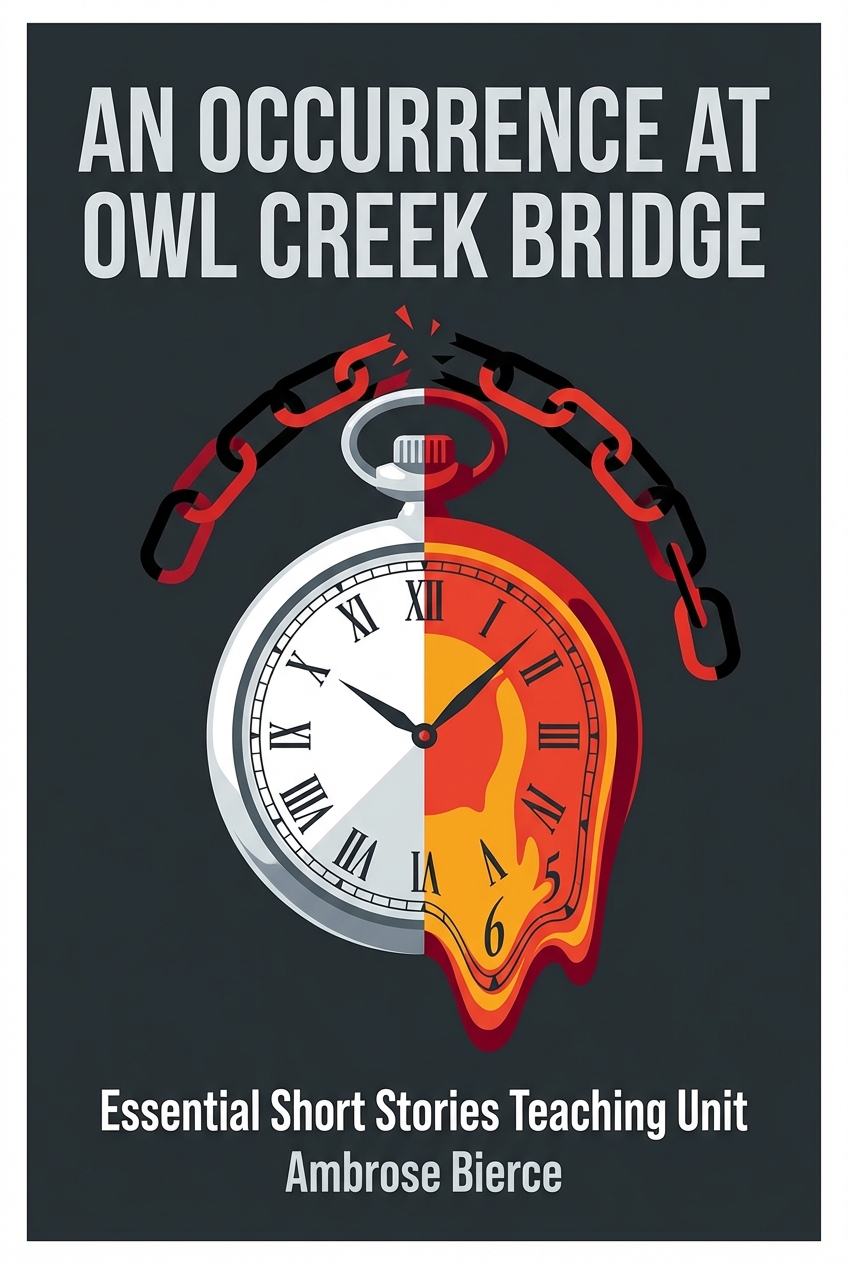
An Occurrence at Owl Creek Bridge book cover

The Script

A professional stage magician stands before a locked wooden chest on an empty stage. He doesn’t have the key. His task is to escape, to convince an audience that he can bend the laws of physics and time to find freedom. He invites a volunteer to inspect the ropes that bind his wrists, the heavy chains, the solid steel of the locks. Every element is real, tangible, and escape-proof. The crowd holds its breath. The curtain falls. Seconds later, it rises again, and the magician stands free, the chest still locked behind him. The audience erupts in applause, delighted by the deception. They don't question the impossibility; they celebrate it. They willingly participated in a fantasy, a shared, temporary suspension of disbelief where a desperate wish for escape becomes, for a moment, a breathtaking reality.

But what if that magician isn't performing for an audience? What if he is both the performer and the sole spectator, trapped not on a stage, but on a crude wooden plank high above a river, a rope cinched tight around his neck? In that final, silent moment, the human mind can become the ultimate escape artist, constructing an elaborate, vivid fantasy of freedom so powerful it feels more real than the crushing reality. This is the territory Ambrose Bierce, a man who had stared directly into the brutal machinery of the Civil War, chose to explore. Having served as a Union officer and witnessed the stark, unglamorous finality of battle firsthand, Bierce became obsessed with the gap between the romantic ideals of war and its grim, physical truth. He wrote "An Occurrence at Owl Creek Bridge" as a chilling examination of the mind's last, desperate act of rebellion against the undeniable.

Module 1: The Architecture of Illusion

Let's start with the story that gives the collection its name. "An Occurrence at Owl Creek Bridge" is a brilliant piece of narrative engineering. It’s structured in three parts. Each part manipulates our perception of time and reality.

The story opens with a man on a bridge. His name is Peyton Farquhar. He is a Southern civilian planter. He is about to be hanged by the Union Army. The scene is described with cold, military precision. Soldiers stand at "parade rest." An officer consults his watch. Death is treated as a formal dignitary. This clinical detachment is the first layer of the story's psychological horror. It frames a human life as a procedural matter.

Here we find our first key insight. Extreme duress suspends and distorts our perception of time. As Farquhar waits, the ticking of his watch slows down. The intervals between ticks become agonizingly long. Sound becomes distorted. He hears a "sharp, distinct, metallic percussion like the stroke of a blacksmith's hammer." It’s just his watch. But his fear amplifies it into something monstrous. This is Bierce showing us how the mind’s internal clock breaks under pressure. For a leader managing a crisis, this is a critical lesson. The subjective experience of time for your team can stretch or compress. What feels like an instant to you might feel like an eternity to them.

Now, let's turn to the execution itself. The plank is kicked away. Farquhar falls. But the rope breaks. He plunges into the creek below. What follows is a desperate, heroic escape. He dodges bullets. He navigates a whirlpool. He runs for miles through a strange, beautiful forest. The trees look like giant plants. The sand glitters like diamonds. His senses are preternaturally sharp. He can see individual leaves on trees. He can hear the humming of gnats. This leads to the second insight. In moments of perceived survival, the mind creates a hyper-real sensory experience. Everything becomes sharper, more vivid. This heightened state is the mind's way of focusing all its resources on a single goal: survival. It’s a powerful, all-consuming state. But is it real?

Building on that idea, the escape narrative is a masterclass in hope. Farquhar finally reaches his home. He sees his wife standing on the veranda. She is beautiful, a vision of safety and love. He surges forward to embrace her. And then, the story snaps back to reality. "As he is about to clasp her he feels a stunning blow upon the back of the neck; a blinding white light blazes all about him with a sound like the shock of a cannon—then all is darkness and silence! Peyton Farquhar was dead; his body, with a broken neck, swung gently from side to side beneath the timbers of the Owl Creek bridge."

This brutal ending delivers the story's core truth. The human mind can construct an elaborate, comforting fantasy in the instant before death. The entire escape—the broken rope, the swim, the long journey home—was a hallucination. It all happened in the split second between the fall and the snap of his neck. Farquhar’s desire for life was so powerful it built a complete, detailed narrative of survival. It’s a tragic and profound statement on the power of hope and the mind's ability to shield itself from unbearable reality. This is the ultimate user-generated content. A reality created to meet a desperate need.

Read More