All Books
Self-Growth
Business & Career
Health & Wellness
Society & Culture
Money & Finance
Relationships
Science & Tech
Fiction
Topics
Blog
Download on the App Store

Bird by Bird

Some Instructions on Writing and Life

18 minAnne Lamott

What's it about

Feeling overwhelmed by that big writing project? Discover the powerful secret to conquering the blank page with one simple mantra: "bird by bird." This summary unlocks Anne Lamott's famously compassionate and funny guide to silencing your inner critic and finally getting your story told. You'll learn why "shitty first drafts" are essential for creativity and how to develop compelling characters that feel real. Dive into practical advice on plot, dialogue, and finding your unique voice, all while learning to trust the messy, beautiful, and human process of writing.

Meet the author

Anne Lamott is a New York Times bestselling author and Guggenheim Fellow whose honest, humorous wisdom has made her a revered mentor for aspiring writers. Drawing from her own chaotic and heartfelt journey as a writer and teacher, she demystifies the creative process with radical honesty. Her work grants permission to be imperfect, offering compassionate and practical advice to help anyone find their voice and get the work done, bird by bird.
Listen Now

Opens the App Store to download Voxbrief

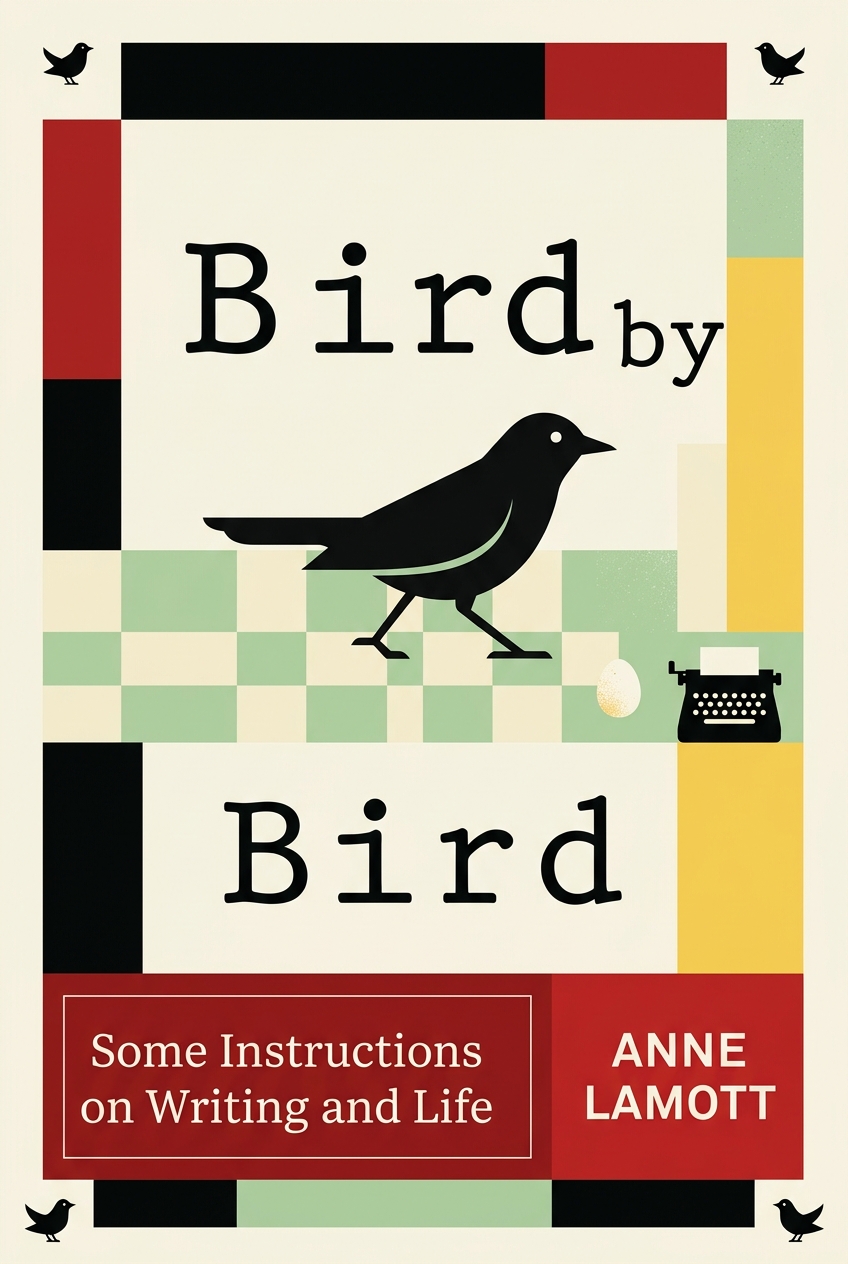
Bird by Bird book cover

The Script

The apprentice weaver sits before the great loom, its wooden frame holding a vast emptiness. To one side is the pattern—a dizzying diagram of interlocking shapes and colors that promises a breathtaking scene of a forest at dawn. To the other, a basket of threads, a chaotic tangle of greens, golds, and deep blues. The distance between the jumbled thread and the finished vision feels impossibly wide. The mind races, trying to hold the entire sequence of a thousand throws of the shuttle at once, and finds only paralysis. The hands freeze. The project is too big, the final image too perfect to even begin. But then the master weaver’s voice echoes in her memory, a simple instruction from the first day: “Don't try to weave a forest. Just pick up one thread.” The apprentice reaches for a single strand of deep green. She guides it through the warp, over and under. One thread. The shuttle makes a soft, satisfying thump as it settles into place. The forest is not yet visible, but something has begun. The chasm between idea and reality has been crossed by a single, fragile line.

This feeling of being overwhelmed by the sheer scale of a creative project is the silent terror of every writer staring at a blank screen. The entire novel, the whole memoir, the sweeping argument—it all clamors for attention at once, creating a noise so loud it becomes impossible to hear the first word. Anne Lamott spent years sitting with this paralysis, both in her own work and in the faces of the students in her writing classes. As a successful novelist and columnist, she knew the professional pressure to produce, but it was her role as a teacher that revealed how universal the struggle truly was. Bird by Bird wasn't written from a pedestal of effortless success; it was assembled from the trenches. It is the frank, funny, and profoundly compassionate advice she found herself giving over and over again—to her students, and just as often, to herself. It’s the permission slip to be messy, to write a terrible first draft, and to find a way forward by focusing on the single, manageable piece right in front of you.

Module 1: Taming the Beast — The "Bird by Bird" Method

We've covered the origin of the book's title. Now let's explore how to apply this philosophy to any overwhelming task. The core problem Lamott addresses is our tendency to see the entire mountain we have to climb. We see the finished novel, the launched product, the perfected presentation. And that vision freezes us. Lamott’s approach is about shrinking your field of vision until the work becomes manageable.

The first step is to break down overwhelming projects into short, manageable assignments. Lamott keeps a one-inch picture frame on her desk. It's a physical reminder. When she feels paralyzed by the scope of a book, she tells herself to write only what she can see through that tiny frame. This could be a single paragraph. It might be describing one character walking into a room. For a product manager, this means writing one user story. For a founder, this means drafting the first three bullet points of the pitch deck. By focusing on a small, concrete task, you create forward motion.

Building on that idea, you must give yourself permission to produce a "shitty first draft." Perfectionism is the enemy of creativity. It’s the voice that tells you not to even start because the result won't be good enough. Lamott argues that nearly all good writing begins with a terrible first draft. She calls this the "child's draft." It's where you let everything pour out onto the page without censorship. It’s messy, chaotic, and often embarrassing. But it's essential. This draft is for your eyes only. Its purpose is simply to exist. It provides the raw material, the clay that you can later shape and refine. A friend of hers breaks it down into three stages. The "down draft" is where you just get it down. The "up draft" is where you fix it up. And the "dental draft" is where you check every last detail. You cannot get to the third stage without starting with the first.

From this foundation, Lamott introduces a powerful metaphor for the creative process. Trust that the story will reveal itself like a developing Polaroid. When you start writing, you don’t need to know the entire plot. You just need a point of focus. Something that interests you. Lamott compares this to taking a Polaroid picture. At first, the image is a murky, greenish-gray blur. You can’t see the details. But if you wait patiently, the picture slowly comes into focus. A face emerges. Then you see the background. Then you notice a small object in the corner that changes the entire meaning of the photo. Writing is the same. You start with a character or a situation. As you write your shitty first draft, the story begins to develop. The theme emerges. The plot reveals itself. The writer E. L. Doctorow said writing a novel is like driving at night. You can only see as far as your headlights, but you can make the whole trip that way.

Module 2: The Writer's Mind — Quieting the Inner Chaos

So far, we've focused on the practical process of getting started. But the biggest battles are often internal. Lamott is brutally honest about the psychological challenges of creative work. She argues that managing your own mind is just as important as managing your prose.

Here's where it gets interesting. You must learn to silence the internal radio station of self-doubt and self-aggrandizement. Lamott calls this "Radio Station KFKD." It's the constant chatter in your head that broadcasts on two channels simultaneously. On one channel, it plays fantasies of your own genius and success. You imagine yourself on a talk show, accepting an award, receiving thunderous applause. On the other channel, it plays a relentless stream of self-loathing. It lists all your failures. It compares you to others. It tells you that everything you create is worthless. This internal noise is a massive distraction. It drains your energy and pulls you away from the actual work. Lamott suggests a simple visualization to manage it. Picture each critical voice as a mouse. Pick it up by the tail, drop it into a jar, and screw the lid on. You don't have to eliminate the voices. You just have to turn down the volume so you can hear yourself think.

And it doesn't stop there. Jealousy is an occupational hazard that must be acknowledged and managed. In any competitive field, you will see others succeed. Sometimes, they will be people you feel are less deserving. Lamott describes jealousy as a deeply degrading emotion. It feels like "oozing unhappiness, like a sump." It stems from a deep-seated feeling of exclusion and a tendency to compare your messy insides to other people's polished outsides. Lamott says there's no magic cure. The only things that help are getting older, talking about it with trusted friends, and using it as material for your work. She found immense relief in a Clive James poem titled "The Book of My Enemy Has Been Remaindered." It made the ugly feeling of professional envy relatable and even funny. Acknowledging the emotion robs it of its power.

Consequently, it becomes clear that writer's block is a state of emptiness. When you feel stuck, your creative well is dry. Trying to force words onto the page is like trying to draw water from an empty well. It only creates frustration. The solution is to step away and refill. Lamott suggests that when you feel empty, your only job is to write one single page of anything. It can be stream of consciousness. It can be a list of memories. It can be a description of how much you hate writing. The point is to maintain the habit. After that, you must get up from your desk and live. Go for a walk. Read a book. Talk to a friend. These activities are the work. They are how you refill the well with new observations, ideas, and emotions, trusting that your unconscious mind is still working in the background, stitching things together.

Module 3: The Craft in Action — Finding Your Story and Characters

We've covered mindset. Now, let's turn to the craft itself. Lamott offers practical advice on how to build a story from the ground up. Her approach is organic and character-driven. It is a process of discovery.

The first principle is that plot emerges naturally from character. Instead of trying to invent a clever plot, Lamott advises you to focus on knowing your characters deeply. What do they want? What are they afraid of? What do they carry in their pockets? She uses a friend's metaphor of an "emotional acre." Every person, and every character, has an internal landscape that defines them. Your job as a writer is to explore that acre. If you truly understand two compelling characters and put them in a room together, something is bound to happen. Their desires will clash. Their fears will be triggered. Their actions and reactions will create the plot. As the novelist Flannery O'Connor's neighbor once said of her stories, "Them stories just gone and shown you how some folks would do." That's plot. It's just showing how your characters would behave.

But flip the coin. You must let bad things happen to your characters. A common mistake is to protect the characters you love. You don't want them to suffer. But a story without stakes has no tension. If nothing is at risk, the reader has no reason to care. Lamott shares a story from an Al-Anon friend whose mother would drag her alcoholic father inside whenever he passed out on the lawn, trying to hide the problem. An older woman in the group gave her some advice: "Leave him lay where Jesus flang him." This applies directly to storytelling. You have to let your characters face the consequences of their actions. You have to let them fail. That's where the drama, and the truth, lies.

Furthermore, authentic dialogue is a translation of speech. Real-life conversation is often rambling, repetitive, and full of filler. Fictional dialogue needs to be sharper and more purposeful. Lamott’s best advice for testing your dialogue is simple: read it out loud. You will immediately hear what sounds unnatural. Each character should have a distinct voice. You should be able to cover up the names and still know who is speaking. A powerful exercise she suggests is to trap two characters who hate each other in a stuck elevator. The supercharged atmosphere forces interaction. What they say, and more importantly, what they don't say, will reveal everything about them.

Read More