All Books
Self-Growth
Business & Career
Health & Wellness
Society & Culture
Money & Finance
Relationships
Science & Tech
Fiction
Topics
Blog
Download on the App Store

Brave, Not Perfect

Fear Less, Fail More, and Live Bolder

16 minReshma Saujani

What's it about

Tired of the pressure to be perfect? What if you could silence the voice of self-doubt and finally pursue what you truly want, without fear of failure? This summary shows you how to break free from the "good girl" conditioning that holds you back. Discover how to embrace imperfection as your superpower. You'll learn practical strategies to build a "bravery muscle," reframe failure as data, and start living a bolder, more authentic life. It's time to stop playing it safe and start being brave.

Meet the author

Reshma Saujani is the visionary founder of Girls Who Code, the international nonprofit that has taught more than half a million girls and non-binary students to code. After witnessing a culture of perfectionism holding her students back, she was inspired to investigate the "bravery deficit" affecting women and girls everywhere. Her experiences running for political office and launching a national movement inform her powerful message that embracing imperfection is the key to a bolder, more authentic life.
Listen Now

Opens the App Store to download Voxbrief

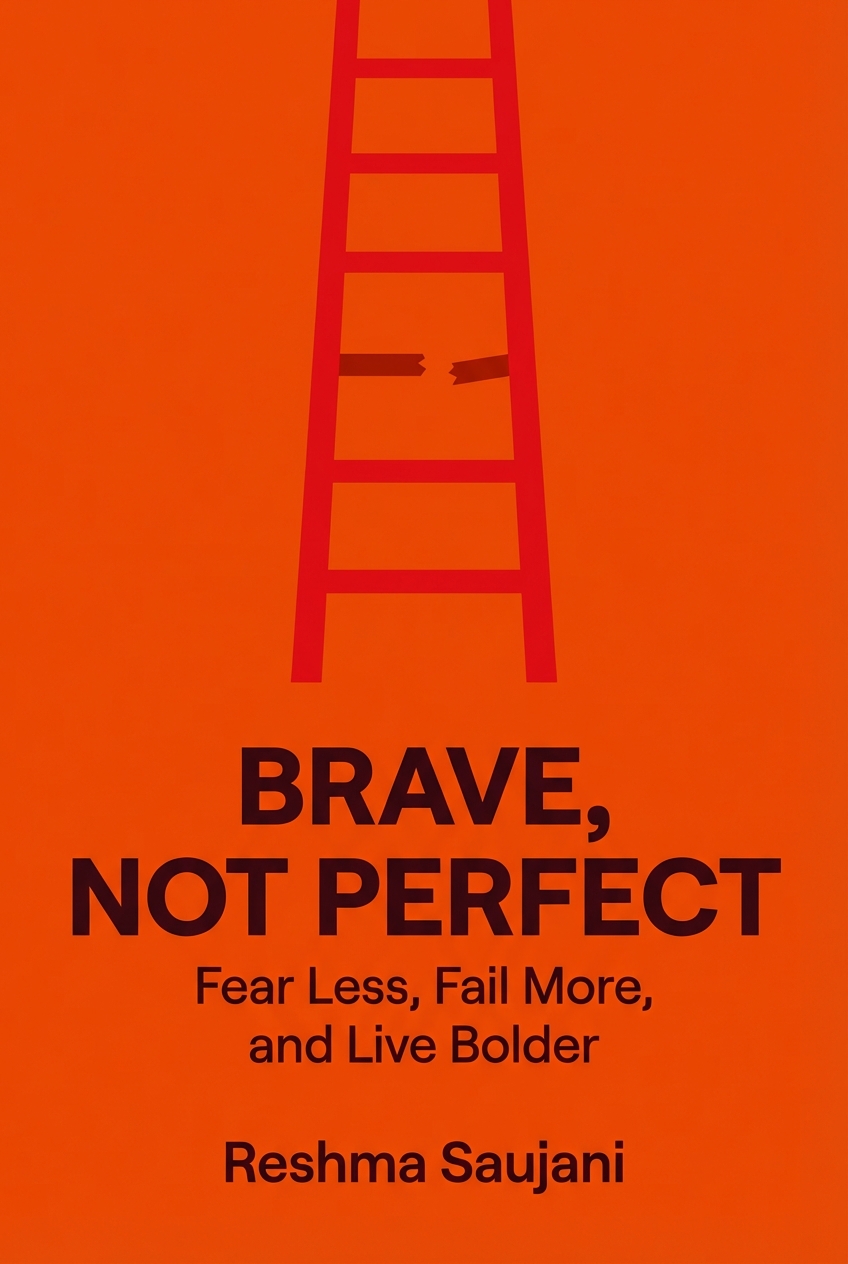
Brave, Not Perfect book cover

The Script

Think back to a coding class, an art studio, or even just a challenging project on your desk. You might see two distinct approaches. One person, when faced with a roadblock, will methodically delete their work, erasing every trace of the 'wrong' attempt before starting over from a clean slate. The other, however, might save the 'broken' version as 'v2_test,' scribble notes in the margins of their sketch, or keep the messy first draft. They see the error as a stepping stone—a clue pointing toward the solution. The first approach is driven by a deep-seated need to present a flawless history, to pretend the struggle never happened. The second is fueled by the courage to be imperfect, to embrace the messy, iterative process of growth and creation. For generations, society has overwhelmingly conditioned girls and women to adopt the first approach: to aim for perfection, to fear the visible mistake, and to retreat at the first sign of not getting it right.

This exact pattern is what Reshma Saujani witnessed firsthand on a national scale. As the founder of Girls Who Code, she created a nonprofit to close the gender gap in technology. She expected to see girls eager to learn and build, but instead, she saw a widespread 'perfection paralysis.' The brightest students would rather show a blank screen than a program with a single error. They would delete entire projects at the slightest hiccup. This recurring, heartbreaking observation became the driving force behind her work. Saujani realized the problem was a crisis of courage, born from a lifetime of being told to be perfect. This book is her response—a call to action to unlearn the destructive habit of perfectionism and rewire ourselves for bravery.

Module 1: The Perfectionist Conditioning

From the moment they're born, girls are wrapped in a different set of expectations. They are praised for being pretty, quiet, and accommodating. Boys are praised for being tough, loud, and adventurous. This is a pattern we see everywhere, from the playground to the classroom.

The author points to a simple experiment. Researchers offered children lemonade that was intentionally salted and tasted awful. The boys immediately spit it out, calling it gross. The girls politely drank it. They didn't want to hurt the researchers' feelings. This illustrates the core of the conditioning: The primary goal for girls is often to please others.

This people-pleasing reflex gets reinforced constantly. In school, girls who get straight A's and follow the rules are rewarded. They learn that achievement means flawless execution. This creates what Stanford psychologist Carol Dweck calls a "fixed mindset." Girls begin to believe their abilities are innate. If they aren't immediately good at something, they think they are simply not good at it, period.

As a result, girls are steered toward activities they can ace and away from challenges where they might fail. A girl might avoid cheerleading tryouts for fear of not making the team. Or she might drop an economics class after getting a B, while her male peers with the same grade stick with it. This behavior stems from a learned fear of imperfection. The message they internalize is clear: perfection is the standard, and anything less is failure.

This conditioning extends to how girls express themselves. When they speak up, they risk being labeled "bossy" or "aggressive." So they learn to be modest. They downplay their achievements. They feign surprise when they win an award. One study found women speak less than 75 percent of the time men do in meetings. They have been trained that being quiet is safer than being judged. The pressure to be perfect silences women's voices and discourages assertiveness.

It doesn't stop there. Social media amplifies this pressure to an extreme degree. Girls spend hours curating a flawless online image, editing photos to hide any imperfection. They live in a state of constant comparison, chasing likes and validation. The result is a generation of young women who are anxious, exhausted, and feel like they are never enough. They are trying to live up to an impossible standard, one that was set for them before they could even choose it for themselves.

Module 2: The Hidden Costs of Chasing Perfection

We've explored how girls are trained for perfection. Now let's examine the consequences. This training hardwires itself into a woman's decision-making, carrying steep personal and professional costs.

The skills that get girls praised in school—being agreeable, quiet, and meticulous—often backfire in the workplace. Being overly accommodating gets you more work. Staying quiet in meetings makes you invisible. The author makes a crucial point: Behaviors rewarded in girls become liabilities for women.

Think about the job market. A famous corporate report found that men apply for a job when they meet only 60% of the qualifications. Women, on the other hand, typically apply only if they meet 100%. This single statistic reveals the confidence gap created by perfectionism. Women hold themselves back from opportunities, waiting until they feel perfectly qualified. Men take the leap, trusting they can figure it out along the way. This is bravery in action versus perfectionist paralysis.

And here's the thing. This is about personal fulfillment. The book is filled with stories of women who followed a "perfect" path, only to find themselves miserable. Saujani shares her own story of going to Yale Law School and taking prestigious corporate jobs. She was building a perfect résumé to please her immigrant father. But she was hollow inside. It was someone else's dream.

This leads to a profound realization. The pursuit of perfection leads to a life dictated by external expectations. Women stay in jobs they hate because "it's what they're good at." They stay in relationships that don't fulfill them because it's what they're "supposed" to do. They spend so much time trying to check all the right boxes that they forget to ask themselves what they actually want. This disconnect is a major source of the anxiety and burnout many women experience.

Moreover, the chase for perfection is built on a series of myths. The first myth is that a flawless exterior protects you from judgment. It doesn't. Critics will always find something to criticize. Another myth is that once everything is perfect, you'll finally be happy. But happiness doesn't work that way. In fact, studies show that while women's objective lives have improved, their subjective happiness has declined. Perfectionism robs life of its joy.

Perhaps the most damaging myth is that failure is not an option. Perfectionists catastrophize mistakes, viewing them as evidence of fundamental personal failure. A single delayed email can trigger a spiral of self-doubt. Forgetting to pack the right snack for a child can feel like a referendum on your motherhood. This intense fear of failure prevents women from taking risks, innovating, and ultimately, from living a full and vibrant life. It keeps them playing small, stuck in a cycle of trying to control everything in a world that is inherently uncontrollable.

Read More