All Books
Self-Growth
Business & Career
Health & Wellness
Society & Culture
Money & Finance
Relationships
Science & Tech
Fiction
Topics
Blog
Download on the App Store

Black Fortunes

The Story of the First Six African Americans Who Survived Slavery and Became Millionaires

14 minShomari Wills

What's it about

Ever wondered how some people build incredible wealth against all odds? Discover the untold stories of America's first Black millionaires, who turned the trauma of slavery into fortunes. You'll learn the timeless financial principles and resilient mindsets they used to create lasting legacies. These aren't just stories; they're your blueprint for overcoming systemic barriers. Uncover the specific business strategies, investment tactics, and community-building secrets that enabled these pioneers to thrive in a hostile world. Learn how they navigated racism and economic oppression to build empires that inspire generations.

Meet the author

Shomari Wills is an acclaimed journalist whose work has appeared in TIME, The New York Times, and on Good Morning America. A former reporter for the New York Post, his deep experience in uncovering compelling stories led him to research his own family's history, revealing a forgotten ancestor who was one of America's first Black millionaires. This personal discovery inspired him to write Black Fortunes, unearthing the incredible and long-hidden sagas of the nation's earliest African American financial pioneers.
Listen Now

Opens the App Store to download Voxbrief

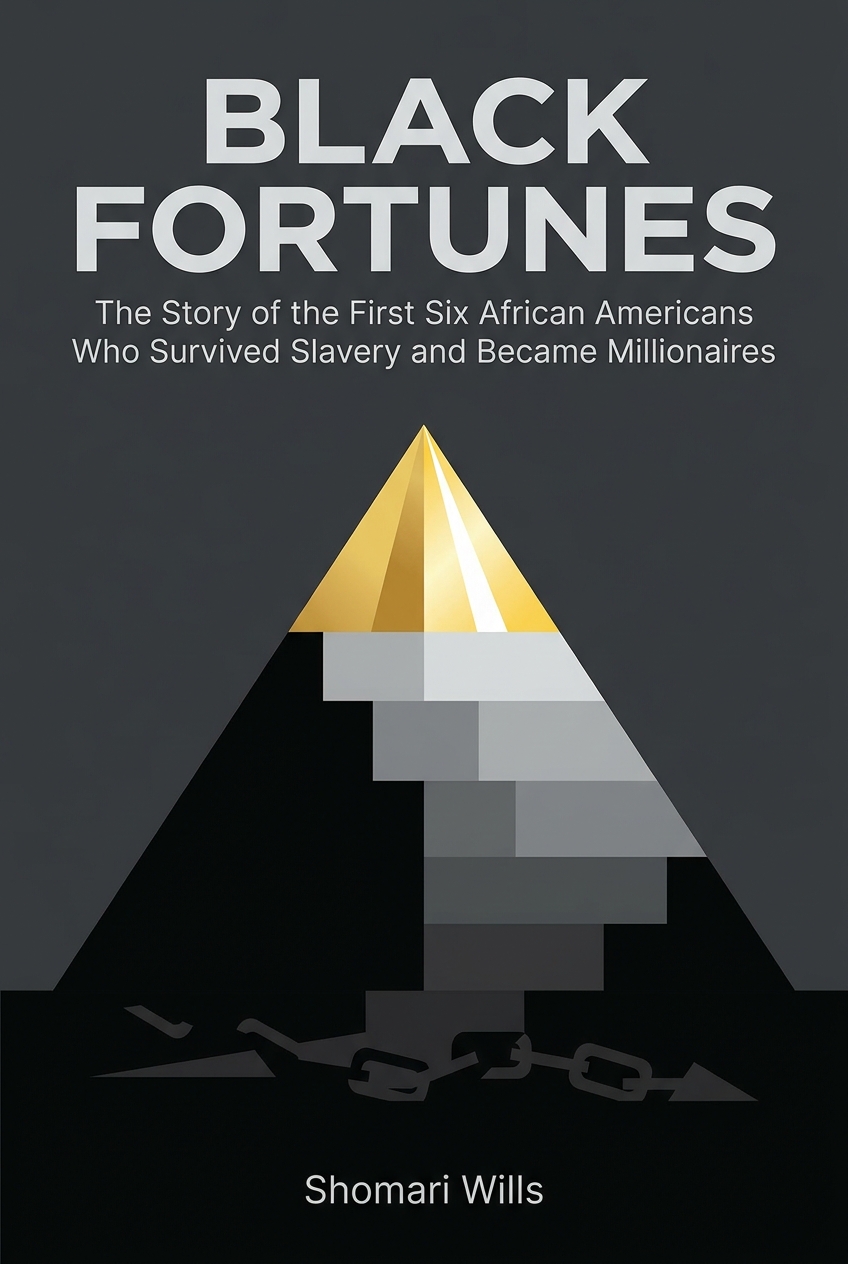
Black Fortunes book cover

The Script

In 1996, the poet and rapper Tupac Shakur released 'All Eyez on Me,' a sprawling double album that celebrated lavish wealth and defiant success in the face of systemic opposition. It was a cultural moment, a declaration that Black ambition wouldn't be confined to the margins. But this narrative of triumph, often framed as a modern phenomenon born from hip-hop culture, overlooks a much deeper, more complex history. The desire to build fortunes, to create generational wealth, and to use that wealth as a shield and a platform, was forged in the fire of the post-Civil War era, a time when the very idea of a Black millionaire was not just improbable, but a direct challenge to the nation's racial hierarchy. These were acts of radical self-determination, often erased from the mainstream account of American capitalism.

That erasure is precisely what drove journalist Shomari Wills to write 'Black Fortunes.' While researching a story on contemporary Black wealth, he stumbled upon the name of a forgotten 19th-century tycoon and was struck by a powerful question: why didn't he know this story? Why weren't these figures—who built empires in real estate, beauty, and finance against impossible odds—celebrated alongside the Carnegies and Rockefellers of their time? Wills, whose work has appeared in outlets like The New York Times, realized that the story of Black economic striving was a long, interrupted legacy. He embarked on a deep archival journey to recover the lives of America's first Black millionaires, piecing together a narrative that was intentionally buried, to restore their rightful place in the story of American ambition.

Module 1: Wealth as an Act of Defiance

The central idea of "Black Fortunes" is that for early African Americans, building wealth was a revolutionary act. In an era where Black people were legally defined as property, accumulating capital was the ultimate form of self-determination. It was a direct rebuttal to a system designed to deny their personhood.

This journey often began with a single, defiant choice. Consider William Alexander Leidesdorff. After facing racial rejection in New Orleans, he didn't retreat. He relocated to Mexican California. There, he built an empire of businesses. He ran an import-export company, a hotel, and a lumberyard. He acquired over 35,000 acres of land. During the Gold Rush, Leidesdorff became the first known African American millionaire. His success was more than financial. Building an economic fortress was a direct counter-narrative to racial commodification. Each dollar earned, each acre bought, was a statement of his humanity.

This pattern of defiance continues after the Civil War. Take Robert Reed Church. He was born into slavery, the son of his enslaver. After gaining his freedom, he moved to Memphis. He faced riots. He was shot and left for dead. His businesses were burned to the ground. Yet, he rebuilt. He bought his first municipal bond to help a bankrupt Memphis recover. He eventually opened the city's first Black-owned bank. By the time of his death, he was a millionaire. Church’s story shows that resilience in the face of violent opposition is a prerequisite for transformative success. He invested in the very city that tried to destroy him, bending its future toward his vision.

But how did they operate in a system built to exclude them? This leads to a crucial insight. Strategic navigation of racial barriers often required unconventional methods. Many early Black entrepreneurs couldn't just walk into a bank or a stock exchange. So they found workarounds. John Mott Drew, who founded the first Black-owned bus line, wanted to invest his profits in the stock market of the 1920s. He couldn’t do it himself. So, he hired a white broker to trade secretly on his behalf. This allowed him to build a fortune and exit the market before the 1929 crash. Similarly, Mary Ellen Pleasant, a formidable Gold Rush-era entrepreneur, often used white allies as proxies in business deals. These were tactical maneuvers in a rigged game. They used the system’s own biases against it to win.

Read More