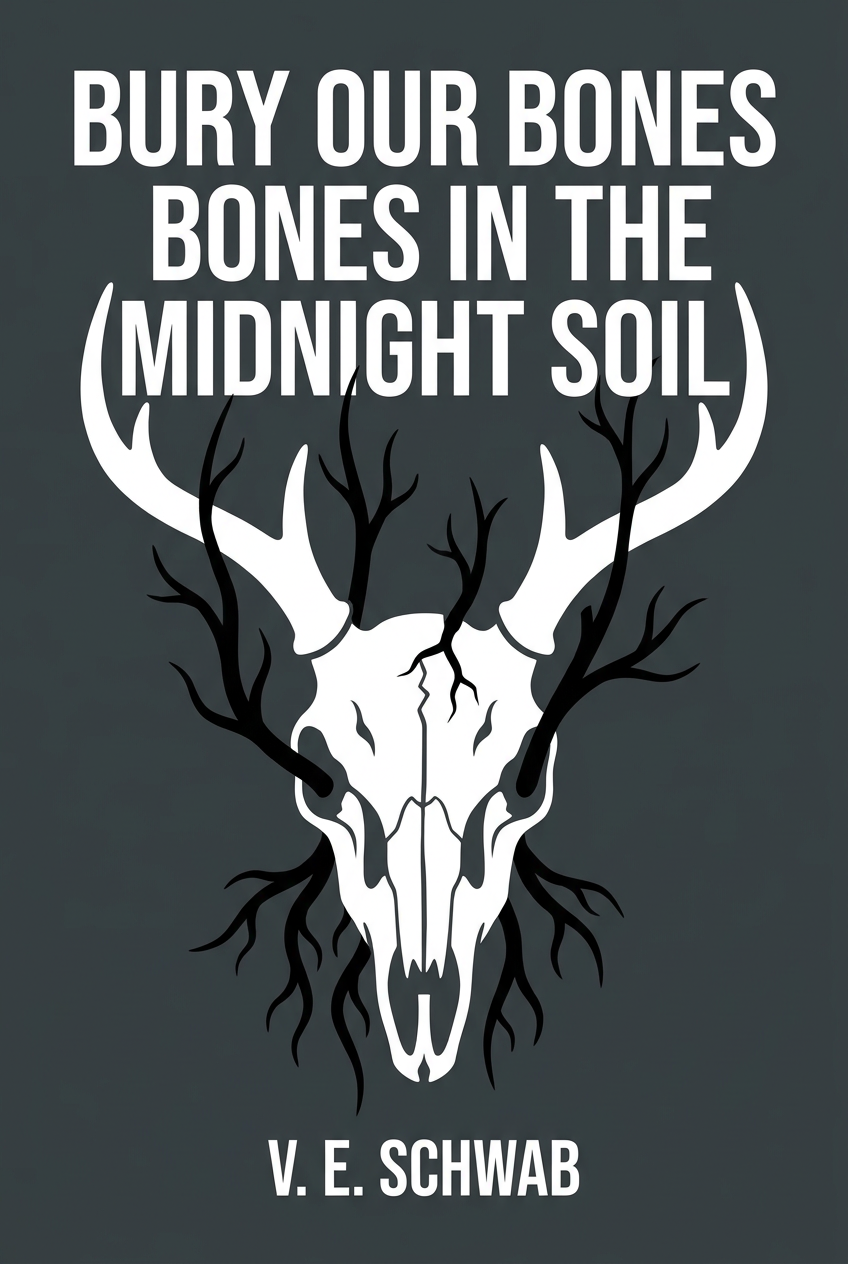
Bury Our Bones in the Midnight Soil
What's it about
Ever wonder how a single idea can take root and shape your entire world? Discover the power of your own creative seeds and learn how to cultivate them into a legacy that outlives you, transforming your passion into a force that can't be ignored. This summary of V. E. Schwab's novel explores the intense, sometimes dark, nature of creation. You'll learn how ambition, art, and obsession intertwine, revealing the sacrifices often required to bring a powerful vision to life. It's a look into the soul of a creator and what it truly takes to make your mark.
Meet the author
V. E. Schwab is the acclaimed, No. 1 New York Times bestselling author of over twenty-five books, including the internationally celebrated The Invisible Life of Addie LaRue. As the queer, neurodivergent child of a scientist and a therapist, Schwab has always been fascinated by the monsters that lurk within us and the stories we tell ourselves to survive. Her work relentlessly explores the porous lines between good and evil, life and death, and the persistence of memory and magic.
Opens the App Store to download Voxbrief

The Script
There are places where the land remembers, holding grudges like a clenched fist. In these towns, the soil itself seems to have a memory, a personality, a temper. It might be the patch of earth behind the old mill, where nothing has grown for a century, no matter how much new topsoil is laid down. Or it could be the particular stretch of riverbank where lovers’ quarrels always seem to erupt, as if the ground itself is stirring up old arguments. These are not haunted places in the traditional sense; there are no ghosts rattling chains. Instead, the land itself is the ghost. It holds onto the past—a forgotten act of violence, a secret betrayal, a tide of grief—and it slowly poisons the present, making people a little meaner, a little quicker to anger, a little more prone to despair, without them ever knowing why.
This feeling of a landscape saturated with a dark, living memory is what drove author V.E. Schwab to write Bury Our Bones in the Midnight Soil. Schwab, known for her masterful blending of dark fantasy and intimate human stories, grew up hearing local folklore about places that were simply 'wrong'—not because of spirits, but because of the earth itself. She became fascinated by the idea of a town where the ground was sentient and malevolent, a living archive of every sin committed upon it. This book was her attempt to answer a chilling question that lingered from her childhood: What if the land doesn't just witness our secrets, but absorbs them, and one day, decides to give them back?
Module 1: The Gilded Cage and the Seeds of Rebellion
The story opens by immersing us in worlds where societal expectations function as prisons, especially for young women. We meet two protagonists, separated by centuries, who both find their identities stifled by the roles assigned to them. María, in 16th-century Spain, is told her restless spirit is a flaw in a daughter. Her vibrant red hair is a "bad omen" to be muted with clay. She is expected to be modest, domestic, and obedient. This pressure to conform is a physical and emotional cage. Alice, in modern-day Boston, faces a different kind of prison. She is suffocated by social anxiety and the pressure to perform normalcy at university. She feels like an outsider, her Scottish accent marking her as different, her very body an ill-fitting costume she hasn't grown into.
This module reveals a crucial insight. Oppressive systems force individuals to live a double life: a public performance of conformity and a private reality of defiance. For María, this means secretly climbing onto the roof to watch the world pass by. She disobeys her brother's commands. She concocts rebellious pranks in her mind. Her defiance is a quiet, simmering resistance. For Alice, the performance is just as exhausting. She forces herself to go to parties, mirroring the fun she sees in others while feeling like a "barnacle" on the wall. Her rebellion is a desperate, internal negotiation. She uses her phone as a shield, creating a safe, mediated distance from the world. This is a modern form of the same survival instinct María exhibits.
From this foundation, we see how the search for agency begins. Both characters actively seek ways to reclaim control, even in small measures. Coping mechanisms, whether mental or physical, are crucial tools for surviving in hostile environments. Alice creates a game called "New Alice." It’s a temporary persona she can inhabit for one hour, a bolder version of herself who "leans in instead of out." This ritual gives her a sense of agency in a situation where she feels powerless. It transforms an overwhelming social obligation into a manageable experiment. María’s rebellion is more symbolic. She curtsies to her brother with "all the flair of a curse" and imagines filling his boots with manure. These small acts of defiance are her way of asserting her spirit within a system designed to crush it.
Here’s where it gets interesting. The narrative introduces mysterious, external forces that act as catalysts for change. For María, it’s the enigmatic widow, Sabine. The townspeople label her a witch, a figure of superstition and fear. But the widow challenges María’s rigid worldview. She blurs the lines between medicine, magic, and miracles. She represents a form of knowledge and power that exists outside the patriarchal church and village gossip. The arrival of an "other"—a person who defies convention—can shatter a protagonist's worldview and offer a new path. The widow’s presence awakens a defiant curiosity in María that overrides her fear. She is drawn to the widow, sensing a kindred spirit and an alternative to her prescribed life. This encounter plants a seed. It suggests that there are other ways to exist, other forms of power available to those brave enough to seek them. It’s the first hint of the "feral rose" mentioned in the opening poem—a wild, beautiful, and dangerous potential lying dormant within María.
Module 2: The Transaction of Power and the Price of Freedom
Now, let’s explore how the desire for escape escalates into a calculated pursuit of power. For both María and her modern counterpart, Charlotte, marriage and love are transactional pathways. María views her marriage to the Viscount Andrés de Guzmán as a strategic escape from her "small" life. She consciously orchestrates their courtship, playing the game of chastity and boldness to secure a proposal. She sees his wealth and title as a "key, unlocking the doors to a better life." This reveals a core principle of her survival. When conventional paths are restrictive, individuals will treat social rituals as a game to be won. She endures the erasure of her identity, becoming simply "mi esposa—my wife," because it is a necessary cost for social elevation and freedom from her provincial town.
This brings us to a darker truth. The power gained through these transactions is often an illusion. María’s new life is a gilded cage. Her husband, Andrés, grants her ownership of a grand estate but forbids her from leaving its gates. Her personal belongings are replaced with clothes he has chosen. He denies her the simple freedom of riding her own horse. Her body is not her own. Her pleasure is "of no consequence." Her sole purpose is to produce a male heir. The illusion of ownership is a common tool of control in oppressive relationships. Material wealth is exchanged for personal autonomy. This reality forces María to seek a more radical form of freedom. She secretly obtains an abortifacient from the kitchen, a defiant act to reclaim control over her own body.
So what happens next? The search for genuine connection becomes a form of rebellion. Confined and isolated, both María and Charlotte find solace in relationships that defy social norms. María forges an intimate bond with her maid, Ysabel. They share secrets, play games, and dance barefoot, creating a private world of warmth and companionship that is absent in her cold, transactional marriage. For Charlotte, this connection is with Sabine, the enigmatic widow from her past. Sabine represents a life of thrilling autonomy. She teaches Charlotte that names and roles are like dresses that can be taken off. She introduces her to new sensory pleasures, like chocolate, which awakens a desire that feels insatiable. Forbidden knowledge and relationships offer a powerful alternative to a life of prescribed duty. These bonds are classrooms for a different way of living.
And here's the thing. This education ultimately leads to a terrible and transformative choice. Sabine presents widowhood as the ultimate form of freedom. She tempts María with the idea of a life where she can "be who you please. Take what you please." This proposition forces María to confront the true cost of her desires. To be free, must she become a monster? The narrative suggests that for some, the answer is yes. María accepts Sabine's offer. She undergoes a violent, supernatural transformation, shedding her old identity and her very name. As she kills her husband, she whispers, "María is no more. My name is Sabine." True liberation from an oppressive system may require a violent death of the old self and a rebirth into a new, often monstrous, identity. Her freedom is taken, paid for with blood and the complete abandonment of her former life.