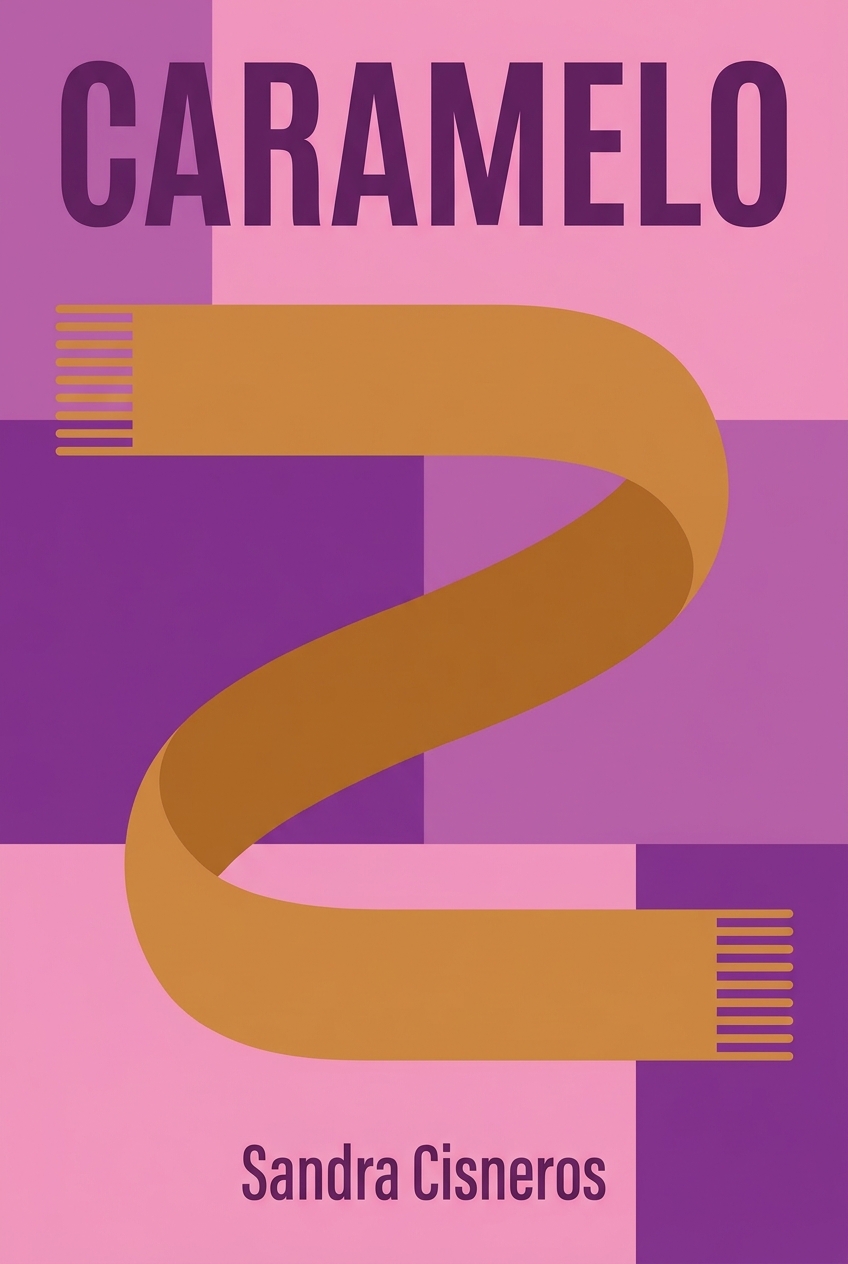
Caramelo
What's it about
Ever felt like an outsider in your own family, caught between cultures and struggling to find your voice? Discover how to embrace your unique identity and weave your personal story into the rich, complicated tapestry of your family's history, turning feelings of otherness into a source of strength. You'll follow the unforgettable journey of Lala Reyes, a young Mexican-American girl navigating the boisterous annual road trips from Chicago to Mexico City. Through her eyes, you'll learn how family myths are made, how secrets shape generations, and how the sweet, messy, and sometimes bitter threads of the past create who you are today.
Meet the author
A pioneering figure in Chicano literature, Sandra Cisneros is a MacArthur Fellow and recipient of the National Medal of Arts for her rich storytelling of the working-class Latino experience. The only daughter in a family of seven children, she moved frequently between Chicago and Mexico, a dual upbringing that profoundly shaped her unique voice and inspired her semi-autobiographical novel, Caramelo. Her work gives voice to the intricate, often-overlooked stories woven between cultures, families, and generations.
Opens the App Store to download Voxbrief

The Script
In a family, stories are a kind of currency, but they are never exchanged at a one-to-one rate. Think of a rebozo, a traditional Mexican shawl, passed down from a great-grandmother. For one cousin, it’s just a beautiful, slightly frayed piece of fabric—an accessory. For another, it’s a living archive. She sees the faded indigo as the memory of a long-ago market day, a tiny snag as the moment a baby’s hand grabbed hold, and a barely-there scent of cinnamon as the ghost of a thousand holiday kitchens. The object is the same, but the stories it holds are radically different, creating parallel realities under one roof. What’s told, what’s embellished, and what’s left out becomes the very architecture of a family—a structure where some truths are load-bearing walls and others are secret, walled-off rooms.
This gap between the official family story and the private, messy truth is the territory Sandra Cisneros has explored her entire life. Growing up as the only daughter in a family of six brothers, constantly migrating between Chicago and Mexico City, she always felt like an observer, piecing together the family narrative from whispers, arguments, and silences. She noticed how the men’s stories were the loud, public epics, while the women’s were the quiet, essential footnotes. Cisneros wrote Caramelo to weave those footnotes into the main text, to create a grand, sprawling rebozo of a novel from all the threads she’d been collecting. It was her attempt to tell not just a story, but all the stories at once—the true, the half-true, and the beautifully untrue—to capture the chaotic, contradictory, and loving reality of a family that existed in two countries and a dozen different memories.
Module 1: The Story is the Only Thing That Lasts
The novel opens with a bold claim: "Tell me a story, even if it's a lie." This is the book's entire philosophy. Cisneros argues that the emotional truth of a story often matters more than the factual details.
The main narrator, a young woman named Celaya, or Lala, is piecing together her family's history. She openly admits to inventing things, calling it a "family tradition of telling healthy lies." This introduces a critical insight: Embrace storytelling as a tool for creating and preserving identity. For the Reyes family, stories are acts of creation. They smooth over painful truths, build up family legends, and give meaning to chaotic lives. When Lala’s father tells an exaggerated war story, he is crafting a version of himself he can live with, a hero for his children. This approach suggests that in our own lives, both personal and professional, the narratives we build around our successes and failures define our trajectory.
This leads to a second, more profound idea. Acknowledge that memory is a reconstruction. The entire novel is framed around an old family photograph taken in Acapulco. But Lala, the narrator, isn't in it. Her absence forces her to reconstruct the moment from the stories she's been told. She has to imagine the feel of the sun, the sound of the waves, and the tensions simmering just beneath the smiling faces. This tells us that our "official" histories, whether a family photo or a company's mission statement, are always incomplete. The real story lies in the gaps, in the voices that were left out. To truly understand our past, we must actively seek out and weave in those missing threads.
So what happens when these personal stories clash? The narrative is filled with conflicting accounts. The brothers remember a summer off from work differently—one says it was a gift from their boss, the other admits they quit. The Awful Grandmother’s memories of the past are constantly challenged by her children. This reveals another core principle: Recognize that every person in a system holds a different piece of the truth. There is no single, objective version of events. In a family or a project team, each person’s perspective is shaped by their own experiences, fears, and desires. Effective leadership is about understanding that the complete picture is a mosaic of all these partial, subjective truths.
And here's the thing. This act of storytelling is for survival. The narrator concludes, "After all and everything only the story is remembered, and the truth fades away." This suggests a final, powerful action: Prioritize the narrative that provides strength and cohesion. In the face of hardship or ambiguity, the most useful story is the one that helps the family—or the team—move forward. It’s the story that creates a shared sense of purpose, even if it’s built on a foundation of "healthy lies."