All Books
Self-Growth
Business & Career
Health & Wellness
Society & Culture
Money & Finance
Relationships
Science & Tech
Fiction
Topics
Blog
Download on the App Store

Cat's Cradle

A Novel

12 minKurt Vonnegut

What's it about

What if the world's most dangerous substance ended up in the hands of three eccentric and completely unqualified heirs? Explore a satirical tale that questions the very nature of truth, religion, and humanity's obsession with self-destruction, all starting with a simple children's game. Dive into Kurt Vonnegut's dark comedy where you'll discover ice-nine, a crystal that freezes water solid at room temperature. You'll follow a narrator investigating the atomic bomb's creator and stumble upon a bizarre new religion, a tiny island dictator, and the absurd, hilarious, and terrifying final moments of the world as we know it.

Meet the author

Kurt Vonnegut is celebrated as one of the 20th century's most influential satirical novelists, a master of blending science fiction, dark humor, and profound humanism. A former soldier and prisoner of war, his firsthand experience with the absurdity and tragedy of conflict profoundly shaped his worldview. Vonnegut’s unique perspective, informed by his time as a publicist for General Electric, allowed him to critique technology, religion, and the often-farcical nature of human existence, themes central to his iconic novel, Cat's Cradle.
Listen Now

Opens the App Store to download Voxbrief

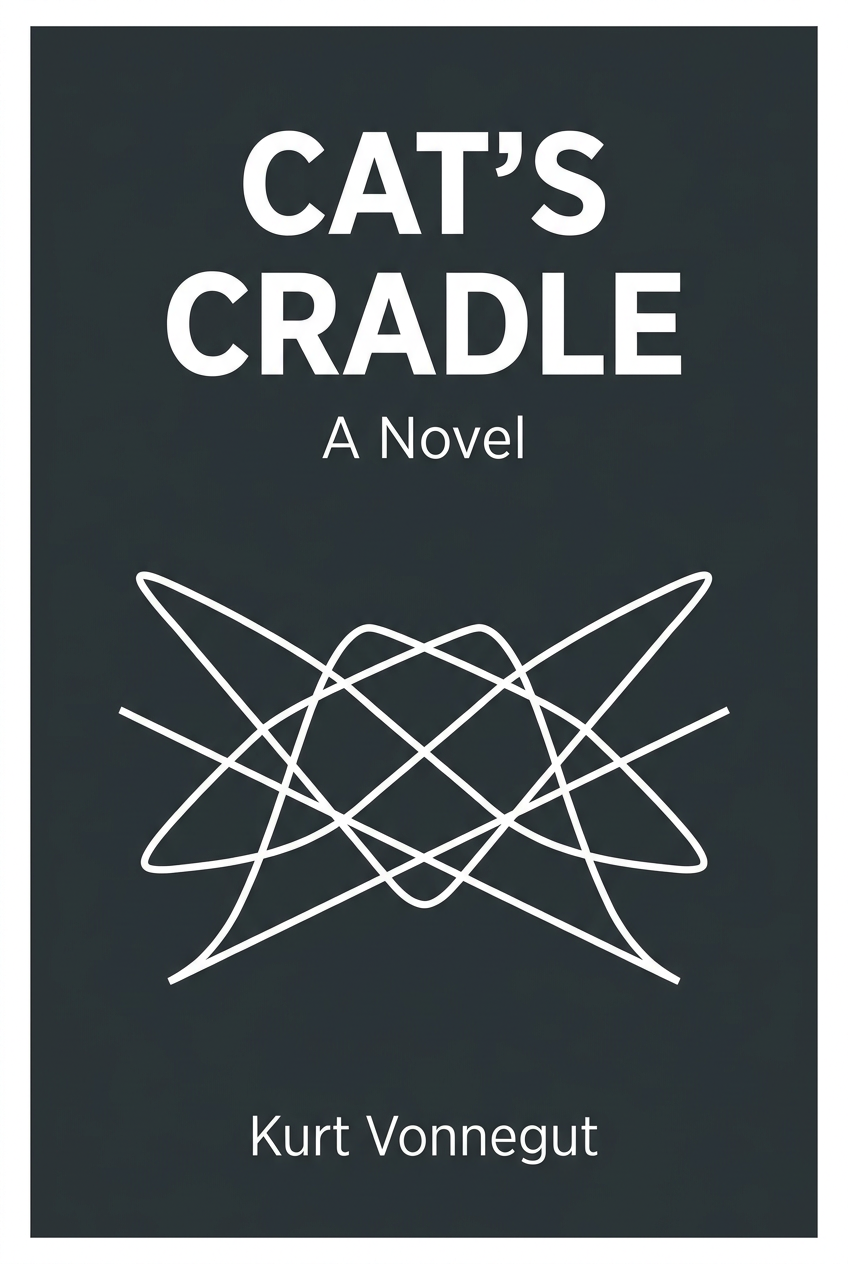
Cat's Cradle book cover

The Script

We tend to believe that the most dangerous lies are the ones told with malicious intent, the grand deceptions designed to seize power or steal fortunes. But what if the most catastrophic falsehoods are the ones we tell ourselves for comfort? What if the most destructive force in the universe is a harmless, shared fiction—a simple, playful story that everyone agrees to believe in because the alternative is too terrifying to confront? This is the paradox of the comforting lie: its very purpose is to soothe, to create a sense of order and meaning where none exists. Yet, by building our lives on this foundation of pleasant nonsense, we construct a world so fragile that a single, inconvenient truth can shatter it completely. The game is enjoyable only as long as no one points out that the pieces are imaginary and the rules are made up on the spot. The moment someone does, the entire structure collapses with a quiet, frozen finality.

This exact exploration of meaning built on a foundation of absurdity is what drove a young Kurt Vonnegut. After witnessing the firebombing of Dresden as a prisoner of war—an event of such profound, meaningless destruction that it defied all rational explanation—he became obsessed with the stories humanity tells itself to cope. His work at General Electric, watching scientists pursue 'pure' research with little thought to its catastrophic potential, only sharpened this focus. Vonnegut began writing "Cat's Cradle" as a way to process a world where scientific 'truth' and religious 'truth' both seemed like elaborate, and equally dangerous, games. He was building a theological and scientific satire to investigate whether a lie that makes people kind could be more valuable than a truth that destroys them.

Module 1: The Folly of Pure Science

The story introduces us to Dr. Felix Hoenikker. He is a fictional "father" of the atomic bomb. He is also a perfect caricature of detached, amoral genius. Hoenikker’s mind operates on a different plane. It's a plane disconnected from human emotion, consequence, or responsibility. On the day the bomb was dropped on Hiroshima, he wasn't reflecting on his creation. He was at home, captivated by a loop of string. He used it to create a "cat's cradle," a child's game of intricate but empty patterns. This single image captures the book's first major insight. Genius without empathy is a form of dangerous innocence.

Hoenikker’s detachment is a profound moral void. When a fellow scientist remarks, "Science has now known sin," Hoenikker’s reply is chillingly simple: "What is sin?" This is a genuine lack of comprehension. His work is driven purely by intellectual curiosity. He follows whatever problem fascinates him, like a child chasing a butterfly. This leads him to his final, most terrifying invention: ice-nine.

Here's where it gets interesting. A Marine general once asked Hoenikker to solve the problem of mud. Soldiers were always getting stuck in it. Hoenikker, in his playful way, theorized a new form of water. It would be a crystal, solid at room temperature. A single "seed" of this crystal, ice-nine, could teach any water molecule it touched to freeze instantly. A single drop could solidify a river. A river could solidify an ocean. The end of the world, born from a playful solution to a practical problem. This shows us that the pursuit of knowledge for its own sake carries existential risk. Hoenikker never considered the consequences. He just saw an interesting puzzle. He solved it. Then he put the result in a jar. After his death, his three dysfunctional children divide this world-ending substance among themselves. They treat it as a personal inheritance and a bargaining chip. This leads to a critical realization for anyone in a field of innovation. Your creation's purpose is defined by its user. Hoenikker saw ice-nine as a mental exercise. His children saw it as power. The military saw it as a weapon. The creator’s intent becomes irrelevant the moment the creation is released into the world.

Module 2: The Utility of Comfortable Lies

But flip the coin. If truth can be so destructive, what is the value of lies? This brings us to the second pillar of the book: the religion of Bokononism. The narrator, a writer named John, travels to the fictional Caribbean island of San Lorenzo. It's a desperately poor, forgotten nation. Its people have nothing. But they have Bokononism. And Bokononism is founded on a simple, radical premise. It's all lies.

The religion's founder, a man named Bokonon, openly admits this. The sacred texts, The Books of Bokonon, begin with a warning: "All of the true things I am about to tell you are shameless lies." Bokononism is built on foma, a term defined as harmless, comforting untruths. The core principle is simple. Live by the lies that make you brave, kind, and happy. This is a direct challenge to our modern obsession with objective fact. In a world of unbearable suffering, Bokonon argues that a beautiful lie is more useful than a terrible truth. The people of San Lorenzo are impoverished and oppressed. The truth of their situation is misery. Bokononism gives them purpose, community, and hope. It gives them a story that makes life worth living.

So what happens next? The dictator of San Lorenzo, "Papa" Monzano, outlaws Bokononism. He threatens anyone caught practicing it with a gruesome death on "the hook." This sets up a theatrical dynamic. The government represents the forces of evil. Bokonon, hiding in the jungle, represents the forces of good. But here’s the secret. It’s all a performance. Bokonon and the island's first dictator designed the system together. They understood a fundamental truth about human nature. A society needs tension between good and evil to feel alive. The constant threat gives the religion its power. The forbidden rituals give life meaning and zest. It's a manufactured drama that keeps everyone employed as actors in a play they understand.

And it doesn't stop there. Bokononism provides a whole new vocabulary for understanding life. It replaces the cold, random universe of science with a world of intricate, hidden connections. A karass is a team of people unknowingly working together to do God's will. These teams transcend nationality, class, or family. The narrator realizes his own karass includes the Hoenikker children, the dictator of San Lorenzo, and others, all brought together by his initial book project. This introduces the idea that our lives are interwoven in ways we cannot see or comprehend. The instrument that brings you into your karass is your kan-kan. The central theme that your karass revolves around is its wampeter. For the narrator's karass, the wampeter becomes ice-nine. This framework replaces meaningless coincidence with a sense of cosmic purpose. It’s a lie, but it’s a profoundly useful one.

Read More