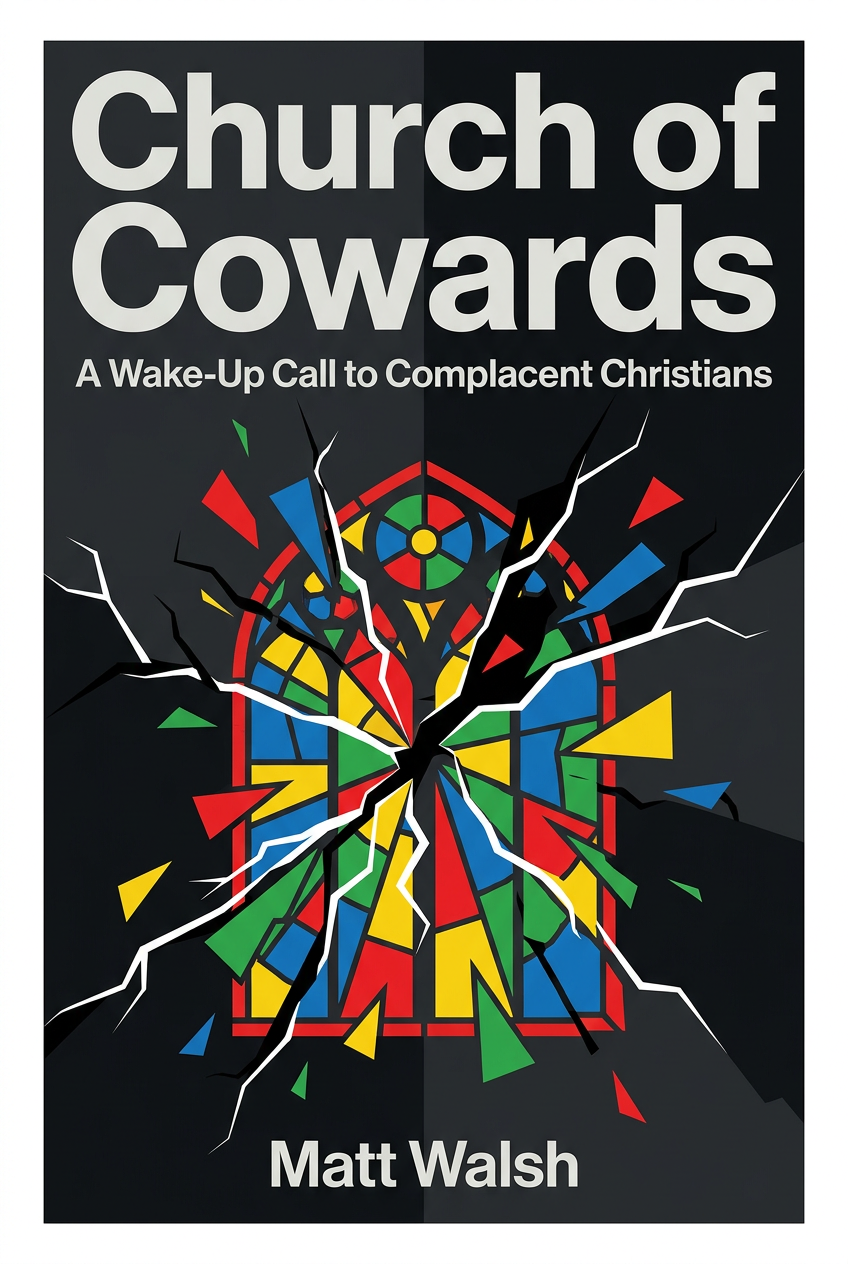
Church of Cowards
A Wake-Up Call to Complacent Christians
What's it about
Are you frustrated with a modern Christianity that feels watered-down and afraid to speak the truth? Discover how to reclaim a bold, uncompromising faith that actively confronts cultural challenges instead of retreating from them, and learn what it truly means to be a courageous Christian today. This summary of Matt Walsh's provocative work unpacks why so many churches have become "safe spaces" of comfortable complacency. You'll explore the historical roots of this spiritual cowardice and gain a clear, actionable framework for standing firm in your convictions with clarity and confidence.
Meet the author
Matt Walsh is one of the most influential and provocative conservative voices in America, reaching millions through his columns, podcasts, and documentaries for The Daily Wire. A prominent Catholic commentator, his unflinching analysis of cultural and religious issues stems from a deep-seated conviction that modern society has lost its moral compass. Walsh’s work is a direct challenge to what he sees as the widespread apathy within Christianity, urging believers to reclaim a more robust and courageous faith in the public square.
Opens the App Store to download Voxbrief

The Script
The most effective way for a hostile force to conquer a vibrant city is to quietly offer its citizens a more comfortable alternative. It doesn’t require cannons or battering rams, only a compelling invitation to trade the burdens of duty for the ease of personal comfort, to exchange the weight of a difficult inheritance for the lightness of a self-defined identity. The city empties out, one citizen at a time, as its inhabitants voluntarily walk out the gates, convinced they are moving toward liberation. The fortress is simply abandoned. The most devastating conquest is the one where the vanquished don't even realize a battle was fought, because they were too busy admiring the architecture of their new, more accommodating homes.
This subtle hollowing-out of a once-unshakeable institution is the crisis that compelled Matt Walsh to write “Church of Cowards.” As a prominent Catholic voice and cultural commentator for The Daily Wire, Walsh witnessed what he saw as a faith trading its eternal significance for fleeting cultural relevance. He argues that the modern Church has been steadily surrendering from within, prioritizing a non-confrontational 'niceness' over the demanding truths it was built to defend. This book is his direct response, a polemical and unapologetic call to abandon the comfortable suburbs of cultural accommodation and re-inhabit the demanding, formidable fortress of faith.
Module 1: The Counterfeit Faith
The central argument of the book is that much of modern American Christianity is a superficial impostor. It’s a self-centered spirituality designed for personal fulfillment, not spiritual transformation. Walsh opens with a thought experiment. Imagine a band of violent heathens capturing a hundred self-professed Christians. Their demand is simple: profess your faith and die, or renounce it and live. The result is a disaster.
The pastors and priests immediately fold. They claim all faiths are equal. They dismiss core doctrines as outdated. The congregation follows suit, denouncing the one person who dares to stand up and recite the Apostles' Creed, a foundational statement of Christian belief. They call him a bigot and a fundamentalist. This scene sets the stage for the book's core diagnosis. The first step to understanding this crisis is to recognize that comfort has become the new idol.
Churches now resemble shopping malls or coffee shops. Mediocre rock bands replace reverent hymns. Pastors in jeans deliver motivational speeches that avoid any mention of sin, hell, or judgment. This is what Walsh calls the "Gospel of Positivity." It’s a message that promises resurrection without the crucifixion. It offers a version of God who is a non-judgmental friend, a "magical genie" who guarantees heaven for everyone, no questions asked. The goal is to feel good.
This leads to a second critical insight. Many Christians now live lives indistinguishable from non-believers. Walsh asks a piercing question: If you stopped believing in Jesus tomorrow, what in your life would actually change? For many, the honest answer is nothing. They consume the same media. They use the same language. They pursue the same material comforts. Faith has become a label, not a lifestyle. It’s a passive acknowledgment of God's existence, similar to believing in aliens. It has no practical impact on daily choices.
Here’s the thing. This is a strategic problem. Walsh argues that Satan’s primary weapon in the West is comfort. While Christians in other parts of the world face martyrdom for their faith, American Christians are lulled into spiritual sleep by Netflix, materialism, and endless distraction. A faith that costs nothing is a faith that is worth nothing. And a faith that is worth nothing is easily abandoned. This is why superficial cultural battles have replaced genuine spiritual warfare.
Christians get outraged over Starbucks cups or store clerks saying "Happy Holidays." Walsh sees this as a distraction. It’s a way to feel religious without making any real sacrifices. It’s easier to complain about a coffee cup than to give up a comfortable sin or spend an hour in prayer. The church has become distracted by trivialities while its core identity rots from within. The heathens in the opening story leave disappointed. They couldn't find any Christians to persecute because, as Walsh concludes, the church they found was already dead.
Module 2: The Lost Language of Faith
We’ve explored how modern Christianity has become hollowed out. Now, let’s get into the "why." Walsh argues that this crisis stems from a fundamental misunderstanding of the very language of faith. Words like "faith," "love," and "relationship" have been redefined to fit our modern, self-centered culture.
The first casualty is the word "faith" itself. For many today, belief is a passive, intellectual exercise. But Walsh insists that true faith is active surrender. He points out that the New Testament word for faith, pisteuo, is a verb. It implies total trust and commitment. It’s the difference between acknowledging that a bridge exists and actually walking across it over a deep canyon. Even demons believe in God, as the book of James reminds us. What they lack is submission. A person who acknowledges God but refuses to obey Him is in the same spiritual boat as a demon.
This brings us to a related point. Faith without works is dead. Walsh draws on Dietrich Bonhoeffer's concept of "cheap grace," which is grace without discipleship. It’s the idea that you can be saved without any change in your behavior. This reduces Jesus to a distant figure who offers a "Get Out of Hell Free" card. But Christ’s command was "Follow me." This implies movement, effort, and a constant journey toward God. It’s a life of discipleship. If your faith doesn't compel you to act, to change, to strive for holiness, then it’s not real faith. It’s a cheap imitation.
Building on that idea, the popular phrase "personal relationship with Jesus" has been twisted. It’s often used to justify a self-directed, casual faith. But as Walsh explains, a relationship with God requires submission. Jesus is not your buddy. He is your King, Lord, and Creator. Calling Him a "friend" doesn't reduce His authority any more than a father calling his son a friend erases the parent-child dynamic. The modern emphasis on "my" personal relationship treats Jesus like an accessory, an invisible genie who caters to our needs. True intimacy with God is forged through surrender and obedience, not by trying to control the terms of the relationship.
So what happens next? This distortion of language creates a culture of irreverence. Casual faith leads to casual worship. When Jesus is just a friend, church becomes a casual social gathering. People show up in flip-flops, chat during the service, and listen to sermons that sound more like pep talks. The sense of the sacred is lost. Walsh admits his own past failure here, recalling a time he wore a t-shirt and shorts to church, only to be convicted by a priest’s sermon on reverence. He realized his casual attire reflected a deeper spiritual laziness. When Christians treat their faith with such little reverence, it becomes a scandal to the outside world. An atheist is more likely to take Islam seriously, with its visible devotion, than a Christianity that acts as if its own God isn't worth dressing up for.