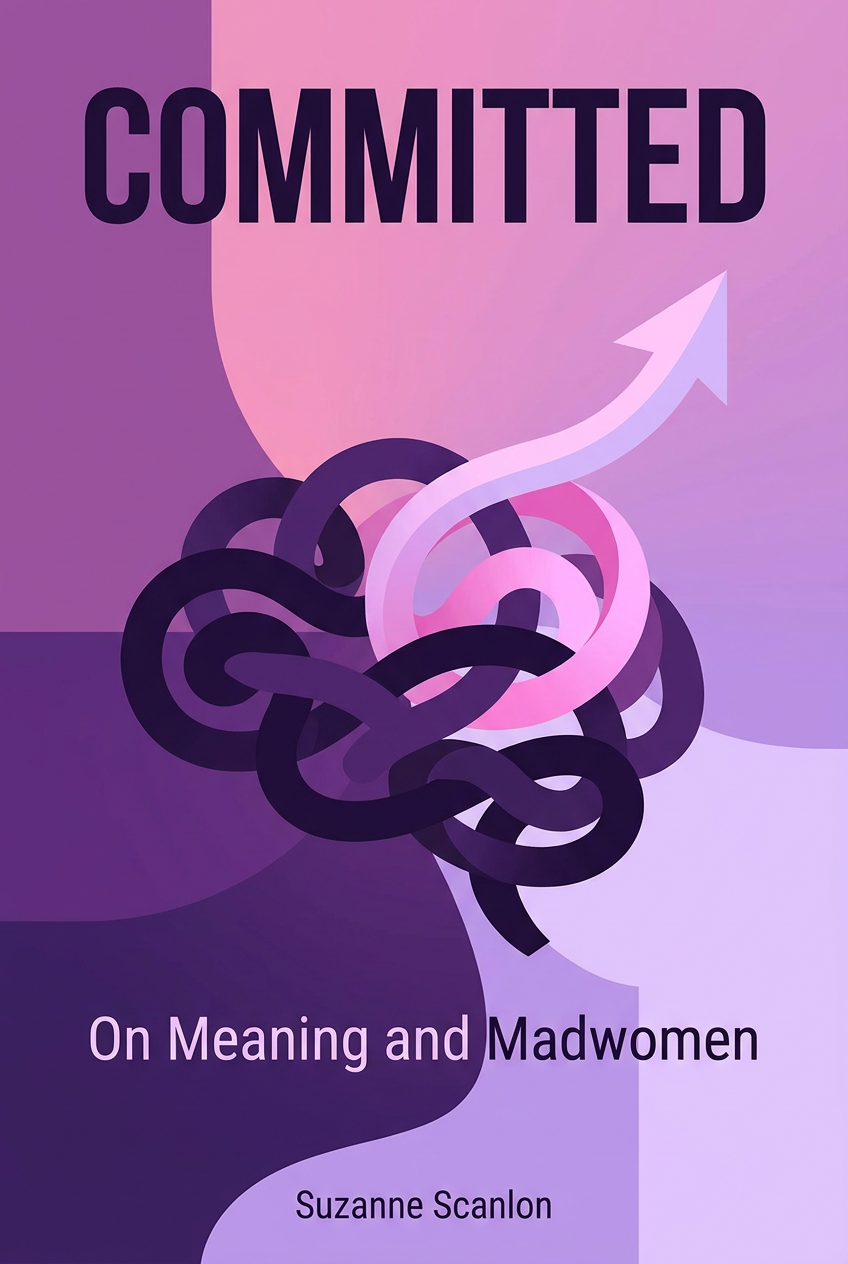
Committed
On Meaning and Madwomen
What's it about
Ever felt like you're losing your mind, but worried what people would think if you admitted it? What if the very label of "madness" is a tool used to silence women, and understanding its history could set you free? Committed is your guide through the maze of female mental health and societal expectations. Through a powerful blend of memoir and sharp cultural critique, you'll uncover how figures from Virginia Woolf to Britney Spears were judged and confined. This summary reveals how to reclaim your own narrative, find meaning in your struggles, and challenge the systems that try to define you.
Meet the author
Suzanne Scanlon is a critically acclaimed author and an Associate Professor of English at the University of Illinois Chicago, whose work has been recognized by The New York Times. Her own experiences with psychiatric institutionalization as a young woman directly inform the powerful research and profound insights found within Committed. This blend of lived experience and scholarly inquiry provides a unique and deeply humanizing perspective on the history of women, mental health, and the quest for meaning against the odds.
Opens the App Store to download Voxbrief

The Script
Think of two different medical charts for the same patient. The first is crisp, clinical, and official. It lives in a manila folder under the fluorescent lights of a nurses' station. It’s a document of objective data: medication dosages, vital signs, incident reports, diagnostic codes from the DSM. It tells a story of pathology, a neat narrative of symptoms and treatments, all designed to make the patient legible to the institution. It is a story told about her. Then there is the second chart. This one doesn't exist on paper. It’s a chaotic, internal archive of sensation and memory. It's the feeling of the institutional sheets, the taste of the medication, the specific echo of a voice down the hall, the splintered memories of the life that led here. This chart is unwritten, illegible to others, a story told by her, to herself. The official chart aims for a cure, a resolution. The internal one just is—a messy, contradictory, and deeply human reality.
This chasm between the story told about a person and the story they live inside themselves is the space Suzanne Scanlon explores in her novel, Committed. The book itself is presented as a kind of counter-chart, a collection of fragments—memories, letters, literary quotes, dialogues—that resist a single, clean diagnosis. Scanlon draws from her own experiences with psychiatric institutionalization to assemble a work that questions the very nature of memory and identity. As a writer and professor teaching autofiction, she became fascinated with how we construct a self out of the stories available to us, and what happens when those stories, especially the medical ones, feel like a cage. Committed is her attempt to break that frame, offering a narrative that is as fractured, poetic, and stubbornly alive as the consciousness it portrays.
Module 1: The Five Essential Qualities for a Meaningful Life
The book's entire structure rests on a powerful piece of ancient wisdom. The Talmud tells of a great sage, Rabbi Yochanan Ben Zakkai, who asked his five top disciples a question. What is the most important quality a person should cultivate?
Their answers form the backbone of this book.
- A Good Eye.
- A Good Friend.
- A Good Neighbor.
- The ability to See the Future.
- And finally, a Good Heart.
The Rebbetzin argues these five qualities are practical, actionable principles for building a life of purpose and a marriage that lasts. So, let's explore the first of these.
First, you must cultivate a "good eye," the practice of actively seeking the good in others. This is a disciplined way of seeing the world. The author's husband, a rabbi, once saw a man enter the synagogue on the Sabbath with pens in his pocket, a violation of religious law. Instead of shaming him, the rabbi welcomed him warmly. He praised the man's desire to pray, choosing to see the good intention behind the mistake. A good eye transforms potential criticism into compassion.
This shift in perspective is a skill. It requires practice. One participant in the Rebbetzin's seminar, Eddie, was skeptical. He grew up in a home full of discord. He didn't believe he could change his critical nature. The advice was simple. Start small. Say "thank you" more often. Acknowledge the good someone does, no matter how minor. Use humor to deflect anger. These small actions train your eye. They build the muscle of positive perception. When you feel anger rising, imagine you're on a highway hitting gridlock. You can sit in the jam, fuming. Or you can take another route. A good eye is about choosing that other route.
Jessica, another person mentioned in the book, struggled with her marriage. She constantly compared her husband to her more financially successful brothers-in-law. This "evil eye" of comparison bred resentment. The Rebbetzin guided her to use a "good eye" instead. To focus on her husband's virtues. His kindness. His devotion as a father. This reframing didn’t change her husband. It changed her perception of him. And that saved her marriage. You must learn to focus on your partner's strengths. This shift is critical. Comparison is the thief of joy, and it will poison a relationship.
Module 2: The Architecture of Committed Love
So you've learned to see the good. Now, how do you build on it? The second module unpacks the very purpose and mechanics of a committed relationship. It’s a radical departure from modern ideas about love.
The central idea is that the purpose of marriage is growth. The Torah describes a spouse not just as a helper, but as an ezer k’negdo. This Hebrew phrase means a "helpmate against you." This is about having a partner who challenges you. Someone who holds you accountable. Someone who pushes you to become a better, more complete person. A spouse who only ever agrees with you and inflates your ego is not fulfilling this higher purpose. True partnership involves friction, because friction creates growth.
This leads to a powerful insight about communication. You have to learn to listen with your heart. The book tells the story of Jason, a young husband frustrated with his wife Dana. He felt she was constantly nagging him about his long work hours. He heard her words as criticism and control. The Rebbetzin reframed it for him. She asked him to listen with his heart. To hear the emotion behind the words. Dana wasn't trying to control him. She was expressing a clumsy, poorly communicated desire to be with him. Her "nagging" was a backwards compliment. When Jason shifted his perspective, he no longer heard an adversary. He heard a partner.
This is where the "good eye" from Module 1 becomes crucial. How you see your partner determines how you interpret their actions. Your perspective literally creates your reality in the relationship. If you see your spouse as an adversary, even their kindest gesture can feel manipulative. But if you see them as your partner—your other half—their criticism can be heard as a form of care. The author tells a story from Sesame Street. A lost boy describes his mother to a police officer. He says she's "the most beautiful lady in the entire world." When the mother arrives, she's disheveled and frantic. But to the boy, she is perfect, simply because she is his mother. A committed relationship requires this kind of perspective. Your spouse is the most special person in your life for no other reason than that they are yours.
Finally, the book argues that small, consistent acts of attention are the fabric of a loving relationship. Grand gestures are nice. But they don't sustain a marriage. The Rebbetzin’s husband had a simple ritual. Whenever she left the house, he would wave from the porch until her car was out of sight. It was a small act. But it communicated a powerful message: "You are seen. You are important." In our multitasking world, giving someone your undivided attention is one of the most profound gifts you can offer. When your partner speaks, put down your phone. Look at them. Listen. A half-hearted greeting is like a half-baked cake. It just doesn't work.