All Books
Self-Growth
Business & Career
Health & Wellness
Society & Culture
Money & Finance
Relationships
Science & Tech
Fiction
Topics
Blog
Download on the App Store

Cry of the Kalahari

17 minMark James Owens, Cordelia Dykes Owens

What's it about

Ever dreamed of leaving it all behind for a life of true adventure? Imagine trading your daily routine for seven years of total isolation in the African wilderness, studying animals that have never seen a human before. This is your chance to experience that journey. Discover the incredible true story of two young American scientists who did just that. You'll learn how they survived in the harsh Kalahari Desert, forged an unprecedented bond with lions and hyenas, and made groundbreaking discoveries about animal behavior, all while facing down life-threatening dangers.

Meet the author

Mark and Delia Owens are award-winning zoologists who spent seven years conducting unprecedented research on brown hyenas and lions in the remote, untouched Kalahari Desert. Their groundbreaking work, often performed in complete isolation hundreds of miles from the nearest human settlement, provided a unique and intimate window into the lives of Africa's most elusive predators. This immersive experience, facing drought, fire, and dangerous encounters, formed the very foundation for their internationally bestselling memoir, Cry of the Kalahari, a testament to both scientific dedication and human endurance.
Listen Now

Opens the App Store to download Voxbrief

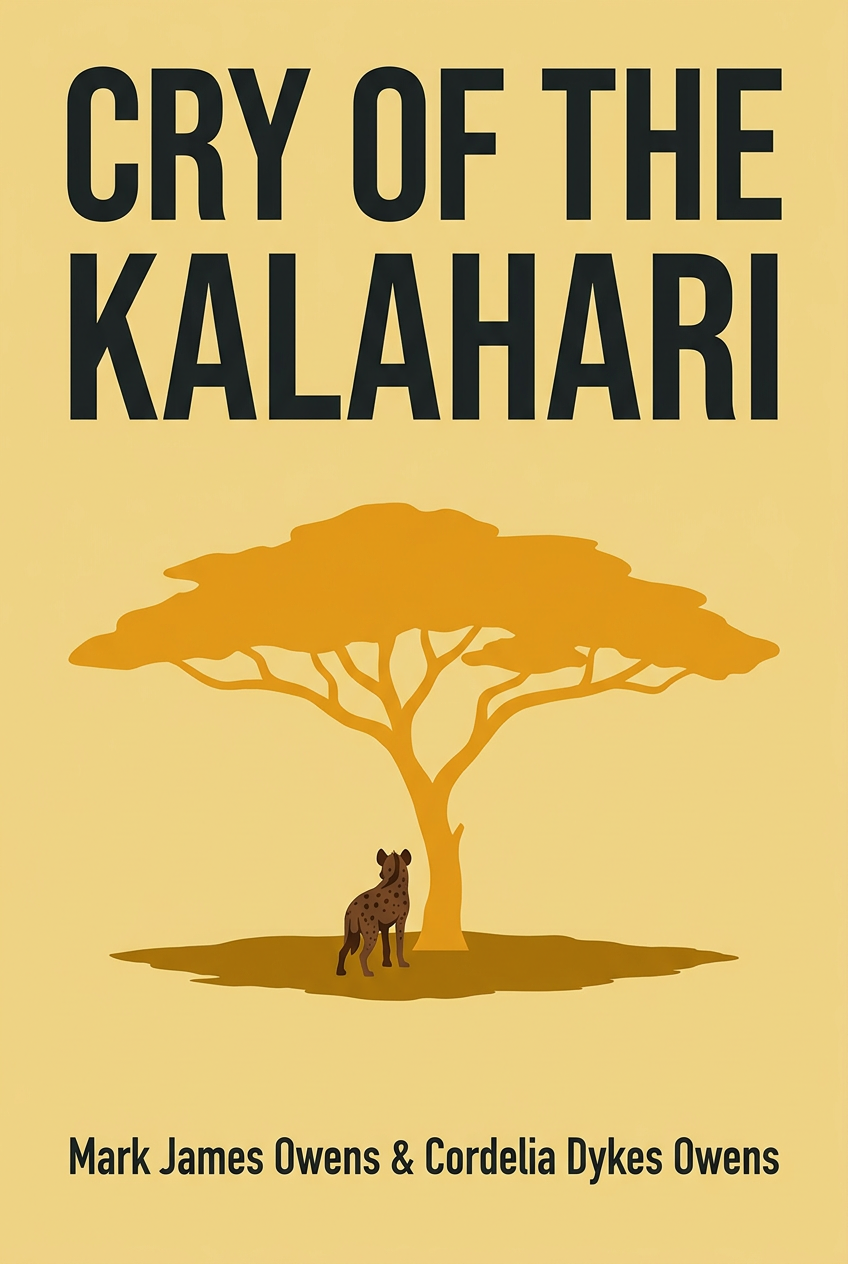
Cry of the Kalahari book cover

The Script

Think of the last time you felt truly alone, not just by yourself in a quiet room, but profoundly isolated, miles from the nearest person. Now, imagine stretching that feeling over seven years. Imagine your only companions are the subjects of your life's work: lions who have never seen a human, hyenas whose calls are the only nightly news, and a sky so vast and silent it feels like the roof of an empty world. This is a deep immersion into a world that operates on ancient, non-human rules. It’s a commitment so absolute that the line between observer and participant begins to dissolve, where the need to understand an animal becomes as urgent and intuitive as the need to find water.

What kind of person chooses this life? What drives someone to trade every human comfort for a tent in one of the planet's harshest environments, armed with little more than a Land Rover, a shared dream, and a fierce determination to study life on its own terms? This question is answered by the story of Mark and Cordelia Owens. Fresh out of graduate school in the 1970s, the young American zoologists sold everything they owned to fund a one-way trip to the Kalahari Desert in Botswana. They sought a place untouched by human influence, a pristine ecosystem where they could conduct the first-ever long-term study of the region's large carnivores. "Cry of the Kalahari" is the unfiltered record of that radical seven-year journey, a chronicle of scientific discovery, relentless hardship, and the profound connection they forged with a wilderness that became their entire world.

Module 1: The Price of Entry—Survival in an Unforgiving Eden

The Kalahari is a semi-desert defined by extreme scarcity that does not welcome outsiders. There is no permanent surface water. The Owenses' first challenge was simply staying alive. Their journey from the edge of civilization to their chosen study site, Deception Valley, was a brutal test. Their Land Rover got stuck in mud for days. They nearly lost their vehicle in a hidden sinkhole. Every delay burned through their tiny budget, adding intense pressure to their mission. This experience forged their first critical insight. To operate in extreme environments, you must master self-reliance and ingenuity.

They couldn't just buy what they needed. They had to build it, fix it, or find it. A broken truck chassis in the middle of nowhere meant learning mechanics on the fly. A food shortage prompted Mark to fashion fishing hooks from scrap metal. An abandoned 50-gallon drum became a lifeline, allowing them to haul precious water across a hundred miles of trackless sand. Every day was a masterclass in improvisation.

But here's the thing. This intense hardship also opened the door to a unique opportunity. Because the Kalahari was so untouched, they could observe animals that had never encountered humans before. This led to their second realization: A non-threatening human presence can foster unprecedented intimacy with wildlife. The animals weren't afraid. They were curious. A pride of lions, which they named the Blue Pride, accepted them so completely that the lions would sleep around their unenclosed camp at night. Hyenas would tug on their tent ropes. Jackals would steal coffee mugs. This was a state of grace, a glimpse into a world where the fear of humans hadn't yet been learned.

This immersion was central to their work. But it was only possible because they chose a location of extreme isolation. The Central Kalahari Game Reserve was a protected area larger than Switzerland. It had no roads, no buildings, and no permanent water sources. It was a blank slate for research. This deliberate choice highlights a key principle of their work. Pristine ecosystems offer a rare window into unaltered animal behavior. They were studying life as it had existed for millennia, not animals reacting to human development.

So what happens next? With their camp established, they faced a new problem. They needed funding. To get it, they had to choose a species to study. Their choice couldn't be random. It had to be strategic. They considered lions, but lions had been studied elsewhere. They thought about cheetahs, but cheetahs were too wary and mobile. Then, they found their subject. The brown hyena. It was rare, nocturnal, and almost completely unstudied. Effective research prioritizes scientific novelty and conservation value to attract support. By focusing on the brown hyena, they knew any discovery would be a significant contribution. It was a smart, strategic move that would eventually secure the funding they needed to continue their work for seven years.

We've seen how the Owenses paid the price of entry into the Kalahari. Next up, we'll explore what they discovered once they were inside.

Module 2: The Secret Social Lives of Predators

Once settled in Deception Valley, the Owenses began to unravel the complex lives of the animals around them. Their patient, non-intrusive methods paid off. They witnessed behaviors that challenged existing scientific knowledge. This was especially true for the brown hyena, an animal long dismissed as a simple, solitary scavenger. Through thousands of hours of observation, they made a startling discovery. Brown hyenas possess a complex clan-based social system centered on communal care.

They identified a clan of seven hyenas. This group had a clear social hierarchy, maintained through ritualized behaviors like muzzle-wrestling. But the most stunning revelation came when they found the clan's den. Multiple females were raising their cubs together. Lactating mothers would nurse cubs that were not their own. Other clan members, including some males, would bring food back to the den for all the young. This cooperative rearing strategy was a crucial adaptation to the harsh Kalahari. It allowed mothers to forage more widely, increasing the chances that someone would find food for the cubs.

Now let's turn to the lions. The Owenses' close relationship with the Blue Pride gave them a front-row seat to their social dynamics. They saw that, like the hyenas, lion society was far from simple. They learned that male lions form critical alliances to gain and defend territory. The brothers Muffin and Moffet worked together to oust a rival male named Satan. Their coordinated attack gave them a decisive advantage. Once in control of the pride, they patrolled their territory constantly, using roars and scent marks to advertise their dominance. This alliance was the key to their reproductive success.

But flip the coin. While males cooperated, the researchers found that maternal care among lionesses is inconsistent and experience-dependent. A young, inexperienced mother named Gypsy frequently neglected her cubs, leading to their starvation. In contrast, an older, more experienced lioness named Chary was a patient and attentive mother. She even formed a partnership with another young mother, Sassy, to raise their cubs together. This showed that successful parenting was a skill, refined through experience.

And here's the thing. These social behaviors weren't happening in a vacuum. They were shaped by the brutal cycles of the Kalahari. The Owenses documented how environmental stress forces dramatic changes in social structure and survival strategies. During the long, waterless dry season, the abundant life of the valley vanished. The great herds dispersed. In response, the cohesive Blue Pride would fragment. The lionesses would split into smaller groups to reduce competition for the few remaining prey animals. Their home range would expand by over 450 percent as they roamed vast distances searching for food. They even shifted their diet, hunting small animals like porcupines and birds. It was a masterclass in adaptation, driven by the unforgiving rhythm of the desert.

These insights into animal societies were groundbreaking. But as the Owenses looked beyond the valley, they saw a gathering storm that threatened to wipe it all away.

Read More