All Books
Self-Growth
Business & Career
Health & Wellness
Society & Culture
Money & Finance
Relationships
Science & Tech
Fiction
Topics
Blog
Download on the App Store

David and Goliath

Underdogs, Misfits, and the Art of Battling Giants

15 minMalcolm Gladwell

What's it about

Ever feel like the underdog in a world full of giants? What if your biggest weaknesses were actually your greatest strengths? This summary unlocks the counterintuitive power of disadvantages, showing you how to reframe your challenges and turn them into your most powerful weapons for success. Learn why the things that seem to hold you back—like being an outsider, having fewer resources, or facing impossible odds—can be the very keys to victory. Gladwell reveals the hidden logic behind why Davids beat Goliaths, and how you can apply these surprising principles to conquer your own giants, whether in your career or personal life.

Meet the author

Malcolm Gladwell is a celebrated staff writer for The New Yorker and the bestselling author of five New York Times number one bestsellers, including The Tipping Point and Outliers. For decades, his work has explored the hidden social and psychological forces that shape our world. Drawing on his background as a journalist with an insatiable curiosity, Gladwell masterfully uncovers the counterintuitive truths behind why underdogs so often succeed, offering a new lens through which to view our greatest challenges.
Listen Now
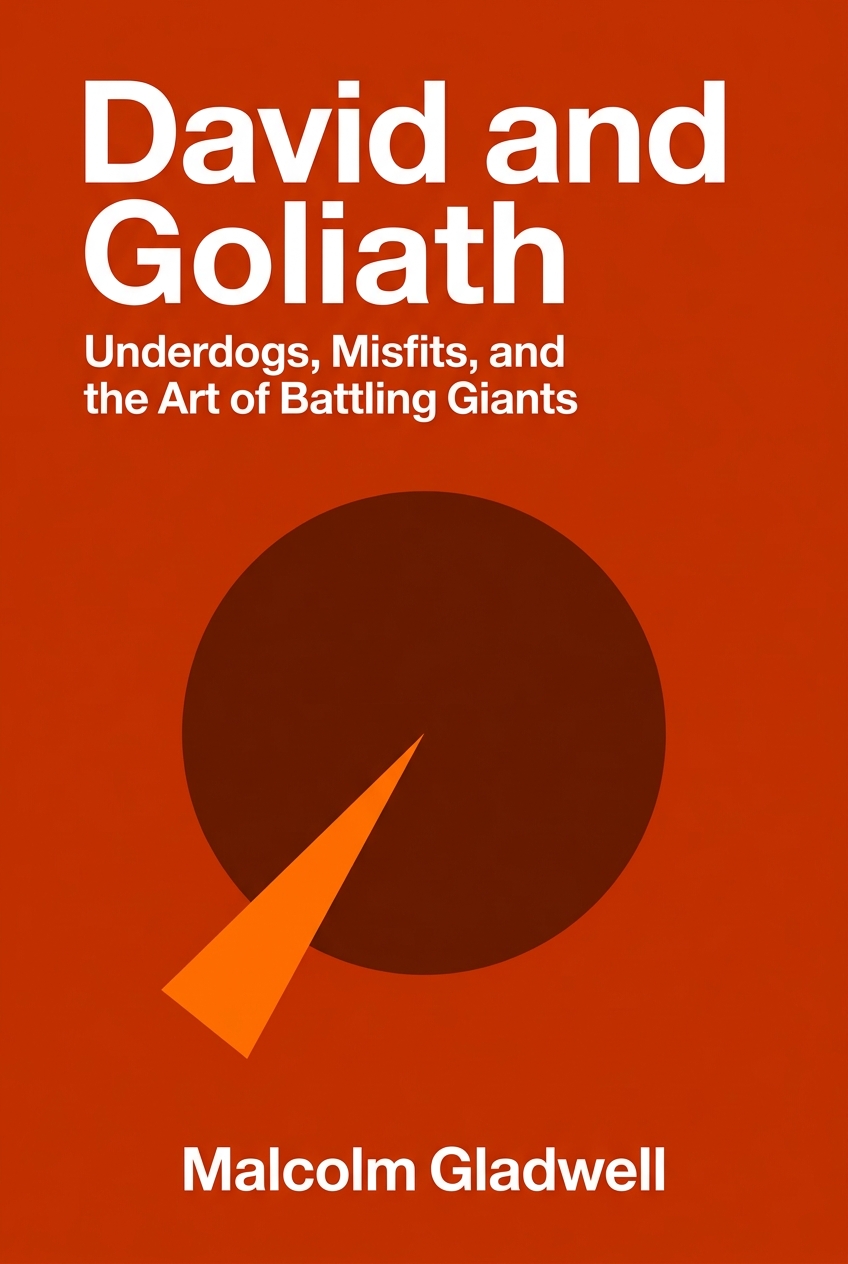
David and Goliath book cover

The Script

We instinctively admire the oak tree, its thick trunk and sprawling branches a symbol of unshakeable strength. We see it as a fortress, invulnerable to the storms that snap lesser saplings. But what if this perception is a dangerous illusion? What if the oak's very size, its rigid refusal to bend, is precisely what makes it a prime target for a lightning strike or a gale-force wind? Meanwhile, the humble, flexible reed, which we dismiss as weak, survives the same storm by yielding, bending to the ground and then springing back up, unharmed. Our intuitive assessment of strength and weakness is often completely backward. We are conditioned to believe that having more—more resources, more power, more size—is an undeniable advantage. We assume the straight-A student will have a more successful career than the dyslexic, that the mighty army will crush the small band of insurgents, and that the child from a wealthy home is set up for a happier life. This logic feels as solid and real as the ground beneath our feet, but what if it’s built on sand?

This exact question—the hidden strength in weakness and the surprising fragility of power—began to crystallize for Malcolm Gladwell when he stumbled upon a perplexing medical study. The study revealed something astonishing about the children who endured the bombing of London during World War II. Contrary to all expectations, many of the children who stayed in the city and lived through the terror of the Blitz were psychologically better off than the children who were evacuated to the safety of the countryside. This paradox, where a 'desirable' difficulty created resilience while a 'safe' advantage bred vulnerability, didn't fit the conventional narrative. As a long-time staff writer for The New Yorker, known for his talent in unearthing the hidden logic behind human behavior, Gladwell realized this was a fundamental, misunderstood principle of how the world works, prompting him to investigate the powerful, counter-intuitive dynamics that govern the struggles between the mighty and the weak.

Module 1: The Myth of the Underdog

We all think we know the story of David and Goliath. A small shepherd boy miraculously defeats a fearsome giant. But Gladwell argues this interpretation is completely wrong. The victory was a strategic mismatch. What we perceive as weakness can be a decisive advantage. Goliath was a heavy infantry warrior, weighed down by over a hundred pounds of armor. He was built for close-quarters combat. He expected David to walk right up to him and fight with a sword.

But David refused to play by Goliath's rules. He was a projectile warrior. He used a sling, a weapon he had mastered as a shepherd protecting his flock from lions and bears. Ancient armies had three types of soldiers: infantry, cavalry, and artillery like slingers. They functioned in a kind of rock-paper-scissors dynamic. Slingers were lethal against slow-moving infantry. Goliath, in his heavy armor, was a sitting duck.

So here is the first insight. Giants have hidden weaknesses tied directly to their strengths. Goliath's size and armor made him powerful in one kind of fight. But they also made him slow and immobile. Medical experts even suggest Goliath may have had acromegaly, a condition causing his giantism but also leading to severely impaired vision. He was a giant who couldn't see well. He was powerful but also profoundly vulnerable. David, unburdened by armor, was fast and agile. He could attack from a distance, exploiting Goliath's slowness and poor eyesight.

This brings us to the core of this module. Underdogs win by changing the rules of engagement. David won because he refused to fight Goliath on Goliath's terms. This principle applies far beyond ancient battles. Take Vivek Ranadivé, a Silicon Valley software executive who knew nothing about basketball. He agreed to coach his 12-year-old daughter's team. They were unskilled. They couldn't dribble well. They couldn't shoot well. By every conventional measure, they were terrible.

So what did Ranadivé do? He had them play a relentless, full-court press for the entire game. This is a strategy so exhausting it's rarely used in professional basketball, let alone in a girls' youth league. But his team had energy and a willingness to try something new. They played a game of chaos and pressure. They overwhelmed more skilled teams and made it all the way to the national championships. Like David, they refused to play by the giant's rules. They leveraged their supposed weakness—a lack of conventional skill—into a radical, effort-based strategy that no one saw coming.

Read More