All Books
Self-Growth
Business & Career
Health & Wellness
Society & Culture
Money & Finance
Relationships
Science & Tech
Fiction
Topics
Blog
Download on the App Store

Democracy Awakening

Notes on the State of America

16 minHeather Cox Richardson

What's it about

Worried about the state of American democracy? This book summary reveals how the nation's foundational principles are being tested by a powerful minority. You'll get a clear, concise breakdown of the historical forces that brought us to this critical moment and what it means for you. Discover the three key movements that have shaped modern American politics, from the rise of originalism to the weaponization of history itself. Heather Cox Richardson provides the historical context you need to understand today's headlines and empowers you to reclaim the narrative of American democracy.

Meet the author

Heather Cox Richardson is a celebrated American historian and Professor of History at Boston College, whose viral daily newsletter, "Letters from an American," reaches over a million readers. Her deep understanding of the American political landscape is rooted in a lifelong study of the interplay between politics and the economy. This unique historical perspective allows her to dissect current events and reveal the centuries-old patterns shaping the nation's present and future, culminating in the urgent insights found within Democracy Awakening.
Listen Now
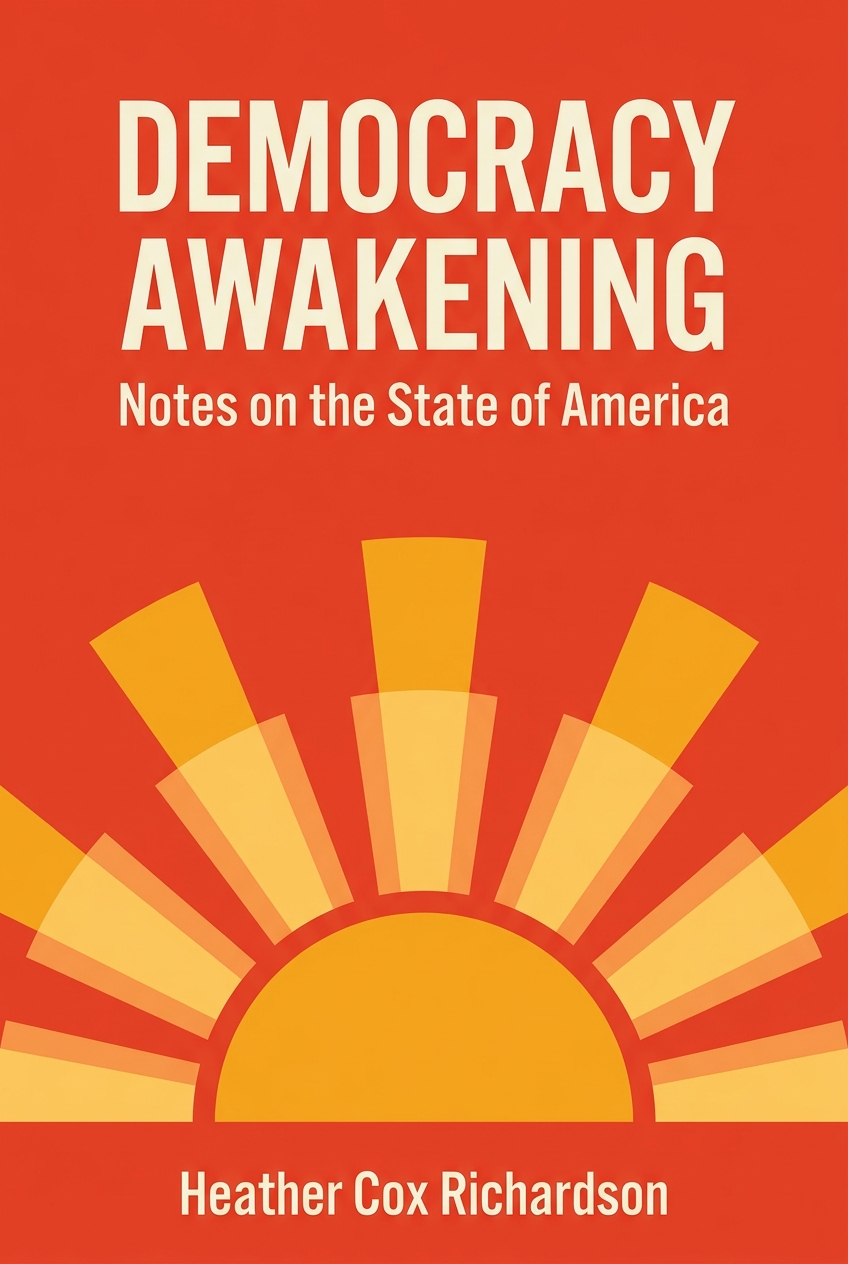
Democracy Awakening book cover

The Script

Think of a community's water supply. For generations, it flows from a clean, shared source, sustaining everyone. Then, one day, a small, organized group gains control of the reservoir. They don't shut it off completely. Instead, they begin to subtly divert the flow, rerouting the main channels to serve their own interests while telling everyone the water is still for all. They use words like ‘purity,’ ‘efficiency,’ and ‘heritage’ to justify their actions, and soon, the language itself becomes a tool to obscure the truth. Those downstream, accustomed to the water's dependable presence, don't notice the change at first. The stream is still running, after all. But over time, the landscape begins to change. Once-fertile ground becomes parched, while a few select plots flourish unnaturally. The community, still speaking the old language of shared access, struggles to articulate what’s gone wrong, unable to name the slow, deliberate capture of their most vital resource.

This gradual, linguistic takeover of a nation’s narrative is a pattern that historian Heather Cox Richardson has spent her career tracing. She recognized that the arguments used today to concentrate power and wealth in the hands of a few were not new; they were echoes of a script that has been deployed throughout American history. Frustrated by the public's lack of awareness of these historical parallels, she began writing daily essays on Facebook to connect the dots between past and present. What started as a simple effort to share historical context exploded into a massive online following, as millions of readers found clarity in her explanations. "Democracy Awakening" is the culmination of that project, born from a historian's urgent need to show how the language of the past is being used to define—and endanger—our future.

Module 1: The Two American Dreams

The book starts with a powerful premise. America was founded on two competing ideas. These two visions have been at war ever since.

The first vision is the one we all know. It's enshrined in the Declaration of Independence. The core American ideal is that all people are created equal and have a right to self-government. This is the democracy of Abraham Lincoln, Franklin D. Roosevelt, and Martin Luther King Jr. It says the government should work for everyone. It should level the playing field. It should provide opportunity for all. This vision is aspirational. It has never been perfectly achieved. But the struggle to realize it is the main engine of American progress.

But there's another, darker vision. It has been present from the very beginning. A powerful, recurring ideology in American history argues that society is naturally a hierarchy. In this view, some people are simply better than others. They are born to lead. The rest are meant to follow. This hierarchical dream justifies inequality. It says that true liberty means the freedom of a select few to accumulate wealth and power without interference. Any government action that promotes equality is seen as an attack on this natural order. George Fitzhugh, an enslaver in the 1850s, put it bluntly. He rejected the Declaration of Independence. He argued that government must originate in force and be continued by force. This isn't some fringe idea. It has been a constant undercurrent in American politics.

This leads to a crucial insight. Authoritarian movements in America rise by exploiting democratic systems. They use the language of freedom to undermine freedom itself. For instance, the American Nazi movement held a rally in 1939 at Madison Square Garden. They called it a rally for "true Americanism." They draped a portrait of George Washington between two swastikas. This shows how authoritarian symbols can be grafted onto national history. The goal is to convince people that hierarchy, not equality, is the true American way. Understanding this fundamental conflict is the first step to understanding the challenges we face today.

Read More