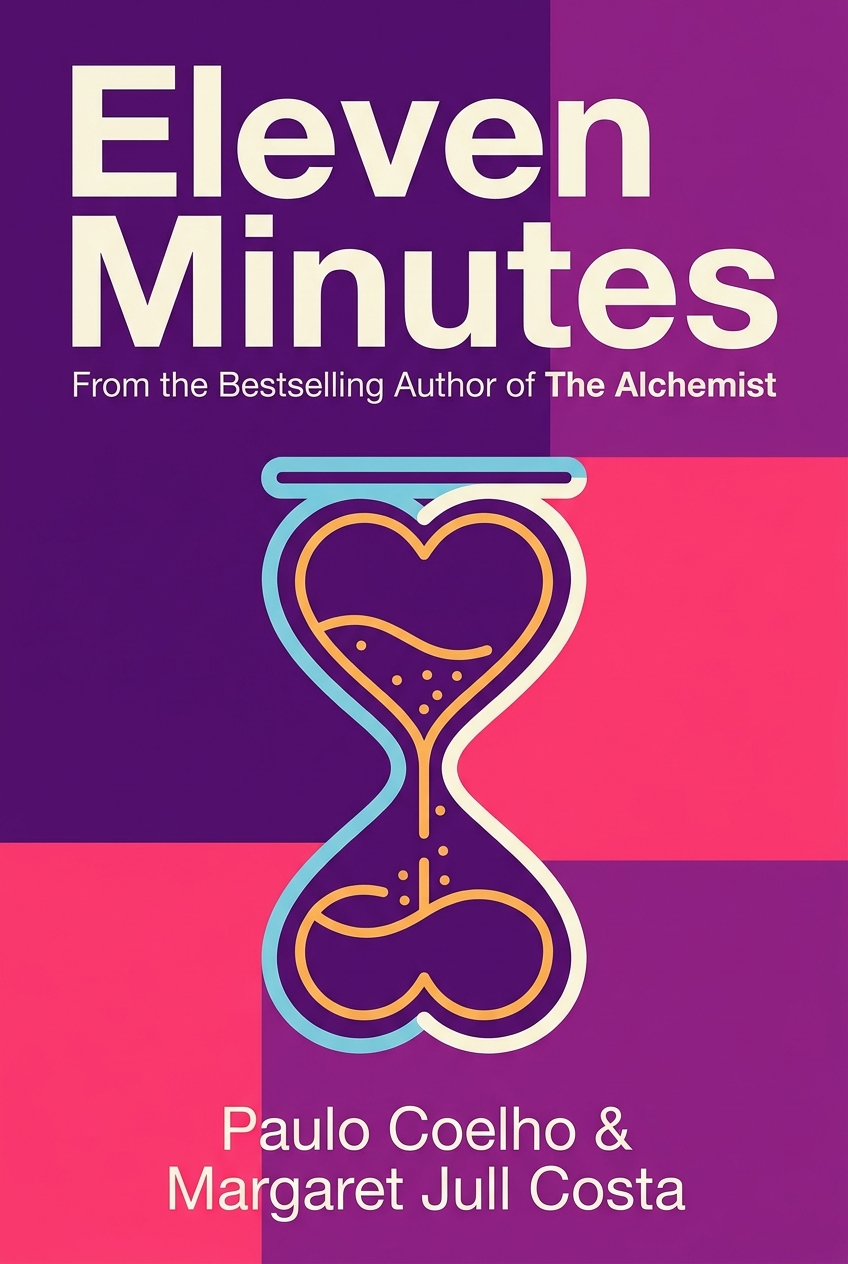
Eleven Minutes
From the Bestselling Author of The Alchemist
What's it about
Ever wondered if true love requires sacrificing your desires? This summary explores the provocative journey of a young woman who dares to separate love from physical pleasure, only to find them intertwined in the most unexpected ways. Discover how embracing your full self can lead to profound connection. You'll follow Maria's path from a naive girl in Brazil to a sought-after prostitute in Geneva, where she believes she can control her heart by focusing only on the physical. Through her diary entries, you'll uncover her deepest insights about sacred sexuality, self-discovery, and the transcendent power of surrendering to love, challenging everything you thought you knew about relationships.
Meet the author
Paulo Coelho is one of the most influential authors of our time, with his masterwork The Alchemist having sold over 150 million copies worldwide. His own transformative spiritual pilgrimage on the road to Santiago de Compostela became the foundation for his storytelling, inspiring him to explore profound themes of destiny, love, and self-discovery. This journey led him to write novels like Eleven Minutes, which fearlessly examines the sacred nature of sex and the complex path to uniting body and soul.
The Script
In a small town, a young woman dreams of a life she’s only seen in magazines. She packs her bags with a naive belief that the world outside her village holds the key to love, adventure, and a grand romance. She believes her body is a currency she can trade for experience, a temporary loan against a future happiness she is certain will arrive. But when she lands in a foreign city, the transaction isn't what she expected. The men she meets don’t see her dreams; they see only a vessel for their own fleeting desires. Each encounter leaves her feeling more hollow, chipping away at the girl who left home until she barely recognizes the woman in the mirror. She learns to separate her body from her soul, building a fortress around her heart to protect it from the emptiness of her work. Yet, in this self-imposed exile, a dangerous question arises: can a heart, once locked away for its own protection, ever learn to feel again?
This question of the sacred and the profane, of the body’s transactions and the soul’s hunger, haunted author Paulo Coelho. He spent a decade collecting stories and interviewing sex workers, trying to understand the delicate line between physical intimacy and true connection. Coelho, already a world-renowned author for his allegorical novels like The Alchemist, felt compelled to explore a darker, more complex side of the human search for meaning. He discovered that the path to understanding love was a winding, often painful, journey through their own deepest shadows. Eleven Minutes became his vessel for these stories, an unflinching look at how one woman’s search for worldly adventure forces her into a profound spiritual reckoning with the nature of love itself.
Module 1: The Idealization and Corruption of Love
We all start with an idealized vision of love. It's shaped by movies, stories, and childhood dreams of a "Prince Charming." Maria, a young woman from a small town in Brazil, is no different. Her early life is filled with universal longings for adventure, marriage, and a perfect partner. But reality quickly intervenes. Her first romantic experiences are defined by crushing disappointment and misunderstanding.
The book's first major insight is that adolescent fantasies of love create a fragile foundation that shatters upon contact with reality. Maria learns to kiss from magazines, mimicking the motions without understanding the intimacy. The result is a clumsy, failed encounter that ends her first relationship. She learns about sex through a mix of taboo, accidental self-discovery, and peer pressure, leading to a shallow understanding. Her first time is painful and unmagical, a stark contrast to the romantic portrayals she grew up with. This clash between expectation and experience teaches her a hard lesson. Love, she concludes, is a source of suffering.
This brings us to a critical coping mechanism. Repeated romantic failures build a defensive wall against emotional vulnerability. After multiple heartbreaks, Maria decides she will never fall in love again. Love, in her experience, "spoiled everything." She learns to manage men by keeping them at a distance, viewing them as fragile and inconstant. This cynical armor is a form of self-preservation. It's a way to navigate the world without getting hurt again. But it also creates a profound split. In her diary, she writes about the disconnect she feels. Those who touch her heart fail to arouse her body. Those who arouse her body fail to touch her heart.
And here's the thing. This emotional armor has a practical application. Beauty and emotional detachment become instruments of power and control. Working in a draper's shop, Maria’s boss falls for her. She uses his infatuation to her advantage, keeping him at arm's length while securing a pay raise and paid overtime. She manipulates his hopes with a seductive smile but never allows physical contact. She understands her attractiveness is a tool. She can use it to get what she wants, as long as she remains emotionally detached and avoids becoming a victim of her own feelings. This mindset sets the stage for her journey, a path where she seeks freedom but often finds herself trapped by the very choices she makes to escape.