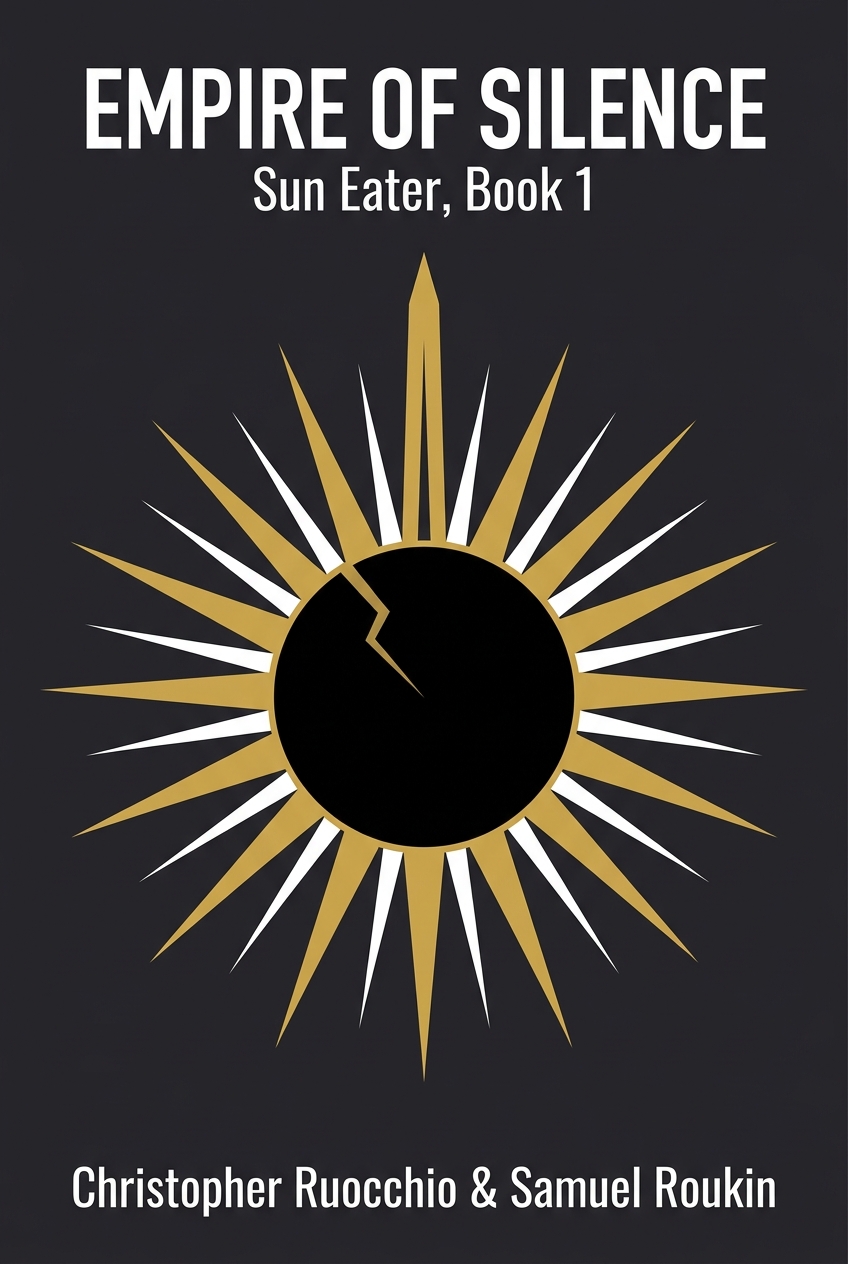
Empire of Silence
Sun Eater, Book 1
What's it about
Ever wondered how a hero's legend is truly forged? What if the path to saving humanity meant becoming its most hated monster? Prepare to discover a story where the line between savior and destroyer blurs, challenging everything you thought you knew about destiny. This is the saga of Hadrian Marlowe, a man vilified for centuries. You'll follow his journey from a reluctant nobleman to a feared legend, uncovering the brutal choices and lost loves that shaped his infamous legacy. Learn the truth behind the myth and decide for yourself if he's a hero or a villain.
Meet the author
Christopher Ruocchio is the international bestselling author of the Sun Eater, a series that has sold more than a half-million copies in six languages worldwide. Samuel Roukin is a celebrated actor and narrator known for his roles in Turn: Washington's Spies and the Call of Duty video game franchise. Together, Ruocchio's background in political science and Roukin's dramatic expertise bring the galaxy-spanning political intrigue and visceral action of Hadrian Marlowe's story to life, creating a truly immersive science-fantasy experience for every listener.
The Script
Think of the great heroes of history, the ones whose stories are told and retold across generations. Now, what if the official version—the one carved into monuments and taught to schoolchildren—was a lie? What if the hero at the center of it all was forced to live out a legend he never chose, a story polished to a shine, hiding the grit, the blood, and the terrible choices made in the dark? He knows the truth. He knows the person he was before the myth took over, and he is the only one left who can tell the real story, even if it means shattering the galaxy's most cherished beliefs and revealing himself as a monster.
This is the story of Hadrian Marlowe, a man who has lived for centuries, a figure both revered and reviled. He is a scholar who became a gladiator, a nobleman who became an outcast, and finally, a legend who wishes only to be understood. He is ready to set the record straight. He has seen empires rise and fall from the forgotten corners and bloody battlefields where history is truly made. He is telling us his story now as the man who survived, the man who remembers everything.
This epic saga was born from a deep fascination with the way history is recorded and remembered. Author Christopher Ruocchio, a former assistant editor at Baen Books, was captivated by classic works of history like Gibbon's The History of the Decline and Fall of the Roman Empire. He wanted to explore what it would be like if a pivotal historical figure could write their own unfiltered memoir, challenging the legends built around them. By blending the grand scale of classic space opera with the intimate, confessional tone of a memoir, Ruocchio created a universe where the greatest war is fought with memory itself.
Module 1: The Gilded Cage of Nobility
The story opens not with starships, but with swords. We meet Hadrian Marlowe, a young nobleman on a remote planet, born into a life of immense privilege. But this privilege is a cage. His world is governed by rigid hierarchies and cold, political relationships.
The first hard lesson is that names and titles are burdens, not just honors. Hadrian’s father, a cold and calculating Archon, named him after an ancient emperor. The name carries an expectation of rulership, a destiny he never chose. Throughout his life, he will collect other names: Halfmortal, the Sun Eater, Oimn Belu. Each one represents a role forced upon him by others, a layer of identity he must either carry or shed. In this universe, your name is your chain. It dictates your duties, your alliances, and even who you are allowed to become.
This leads to the second insight: in this society, family is a political unit, not a source of warmth. Hadrian’s birth is a clinical procedure. His parents watch from a platform as he is "decanted from a vat," his genetics carefully managed by the Imperium. His mother is a distant figure, more loyal to her own noble house than to her husband’s. His father communicates through commands and silence, never using Hadrian’s name. He is an heir, a chess piece, an extension of his father's legacy. This emotional void forces Hadrian to seek connection elsewhere—with his tutors and, later, with those far below his station.
So what happens when you try to escape this cage? You find that empathy is a liability in a system built on control. Hadrian witnesses the brutal exploitation of miners on his family’s world. Their equipment is ancient. Their death rate is horrifying. When he expresses compassion, the workers are shocked. No one from the ruling class has ever cared. But his empathy is powerless. He lacks the authority to change anything, and his attempts at kindness are seen as weakness by his father. He’s caught between his conditioning as a noble and his instinct to be human. This conflict will define his entire journey. The system doesn't reward compassion. It punishes it.