All Books
Self-Growth
Business & Career
Health & Wellness
Society & Culture
Money & Finance
Relationships
Science & Tech
Fiction
Topics
Blog
Download on the App Store

Enchantment

Awakening Wonder in an Anxious Age

14 minKatherine May

What's it about

Feeling disconnected from the world and overwhelmed by modern life? Discover how to reawaken your sense of wonder and find magic in the everyday. This summary offers a powerful remedy for the anxiety and exhaustion plaguing our digital age, guiding you back to a state of enchantment. You'll learn Katherine May's practical framework for reconnecting with the natural world and your own inner self. Uncover simple yet profound ways to engage your senses, embrace mystery, and cultivate a deeper, more joyful relationship with the world around you, even when things feel uncertain.

Meet the author

Katherine May is the New York Times bestselling author of Wintering, whose celebrated work exploring the cycles of rest and renewal has been translated into over twenty-five languages. Following a period of intense personal anxiety, May began a conscious search for awe and wonder in the everyday, a journey that became the foundation for her profound insights. Her writing reconnects us to the magic of the world and the restorative power of paying attention, offering a guide to finding nourishment in difficult times.
Listen Now

Opens the App Store to download Voxbrief

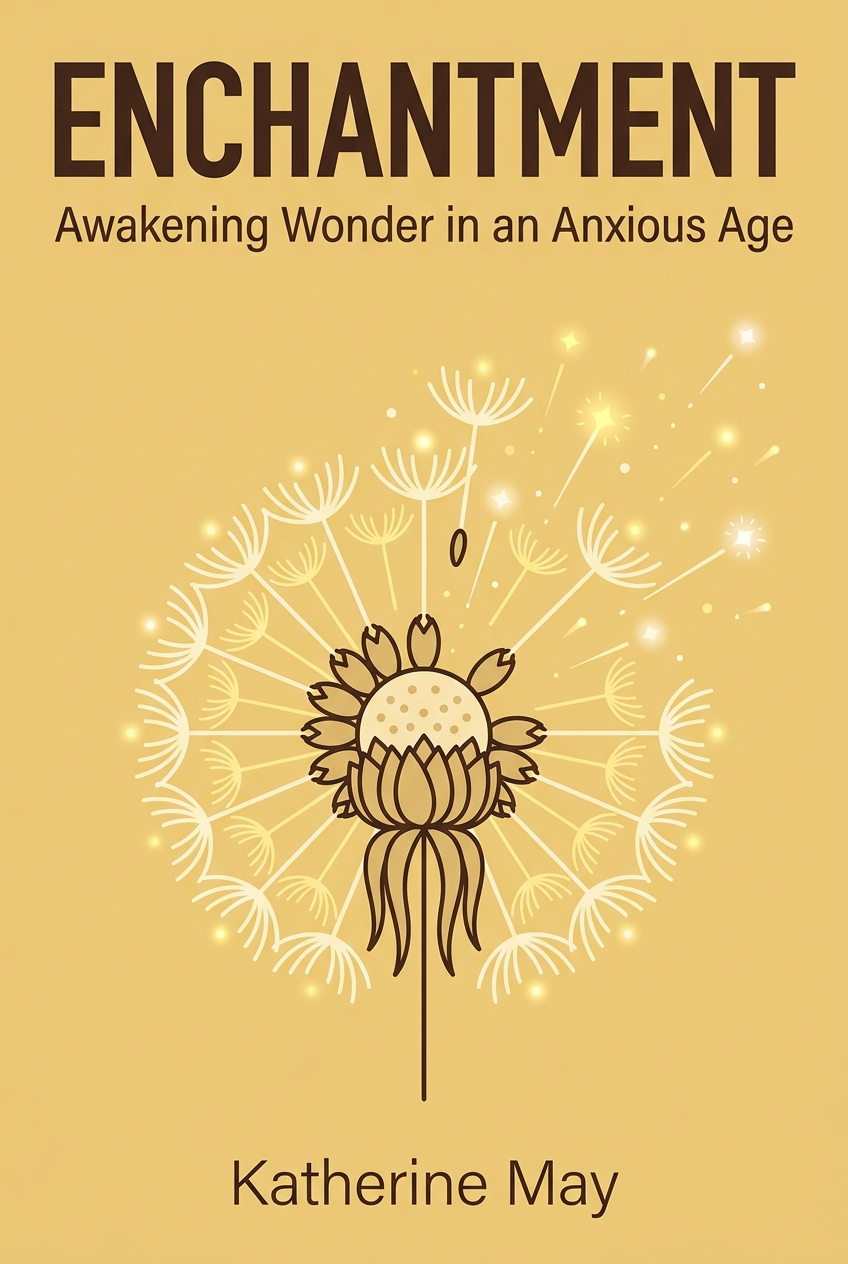
Enchantment book cover

The Script

A ship is wrecked on a remote coast. Among the survivors, two people set out to build shelters. The first, a master carpenter, has a lifetime of experience. He knows the properties of wood, the angles of joinery, the precise way to drive a nail. He sees the shore’s scattered driftwood as a problem of engineering—a collection of flawed materials to be measured, cut, and forced into a preconceived design. He works with grim efficiency, his mind a fortress of established procedure. The second person has no such training. They walk the beach with an open curiosity. They notice how a certain curve of root seems to echo the arc of a sheltering rock. They see how the wind has already woven sea-grass through a tangle of branches, creating a surprisingly sturdy wall. Instead of imposing a rigid structure onto the world, they collaborate with what’s already there, finding strength in the unexpected, the imperfect, and the wild.

This feeling of being stranded, of finding our own meticulously built plans shattered against the rocks of reality, is a near-universal experience. We are taught to be the carpenter—to strategize, to optimize, to control. But what if the more resilient, more human way to live is to learn the art of collaboration with the unpredictable? It was in the depths of her own personal winter, a period of intense illness and burnout, that author Katherine May began to question the modern world’s relentless demand for progress and perfection. A writer and podcaster known for her explorations of the quiet, often overlooked corners of life, May found herself physically and spiritually exhausted by the pressure to always be striving. She realized she had forgotten how to simply be in the world, how to find wonder in the small, the slow, and the strange. This book, “Enchantment,” is her record of relearning that lost art—a journey back to a more magical way of seeing and being by engaging with reality more deeply.

Module 1: The Anatomy of Disenchantment

Modern life often leaves us feeling fragmented and disconnected. We scroll through social media for hours, comparing our messy reality to the solid, certain avatars online. This only amplifies our sense of emptiness. Katherine May argues that this is a symptom of a disenchanted world. But the first step to finding a way out is recognizing the landscape. You must diagnose the subtle ways modern life disconnects you from yourself and the world.

May gives a powerful example of this disconnection. She describes waking in the night, completely disoriented. For a moment, she is "nobody," unable to locate which version of herself she is. This feeling of unreality is a core symptom of disenchantment. It's the exhaustion that comes from constant change, digital overload, and a sense of societal fragmentation. The author feels that our collective loss of shared rites of passage, like those for grief, has led to a chronic loneliness. We are surrounded by digital chatter but lack true connection.

From this foundation, we can understand the deep yearning that follows. Beneath the anxiety, there's a craving for something more. May calls this a hunger for enchantment, a connection to something larger than the self. It's an intuitive, felt engagement with the world. Acknowledge the universal human yearning for wonder and meaning beyond surface-level existence. This is about recognizing a fundamental human need. May describes feeling she lacks an "essential nutrient," one found only in her own soil. This points to a need for a deeply personal reconnection to what makes life feel vibrant and meaningful. She's not alone. This yearning is a quiet rebellion against a world that feels like "tap water left overnight, flat and chemical, devoid of life."

So what happens next? If enchantment is the goal, we need to redefine it. It isn't found in dramatic, faraway places. Enchantment is small wonder magnified through meaning, found in close attention to the ordinary. It’s a quiet, accessible form of awe. May recalls her childhood, where enchantment was in the "compromised" local places. Footprints in the mud that might be a badger's. Swans nesting by an abandoned factory. These small moments, caught in the web of memory and fable, create a sense of magic. The key is personal engagement. It's about finding your own "holy relics" in the everyday. The drift of headlights on a quilt. The red lights of distant chimneys at night. These are the things that make your stomach tingle with a sense of imminence.

Module 2: Re-grounding in the Physical World

We've explored the feeling of being unmoored. Now, let’s turn to the solution May proposes: a deliberate return to the physical world. When she felt her head floating away from her body, she followed a simple note: "Go for a walk." Not just any walk, but a strenuous hill climb designed to make her feel the weight of her own being. This points to a powerful principle. To counter disorientation, intentionally engage with the physical world to feel your own gravity. This is about using tactile sensations—the strain of a climb, the feel of the ground—to anchor a scattered mind.

This principle extends to our interaction with objects. May describes a lifelong fascination with stones. She collected pebbles, smashed rocks to find geodes, and bought mineral specimens. Stones, for her, offer a "pure kind of weight." They are a tactile anchor that connects her to a more solid reality. And here's the thing. This is about finding physical anchors in your own life. The author recalls ceramic artist Jean Lowe, who noted that "clay remembers." The heat of a kiln reveals seams and stresses, showing how materials hold memory. In the same way, physical objects can hold our memories and ground our experiences. Use tangible, physical objects as anchors for memory and meaning.

But what if the world around you feels artificial? May explores this when she visits a newly erected stone circle in Whitstable. Initially, she's skeptical. It's "ersatz," lacking ancient history. The stones seem to shrug her off, telling her to "make your own meaning." This is a critical insight. In a disenchanted age, we can't always rely on inherited traditions. We often have to create our own rituals and imbue new spaces with significance. Actively create your own meaning in new or artificial spaces instead of waiting for it to be given.

She returns to the stone circle later. Others have been there. They've carved symbols and lit fires. It has become a site of quiet, shared ritual. She sits barefoot on the central stone and experiences a moment of active rest. Her attention settles. Her doubt is accepted. The stones don't offer answers, but they provide a space to "pattern the stones" with her turmoil. This reveals a deep human need. As traditional structures fade, we seek neutral spaces to gather our thoughts. These new sites become sacred through our shared, unspoken need for connection and contemplation.

Read More