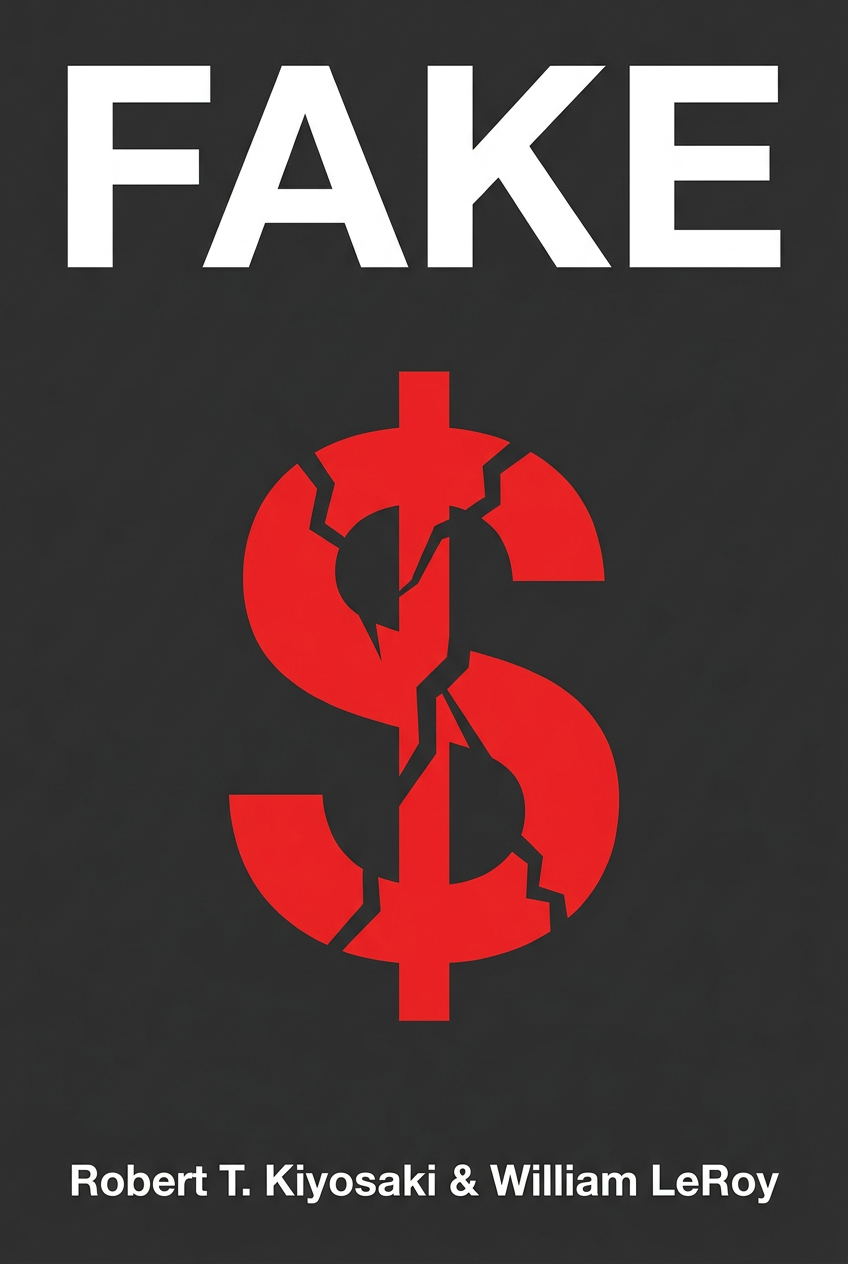
FAKE
Fake Money, Fake Teachers, Fake Assets: How Lies Are Making the Poor and Middle Class Poorer
What's it about
Are you tired of playing by the rules and still falling behind? Discover why the conventional advice to save money, get a good job, and invest in the stock market is a trap designed to keep you financially struggling. It's time to learn the real rules of money. This summary of Robert Kiyosaki's FAKE uncovers the three biggest deceptions in our modern world: fake money, fake teachers, and fake assets. You'll learn why your cash is losing value, how the education system fails to teach real financial literacy, and what truly makes an asset valuable.
Meet the author
Robert T. Kiyosaki is the acclaimed author of Rich Dad Poor Dad, the 1 personal finance book of all time, which has challenged and changed the way tens of millions of people think about money. A fourth-generation Japanese American who served in the Vietnam War, his real-world experience as an entrepreneur and investor fuels his mission to expose the financial "fake news" that keeps people trapped. Kiyosaki's outspoken and often controversial perspectives are born from a life dedicated to financial education and achieving true financial freedom.
Opens the App Store to download Voxbrief

The Script
We treat our financial lives like a construction project, carefully stacking bricks of savings, paychecks, and pension plans, hoping to build a fortress of security. We follow the blueprints given to us by financial planners, news anchors, and university professors—the trusted architects of prosperity. But what if the very materials they hand us are counterfeit? What if the bricks are hollow, the mortar is sand, and the blueprints are designed not for our fortress, but for their palace? This is a crisis of fraudulent materials. When the system's core components—the money, the assets, and the advice—are themselves fake, following the rules isn't just ineffective; it's a guaranteed path to the very financial ruin you're trying to avoid.
This realization—that the game is rigged by its components—is what drove Robert Kiyosaki to write FAKE. After the 2008 financial crisis, he watched as the official solutions—bailouts and quantitative easing—seemed to only reinforce the system's dishonesty, printing more 'fake' money to solve a problem caused by fake assets. As the author of Rich Dad Poor Dad, the best-selling personal finance book of all time, Kiyosaki saw the advice from mainstream 'experts' as a dangerous form of intellectual counterfeit. He wrote this book as a direct warning that the fundamental elements of wealth have been replaced by illusions, and that recognizing the fakes is the first, and most critical, step toward building real, lasting financial security.
Module 1: The Architecture of a Fake Relationship
The story begins with two former best friends, Alec and Dani, who are now practically strangers. They are forced back into each other's orbits after years apart. An awkward, misunderstood incident in a hockey locker room puts Alec's future at risk. His coaches, trying to spin the story, invent a narrative: Alec and Dani are childhood sweethearts. This lie becomes the foundation for the central premise.
This leads to a critical negotiation. A fake relationship can be a strategic tool for mutual benefit. Alec needs to clean up his reputation to secure a spot on a high-level hockey team. His career and his family's financial future depend on it. Dani, a new student desperate for an extracurricular activity to get into Harvard, needs a guaranteed role as the hockey team's manager. Alec makes a proposition. He'll get her the manager job if she agrees to pretend to be his girlfriend. It's a purely transactional arrangement. She helps him look like a stable, committed guy. He helps her get into her dream school.
But here's the thing about performing a relationship. To be convincing, a fake relationship must be built on a foundation of real, shared history. Alec and Dani can't just invent chemistry. They have to draw from their past. Alec remembers Dani’s childhood obsession with gummy bears and buys her a bag. It’s a small gesture, but it’s rooted in a real memory. They fall back into old patterns of banter, referencing inside jokes from summers spent at the library. This shared history makes their performance believable to outsiders. More dangerously, it starts to feel real to them.
This brings us to a crucial point. The line between performance and reality blurs under the pressure of constant proximity. They start with a "hard launch" at school, holding hands and staging interactions for social media. But the act starts to bleed into reality. Alec finds himself genuinely distracted by Dani's presence. Dani feels a real flush in her cheeks when he performs a flirtatious gesture. She has to constantly remind herself, "This is an act." The problem is, her body isn't listening. Their minds know the rules of the game, but their emotions start playing by a different set. They agreed to a business deal, but they're building a relationship on real memories and genuine moments of connection. This sets the stage for inevitable emotional chaos.
Module 2: The Weight of Unresolved History
This story is about the real, unresolved pain from the past. Years ago, Alec and Dani had a secret correspondence. They sent postcards back and forth, a lifeline of their friendship. Then, one day, Dani just stopped. Alec kept writing, but he never heard back. He felt abandoned during the most difficult time in his life, when his father had a near-fatal accident.
This unresolved history becomes a powerful, disruptive force. Past abandonment creates a filter of mistrust that colors all present interactions. When Dani returns, Alec isn't happy to see his childhood friend. He's angry. He sees her through the lens of that past betrayal. He calls her "some chick" and acts dismissive. This is a defense mechanism built on years of unprocessed hurt. He even creates a persona, "Zeus," the cocky hockey star, to distance himself from "pathetic little Alec," the boy who got his heart broken.
So what happens next? Sensory triggers can collapse time and resurrect dormant feelings. Alec tries to stay detached, but memory is a powerful opponent. He hears a song that reminds him of Dani and has to skip it immediately. He sees her handwriting and is instantly transported back to being a kid, waiting for a postcard that never came. For Dani, seeing Alec's childhood bedroom is like stepping into a time machine. These triggers prove that no matter how much they try to live in the present, the past is always there, waiting to pull them back.
This emotional baggage ultimately sabotages their present. When Dani tries to break up with Alec—a sacrifice she's making to protect him—he doesn't see her pain. He only sees a pattern. His immediate reaction is, "Leaving me behind yet again." He brings up the unanswered letters from years ago. His past trauma makes it impossible for him to understand her current motivations. He assumes the worst because the wound of her previous "abandonment" never truly healed. This is a powerful insight: without resolving old hurts, we are doomed to misinterpret the present.