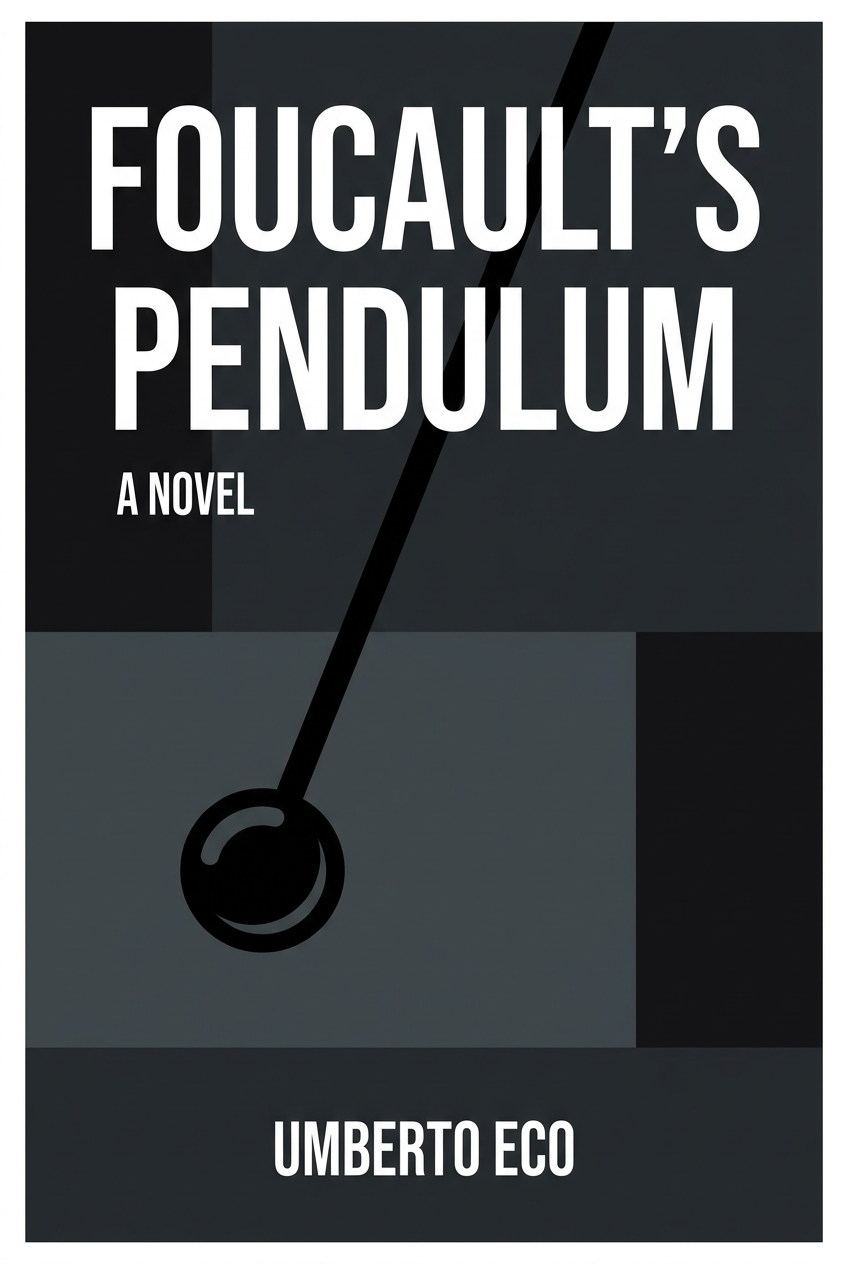
Foucault's Pendulum
A Novel
What's it about
Ever feel like you're missing a hidden layer to reality, a secret history connecting everything? Discover "The Plan," a massive conspiracy theory invented by three bored editors as a joke. But what happens when your creation becomes so convincing that deadly secret societies believe it's real and will kill to possess it? You'll follow the editors as their intellectual game spirals out of control, blurring the lines between skepticism and paranoia. This journey through ancient texts, cryptic messages, and occult traditions reveals how easily we can fall for complex narratives—and the dangerous consequences of creating a truth others are willing to die for.
Meet the author
Umberto Eco was a world-renowned semiotician and philosopher whose academic work explored the nature of signs, symbols, and interpretation. This profound expertise in how we create meaning from history, myth, and conspiracy provided the intellectual foundation for his masterpiece, Foucault's Pendulum. His unique ability to blend scholarly rigor with narrative genius allowed him to craft a novel that is both a thrilling intellectual puzzle and a cautionary tale about the seductive power of obsessive interpretation.
Opens the App Store to download Voxbrief

The Script
We believe our minds are sophisticated instruments, carefully distinguishing fact from fiction. But the truth is more humbling: the mind is a meaning-making engine that abhors a vacuum. When confronted with a collection of disconnected facts—a laundry list of Templar Knights, an ancient shopping receipt, a cryptic symbol—it doesn't just store them. It begins, automatically and unstoppably, to weave them into a story. This process is a feature, not a flaw. The danger arises when we start to believe our own story too much, when the elegant tapestry we've woven from scraps of data becomes more real, more compelling, than reality itself. The conspiracy is something we build, not something we discover.
The line between a playful intellectual game and a deadly obsession is where the story of this book begins. In the late 1980s, the Italian novelist, semiotician, and medievalist Umberto Eco noticed this very human tendency to connect unrelated dots. Having already achieved worldwide fame for his labyrinthine historical mystery, The Name of the Rose, Eco was fascinated by the modern world's growing appetite for occult theories and grand, unifying conspiracies. He decided to construct a novel that would embody this impulse, creating a fictional 'Plan' so vast and convincing that it would swallow its own creators. Foucault's Pendulum became his warning about the seductive gravity of nonsense, a monumental exploration of how the act of inventing a secret history can become the most dangerous secret of all.
Module 1: The Seduction of the Secret
The novel opens with a powerful idea: the world is not what it seems. Beneath the surface of official history lies a hidden, coded reality. This idea is what fuels the entire narrative and ensnares its characters.
The story introduces us to this mindset through its very structure. The table of contents is named after the ten Sefirot, the divine emanations from the Jewish mystical tradition of Kabbalah. It isn't a list of chapters. This immediately signals that we are entering a world where knowledge is symbolic, layered, and not straightforward. The book itself becomes an artifact to be decoded. An early epigraph from the occultist Agrippa reinforces this. It warns that meaning is deliberately "dispersed in various places and gathered again." The search for hidden knowledge is presented as an intellectual puzzle requiring active reconstruction. You can't just read this book; you have to connect the dots.
This brings us to the central symbol: Foucault's Pendulum. In a museum in Paris, a massive pendulum swings from a high dome, its path slowly rotating to prove the Earth's spin. For the narrator, this is a metaphysical revelation. The pivot point of the pendulum becomes "the Only Fixed Point in the universe," an absolute anchor in a world of chaos. It’s a direct experience of order, a hint of a divine, mathematical logic governing reality. The allure of a single, fixed point of truth can validate an entire web of conspiratorial beliefs. After this experience, the narrator starts to believe his friend Belbo might be right. Maybe there is a universal plot. This is the first step down the rabbit hole. The desire for a single, elegant answer makes you vulnerable to increasingly complex and unsubstantiated theories. For a professional building a company or a product, this is a critical warning. It’s easy to latch onto a single metric or a single "truth" about your market, but that can blind you to the messier, more complex reality.
Finally, the book shows how this search for secrets is often a performance. We meet Count Agliè, a charismatic aristocrat who hints that he is the immortal Comte de Saint-Germain. He surrounds himself with ancient books and speaks in cryptic aphorisms. He never proves anything, but his performance of ancient wisdom is intoxicating. Authenticity in esoteric circles is performed through mastery of its language and symbols. Agliè doesn't need to offer evidence; his credibility comes from his ability to synthesize myths, from the Gnostics to the Rosicrucians, into a compelling narrative. He demonstrates that in the world of secrets, the story is often more powerful than the fact.
Module 2: The Mechanics of Paranoia
Once you start looking for a secret Plan, you will find it everywhere. This module explores the engine of conspiratorial thinking: the art of connecting everything to everything else.
The protagonists—Belbo, Diotallevi, and Casaubon—decide to turn this tendency into a game. They feed random facts from the manuscripts of their "Diabolicals"—their term for occult-obsessed authors—into a computer program named Abulafia. The program spits out a jumble of disconnected sentences: "The Templars have something to do with everything." "Minnie Mouse is Mickey's fiancée." "Debussy was a Rosicrucian." Their job is to connect these dots into a coherent narrative. This is the birth of the Plan.
The core principle they adopt is simple but powerful. Every fact, no matter how trivial, must be part of the secret. There are no coincidences. This is the fundamental axiom of paranoid interpretation. A traffic sign is a coded message. An automobile isn’t just a machine; its parts can be mapped to the Kabbalistic Tree of Life. The engine's four-stroke cycle becomes a metaphor for cosmic creation and return. This kind of analogical thinking is a powerful tool for innovation, but the book warns it can also become a trap. When you force connections, you start to see a world of your own making.
This leads to the second insight. Pseudo-history is built by recycling and cross-referencing unverified claims until they feel true. The characters realize that the manuscripts they receive are all citing each other. A baseless legend about the Knights Templar founding Freemasonry appears in dozens of books, each one referencing the last, creating an echo chamber of "truth." Garamond, their boss, cynically notes that in this genre, originality is a flaw. The books must "confirm one another; therefore they’re true." They build a web of authority without a single anchor in verifiable fact. This is a powerful lesson for anyone navigating the modern information landscape. We see this today in everything from financial blogs to political commentary, where a claim, repeated often enough across enough platforms, can acquire the veneer of truth.
So what's the result? An obsessive search for patterns eventually makes it impossible to distinguish the meaningful from the mundane. Lia, the narrator's pragmatic partner, offers a brilliant counter-argument. She argues that all the universal symbols the Diabolicals attribute to secret knowledge—labyrinths, sacred numbers, vertical stones—are rooted in the human body. The labyrinth is the gut. The number two is our pairs of eyes and ears. A vertical stone is worshipped because standing upright means life, while lying flat means death. The secret is inside us. The Diabolicals make the mistake of seeing the body's reality reflected in the world and thinking it’s a coded message from an external source. They are searching for a secret that is simply the echo of their own biology.