All Books
Self-Growth
Business & Career
Health & Wellness
Society & Culture
Money & Finance
Relationships
Science & Tech
Fiction
Topics
Blog
Download on the App Store

Friends, Lovers, and the Big Terrible Thing

A Memoir

15 minMatthew Perry

What's it about

Ever wonder what was really happening behind the scenes with Chandler Bing? Get ready for the raw, unfiltered story of the man behind the beloved character. This is Matthew Perry's journey through the dizzying highs of fame and the crushing lows of a life-threatening addiction he hid in plain sight. You'll discover the stark reality of his battle with the "Big Terrible Thing," from near-death experiences to the immense pressure of being on the world's biggest TV show. Perry reveals how he fought for his life, the cost of his secrets, and the powerful hope he found in recovery.

Meet the author

Matthew Perry was the beloved Emmy-nominated actor who starred for a decade as Chandler Bing on the iconic sitcom Friends, a role cherished by millions worldwide. After achieving global fame, he faced a private, decades-long battle with addiction, a harrowing journey he navigated both in and out of the public eye. Perry dedicated his later years to helping others struggling with substance abuse, using his own profound experience to offer a powerful, unfiltered, and ultimately hopeful voice for recovery.
Listen Now

Opens the App Store to download Voxbrief

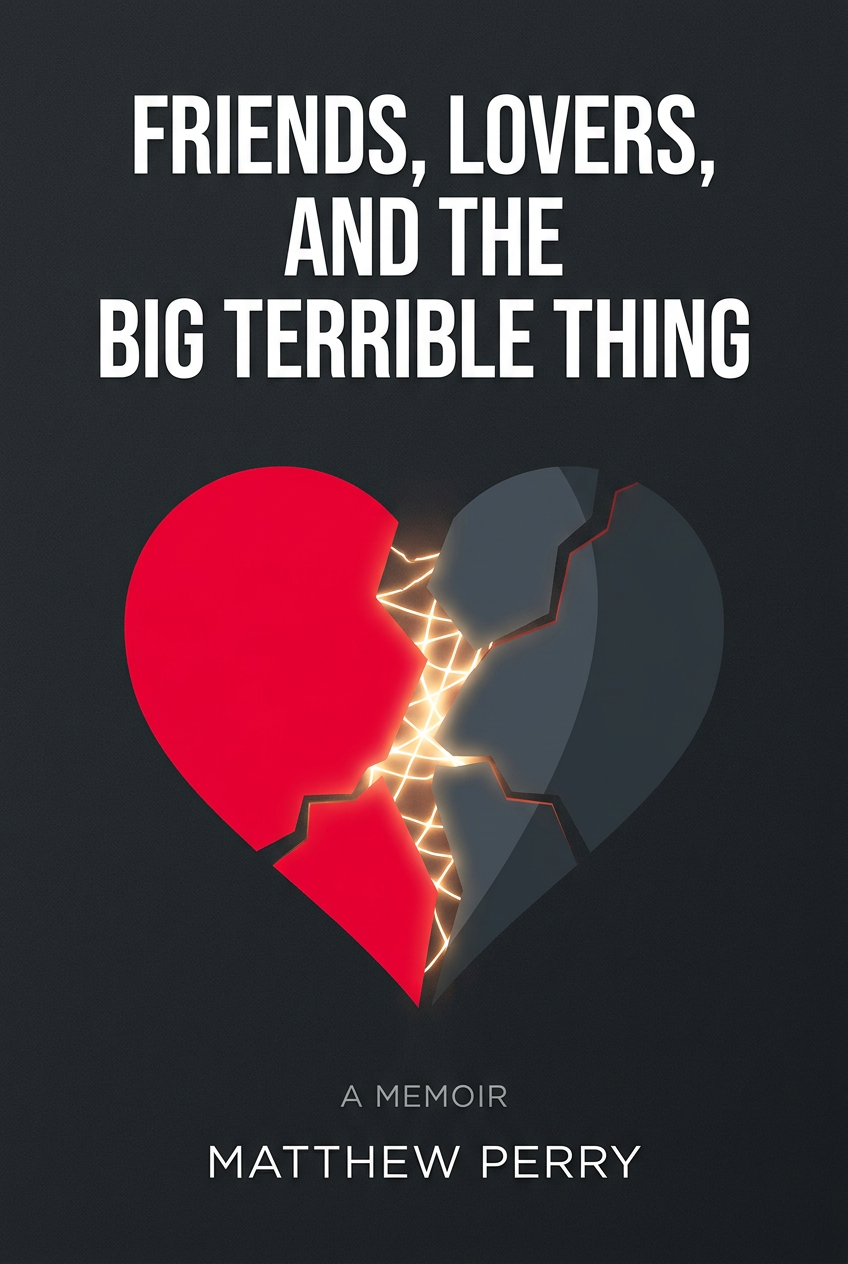
Friends, Lovers, and the Big Terrible Thing book cover

The Script

Think of a person's life as a play. There are the scenes performed for the public on the main stage: the laughter, the applause, the big, bright, funny moments that everyone remembers and quotes. Then there is the backstage, a chaotic, dim, and often dangerous place filled with tangled ropes, heavy counterweights, and the constant, grinding noise of machinery. The audience only sees the seamless show; they have no idea that just inches away, a stagehand could be crushed by a falling sandbag or a lead actor could be battling a private terror just before their cue. The distance between the public performance and the private reality is often measured in inches, but the chasm between the two experiences is immense. We see the smile, not the sweat. We hear the punchline, not the panic.

This gap between the stage and the backstage was the lifelong reality for Matthew Perry. For millions, he was Chandler Bing, the effortlessly witty, lovably sarcastic friend everyone wished they had. His performance was so perfect, his timing so flawless, that it seemed to be the man himself. But while the world was laughing, Perry was living backstage, trapped in a life-or-death struggle with the 'Big Terrible Thing'—addiction. He wrote this book as a desperate message from that dark, hidden space. It was a lifeline thrown out in the hopes that someone else, tangled in the same backstage machinery, might see it and know they weren't alone. After countless rehabs and near-death experiences, he felt an urgent need to finally turn the house lights on, to show the audience the whole terrifying, complicated, and deeply human truth of what it takes to simply stay alive until the next scene.

Module 1: The Anatomy of Addiction

Matthew Perry’s story forces us to confront a difficult truth about addiction. It is a disease. A relentless, cunning, and powerful force that operates with its own logic.

Perry's first drink at fourteen felt like a revelation. For three hours, the gnawing feeling of abandonment he’d carried since childhood vanished. He felt "complete." This moment planted a seed. It taught his brain that alcohol was a solution. This leads to the first core insight. Addiction often begins as a coping mechanism for deep-seated emotional pain. Perry traces his lifelong feeling of being "not enough" to early childhood abandonment. He was sent on a plane alone at age five. His father left when he was a baby. These events created a "great hole" inside him. Substances, for a short time, seemed to fill that void. They offered a temporary peace he couldn't find anywhere else. For anyone battling their own demons, the book suggests identifying the original wound is a critical first step. What pain are you trying to numb?

From there, the disease progresses. Perry makes a sharp distinction between a "partier" and an "addict." His friend Bruce Willis, he notes, was a partier. He could go hard and then stop. He had an off-switch. Perry did not. He explains that for an addict, the first drink or pill flips a switch in the brain. Control is gone. This brings us to a stark reality. Addiction is a progressive disease that cannot be controlled by external success or willpower. At the peak of his Friends fame, earning a million dollars a week and dating Julia Roberts, his mind was still screaming for drugs. He lived in a beautiful home but was taking 55 Vicodin pills a day. The fame, the money, the dream life—none of it mattered. The disease didn't care. It wanted more. This is a powerful lesson for high-achievers. You can't "out-work" or "out-think" addiction. It operates on a different level, a biological imperative that overrides rational thought.

So what happens when the disease takes over? It becomes a full-time job. Perry’s life became a cycle of getting drugs, using drugs, and recovering from drugs. He describes his addiction as "The Big Terrible Thing," a force of pure destruction. It’s like the Joker from Batman—it just wants to see the world burn. This reveals a chilling aspect of the disease. Active addiction isolates you and thrives on secrecy. Perry hid his drinking from his castmates. He manipulated doctors for prescriptions. He lied to his family. Lisa Kudrow, in her foreword, admits she often had no idea how bad things were because he kept it a secret. This secrecy is a key symptom. It cuts you off from the very people who could help you. The actionable step here is to break the silence. If you are struggling, the first, hardest, and most important move is to tell someone. One person. Today.

Finally, Perry’s journey shows the brutal physical toll. His colon exploded from opioid abuse. He spent weeks in a coma. He had a 2% chance of survival. He endured dozens of surgeries and lived with a colostomy bag for months. Addiction is a physical war on your body. The book details his medical emergencies with graphic honesty. It's a visceral reminder that this disease is not abstract. It has real, life-threatening consequences. His story forces us to see addiction as a severe, chronic medical condition that requires intensive care.

Module 2: The Illusion of Fame

We've explored the nature of addiction. Now, let's turn to the world that surrounded it: Hollywood. Matthew Perry’s story is a powerful case study in the seductive and destructive nature of fame. Before Friends, he prayed for it. He believed fame would fix everything. It would fill the void, silence the insecurity, and make him "enough." It’s a common dream, especially in a world that glorifies celebrity.

But when fame arrived, it was an accelerant, not a cure. This brings us to a crucial insight. Fame does not solve internal problems; it magnifies them. When Friends became a global phenomenon, Perry was suddenly one of the most recognizable people on the planet. The pressure was immense. He felt he had to be "on" all the time, to be the funny guy. He admits that if a joke didn't land with the live studio audience, he would sweat and go into convulsions. He felt he would "die" without their approval. The very thing he craved—external validation—became a new source of anxiety. His insecurity wasn't healed; it was just projected onto a global stage.

Furthermore, fame created a dangerous bubble. Success can shield an addict from consequences, enabling the disease. On the set of Friends, his castmates were supportive. They were like "penguins," huddling around him when he was struggling. Jennifer Aniston even confronted him, a moment he calls "devastating" but loving. But in the broader Hollywood machine, no one wanted to stop the gravy train. While filming the movie Serving Sara, his addiction was so severe he was slurring his lines. But the production was a high-stakes moneymaker. No one intervened. He was able to buy his way out of trouble, like paying a $650,000 lawsuit to a studio. Wealth and fame created a world where the normal guardrails didn't apply. This is a cautionary tale for anyone in a high-stakes environment. Be wary of a culture that prioritizes results over well-being. It can be deadly.

And here's the thing. The disconnect between public perception and private reality is a heavy burden. The pressure to maintain a public persona while privately suffering leads to profound shame and isolation. The world saw him as the hilarious Chandler Bing. Privately, he was living in "dark rooms and misery," managing drug deals and battling withdrawal. He fantasized about going on a talk show and just telling the truth: "I'm so miserable, and you have no idea." This duality is exhausting. It feeds the addiction, which thrives in the darkness. The lesson here is about authenticity. The cost of maintaining a flawless public image is often your private sanity.

Perry's journey through fame offers a final, sobering lesson. He eventually realized that his prayer to God—"Just please make me famous"—was answered, but with a twist. He believes he got famous so he would not waste his entire life trying to get famous. Achieving a life goal can reveal that the goal itself was misplaced. He had the number one TV show and the number one movie in the world simultaneously. And he was miserable. It was the ultimate proof that external success is not the path to inner peace. For many ambitious professionals, this is a radical idea. We are taught to chase the next milestone, the next promotion, the next funding round. Perry's story challenges us to ask: What if you get it all, and it's still not enough? What are you really chasing?

Read More