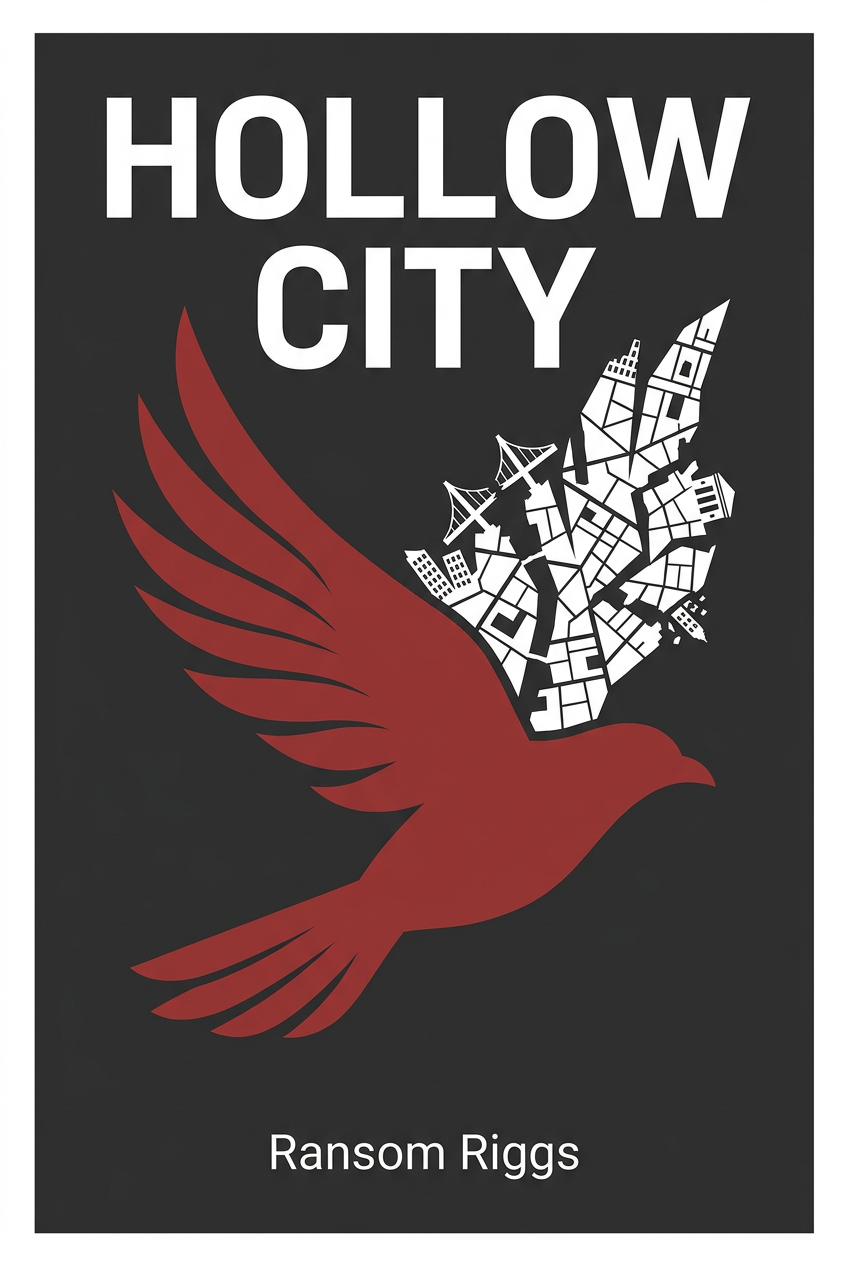
Hollow City
The Second Novel of Miss Peregrine's Peculiar Children
What's it about
What if you were hunted for the very thing that makes you special? After escaping their loop, Jacob and the peculiar children are on the run. Discover how they'll survive in a world filled with monstrous hollows and wights, where every shadow could be their last. You'll follow their perilous journey through war-torn 1940s London as they search for a cure for Miss Peregrine. Uncover the secrets of other peculiars, navigate a menagerie of strange new allies and enemies, and find out if they can reach safety before time runs out for them all.
Meet the author
Ransom Riggs is the 1 New York Times bestselling author of the Miss Peregrine’s Peculiar Children series, which has sold millions of copies worldwide. A lifelong collector of peculiar vintage photographs, Riggs was inspired to create the rich, atmospheric world of his novels by these haunting, found images. His unique hobby of curating anonymous histories gave birth to the story of Jacob Portman and the strange, compelling children of Miss Peregrine's home, blending fantasy with forgotten snapshots of the past.
Opens the App Store to download Voxbrief

The Script
Think of an old, inherited scrapbook. The official one sits on the coffee table, its pages filled with neat, black-and-white portraits and carefully captioned moments—weddings, holidays, graduations. The story it tells is clean, chronological, and complete. But then there’s another collection, a loose bundle of photos tucked away in a dusty attic trunk. Here, the images are candid, torn, and unlabeled. A blurry shot of a laughing face, a group of strangers mid-argument, a landscape that feels both familiar and alien. This second collection whispers fragments of a story. It’s messy, contradictory, and unsettlingly real. While the formal album confirms who you are supposed to be, the scattered photos raise a more frightening question: what if the real story, the one that truly defines you, is the one you can’t piece together?
This tension between a known, safe history and a fragmented, dangerous truth is exactly what drove Ransom Riggs to write. As a filmmaker and an avid collector of antique vernacular photographs—those candid, anonymous snapshots found at flea markets and swap meets—Riggs found himself drawn to the strange, untold stories these images seemed to contain. He was gathering ghosts. He would arrange the pictures, letting their mysterious gazes and bizarre circumstances suggest a narrative. The story of Jacob Portman and the peculiar children began with a series of haunting, real-life photographs that demanded an explanation. Hollow City is the continuation of that answer, an adventure born from the belief that the most compelling tales are discovered in the lost and forgotten images of the past.
Module 1: The Perilous Journey as a Crucible for Identity
The story picks up moments after the first book ends. The peculiar children have escaped their doomed island sanctuary. Their home is gone. Their guardian, Miss Peregrine, is trapped in the form of a bird. They are adrift, both literally and figuratively. This physical journey across a war-torn landscape becomes a powerful metaphor for their transition from a sheltered past to a dangerous, uncertain future.
The core of this module is understanding that survival demands confronting the emotional weight of loss. As the children row away from their island, Cairnholm, they watch their only safe harbor disappear into the fog. It feels "as if it had never existed." The experience is about the dissolution of their entire world. Each character says a private goodbye, clinging to impractical mementos like pickled reptile hearts and a lucky pillow. These items are tangible links to a home they know is gone, but haven't yet learned how to let go of. This teaches a key lesson for any team in crisis. You must acknowledge the loss to move forward.
From this foundation, we see that resilience is forged by pushing past perceived limits, fueled by collective responsibility. The children row until their hands blister and their minds go numb. They are hopelessly exhausted. Yet, when a storm hits and two of their own are in danger, they find a new reserve of strength. They act without thinking, driven by the need to protect each other. Jacob, the protagonist, rows to silence the painful thoughts in his head. The oars become both a "life sentence and a life raft." This illustrates a critical principle: in moments of extreme stress, purpose—especially a shared purpose—is a more powerful fuel than mere physical endurance.
Now, let's turn to how they navigate. Their journey is a desperate race against time. They are pursued by monstrous creatures called hollowgast and their human-like allies, the wights. This constant threat forces them to be endlessly creative. Here, the book shows that ingenuity and interdependence are survival multipliers. When lost in a dense fog, the group's progress depends entirely on their willingness to trust a radical idea. Olive, a girl who is lighter than air, volunteers to be tethered to a rope and float above the fog to act as a scout. The group follows her "tiny voice, an unseen angel in the sky." This is a perfect example of leveraging a unique, specialized skill for the benefit of the entire team. It's about recognizing that the most unconventional talent might hold the key to solving an impossible problem.
Module 2: The Evolution of Peculiar Abilities
As the children land on the mainland, the nature of their struggle shifts. They are no longer just fleeing; they are on a mission. They must find another ymbryne—a time-manipulating guardian like Miss Peregrine—to cure their leader before she is permanently lost. This quest forces them to rely on their peculiar powers in new and untested ways.
And here’s the thing: the book makes it clear that peculiar talents must be developed through practice and necessity. This is a crucial insight for anyone looking to grow their own skills. Millard, the group's scholar, compares peculiarities to muscles that grow stronger with use. We see this directly with Jacob. His ability to sense the monstrous hollowgast starts as a vague, painful feeling. It's a blunt instrument. But under the pressure of a life-or-death confrontation, it evolves. It becomes directional, like a compass needle pointing to danger.
Then, something remarkable happens. Trapped on a cliff with a hollow advancing, Jacob’s ability deepens further. He develops a "premonition," a gut instinct that allows him to predict the monster's next move. This is a qualitative leap. He is no longer just a detector; he is a strategist. He directs Bronwyn, the group’s super-strong girl, to throw a boulder not where the hollow is, but where it will be. This highlights a powerful truth. True mastery comes when you move from reactive use of a skill to predictive application. You anticipate and shape the future. It’s the difference between playing defense and offense.
This leads to another key point. Leadership and responsibility are often thrust upon the unprepared. Jacob never asked to be a hollow-slayer. He sees himself as an ordinary kid from Florida, constantly living in the shadow of his legendary grandfather. Others in the group, like the cynical Enoch, openly doubt him. Yet, the group's survival comes to depend on his unique talent. This forces Jacob to confront his own identity. He has to choose to step into the role he's been given, despite his fear and self-doubt. It’s a compelling look at how crisis can accelerate personal growth, forcing you to become the person the situation requires you to be.